Olga Mykhoparkina
Founder, CEO

Olga Mykhoparkina
Oct 01, 2026I don’t know about you, but these days, every time I need to find a product or service, I go to Claude or ChatGPT. I ask for recommendations, look through the options and then visit the websites of the companies that sound interesting.
And I’m clearly not the only one. Traditional search volume is dropping year by year as more people are using AI chatbots to find answers.
For SaaS companies, this means ranking in Google alone is no longer enough. If ChatGPT, Claude or Perplexity leaves your brand out of its recommendations, potential customers may never reach your website.
This is where Generative Engine Optimization (GEO) comes in. It helps improve your chances of appearing and being cited in AI answers by looking at why competitors are recommended, which sources AI tools rely on and what your brand is currently missing.
As more companies invest in GEO, more agencies have started offering it. Some have already tested their approach with SaaS clients and can show results. Others have simply added GEO to their services.
To put this list together, I looked for agencies with SaaS experience and a clear approach to GEO. I also checked their public case studies and the results they share. Some work exclusively with SaaS companies, while others serve a wider range of clients but have relevant SaaS or AI search experience.
Full disclosure: I’m the founder of Quoleady, so I have included our agency first. I have used the same criteria for every agency and linked to the case studies behind the results.
Office location: Remote (core team based in Europe)
Year founded: 2020
Team size: 11-50
Industries served: SaaS, B2B tech, digital startups
Quoleady is a B2B SaaS SEO and AI visibility agency that helps software companies grow through organic search, digital PR, and content marketing. Instead of treating AI visibility as a separate service, the team combines SEO, content, authority building, and GEO into one strategy. Every engagement starts by analyzing where your brand appears (or doesn’t) across Google, ChatGPT, Gemini, Claude, Perplexity, and Google’s AI Overviews, then building a roadmap to improve both search rankings and AI recommendations.
Book a call with Quoleady if you want a team that lives in B2B SaaS and has the case studies to back it up.
Office location: Miami, FL (with offices in New York, NY and Orlando, FL)
Year founded: 2023
Team size: 51-100
Industries served: Fintech, financial services, banking, regulated industries, technology brands
Avenue Z is a marketing and communications agency specializing in SEO, AI search visibility, and authority-building for financial services and regulated industries. Their approach combines SEO, AI optimization, PR, and entity authority-building to strengthen brand credibility and visibility in high-trust, regulation-heavy markets. Avenue Z focuses on aligning content, brand signals, and off-site authority so AI systems consistently surface their clients as reliable sources.
Office location: San Francisco, CA
Year founded: 2017
Team size: ~20
Industries served: B2B SaaS, ecommerce, real estate, healthcare, nonprofit, and more
Growth Marketing Pro combines GEO with traditional SEO, link building, Reddit, Wikipedia and third-party mentions. The agency looks beyond your own website and works on the external sources that often influence which companies appear in AI answers. Its work is led by senior marketers with experience growing SaaS brands, generating inbound leads and managing large paid campaigns. Growth Marketing Pro also covers paid search and social, so it could be a good fit if you want one team working on AI visibility, organic growth and paid acquisition.
Office location: London, UK
Year founded: 2020
Team size: 51-200
Industries served: SaaS, B2B, Technology
Skale is an organic growth agency helping SaaS and B2B companies scale through SEO, content, and Generative Engine Optimization. Their focus is on improving visibility across Google and AI-generated search results while supporting real business growth. The team treats GEO as a natural extension of SEO, layering entity optimization and topic clustering on top of technical execution so that content earns citations without losing sight of signups and pipeline.
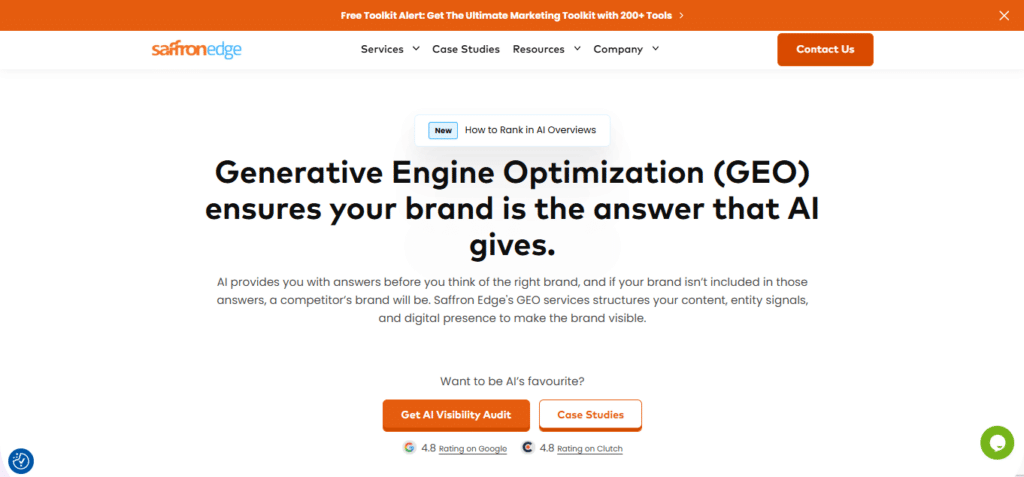
Office location: Totowa, New Jersey
Year founded: 2008 (18+ years in operation)
Team size: 51-200
Industries served: SaaS, DTC, Legal, Dental, Auto, HVAC, and other B2B industries
Saffron Edge built its name on long-standing SEO work and has extended that into GEO and AEO as search is moving toward AI. Their approach centers on semantic SEO – building content around entities, relationships, and intent rather than just keywords – which naturally feeds into how generative engines interpret and cite brand content. This lets them layer GEO on top of an already mature SEO/content system instead of treating it as a separate service.
Related: Schema & Structured Data for LLM Visibility: What Actually Helps?
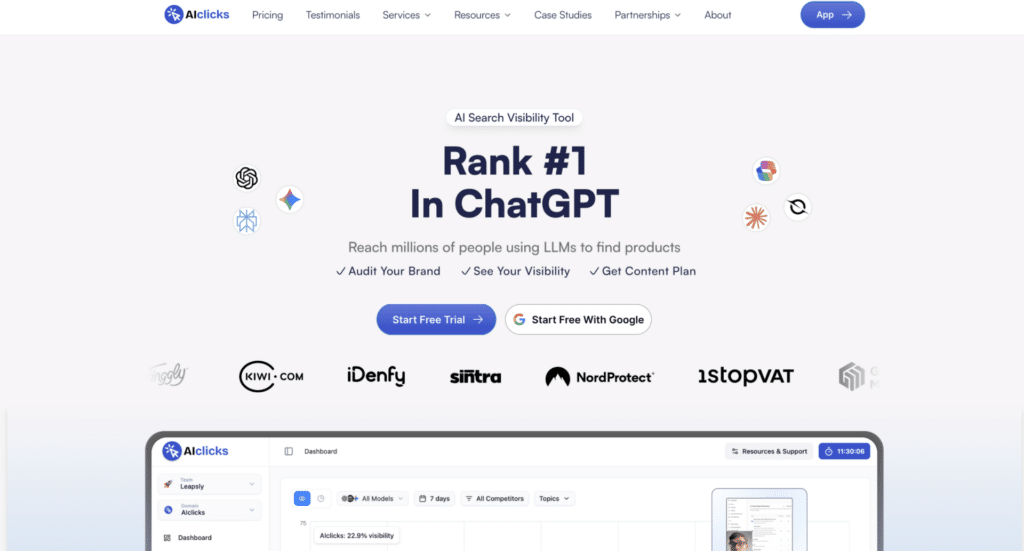
Office location: Vilnius, Lithuania
Year founded: 2025
Team size: 11-50
Industries served: B2B, Ecommerce, SaaS, Fintech
AI Clicks is a GEO agency that helps brands get cited inside AI answers across ChatGPT, Claude, Perplexity, Gemini, Google AI Overviews, and other major models. The team built their own AI search visibility platform, AIclicks.io, and uses it daily on client accounts, so clients work with operators who run GEO at scale. Their process starts with auditing where a brand sits across 6+ AI models and which prompts competitors are winning, then closes the coverage gap with brand mentions on high-authority sites, placements in top-ranking Reddit threads, and content built for citation.
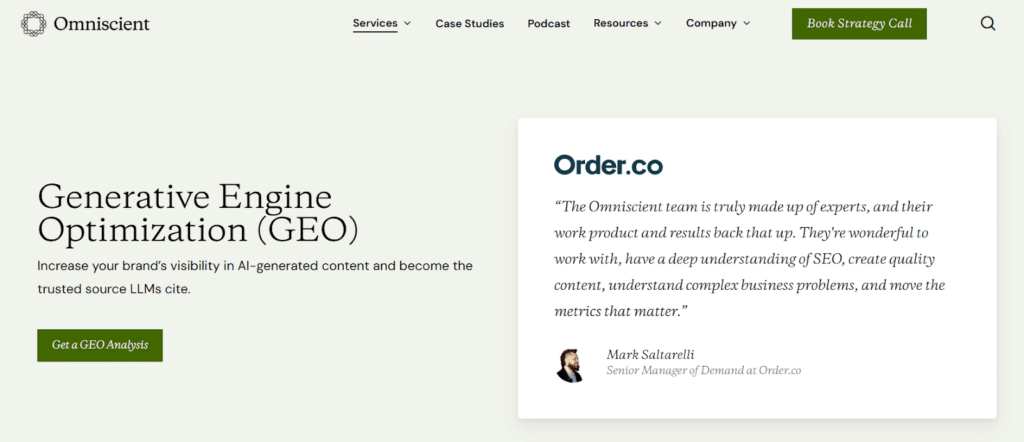
Office location: Austin, TX
Year founded: 2019
Team size: 11-50
Industries served: SaaS, B2B software, technology
Omniscient is an organic growth agency that helps marketing leaders at B2B software companies turn SEO and content into growth channels. They’ve added GEO services to their traditional SEO offerings, focusing specifically on B2B SaaS brands. The team takes a research-heavy approach, mapping where your brand already appears (or does not) in ChatGPT and Perplexity, then building a plan to close the gap through better content targeting and entity work.
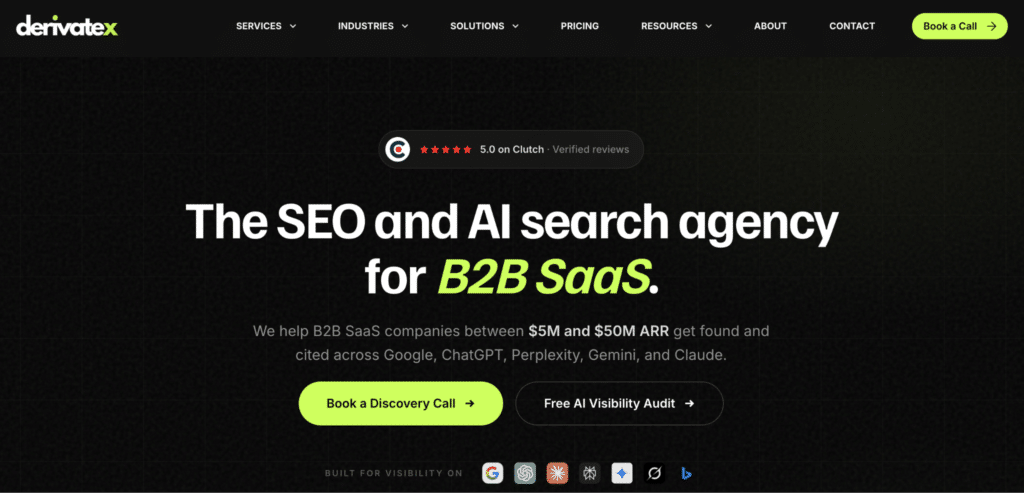
Office location: Bangalore, India (remote-friendly)
Year founded: 2024
Team size: ~10-15
Industries served: B2B SaaS ($5M-$50M ARR), including HR tech, martech, fintech, cybersecurity, and dev tools
DerivateX is a newer agency, founded by operators who built and exited their own SaaS-adjacent ventures before starting the agency, and it shows in how the work is framed. Instead of separate SEO and GEO retainers, every engagement runs both at once, with a weekly AI Visibility Score across 50+ buyer prompts and monthly reporting that ties visibility straight back to CRM data. It is a tight fit for mid-market SaaS companies that want proof of a citation turned into a demo request, beyond a screenshot of a mention.
Office location: Thessaloniki, Greece (remote team)
Year founded: 2020
Team size: 11-50
Industries served: B2B SaaS across 60+ clients in different verticals
Minuttia has spent the past several years building a content and SEO practice for established SaaS brands, and has recently expanded into AEO and GEO as buyer behavior has changed. Their pitch is straightforward: search used to mean Google, results used to mean organic clicks, and now both have widened to include AI mentions and brand visibility across the places buyers actually look. With a 94% client retention rate and clients averaging 24+ months of tenure, the team leans on long-term content programs over quick fixes.
Office location: Berlin, Germany (remote team across 11 countries)
Year founded: 2018
Team size: ~14
Industries served: B2B SaaS startups, professional services
Flow Agency is a boutique SEO consultancy founded by Viola Eva, a well-known SEO and AEO expert who regularly speaks at industry events and has contributed to publications like Search Engine Land and Search Engine Journal. Rather than treating generative engine optimization (GEO) as a separate discipline, Flow sees it as part of the broader evolution of search—where success depends on AI mentions, brand visibility, and recognition across search experiences. The agency has earned industry recognition too, winning the 2023 European Search Award for Best B2B SEO for its work with Betterworks, along with Best Use of Content Marketing for its Mailcharts campaign.
Office location: Remote/distributed team
Year founded: 2015
Team size: 100+ writers, strategists, and editors
Industries served: B2B SaaS and technology, including Intercom, GoDaddy, Zendesk, Amplitude, and Airtable
Animalz has built its reputation by helping B2B SaaS companies publish deeply researched, expert-led content that shapes how people understand an industry. While the agency isn’t solely focused on generative engine optimization (GEO), its editorial approach naturally aligns with how AI search works. Animalz combines interviews with subject matter experts, original research, and strong editorial standards to create content that explains complex topics with clarity. That makes its content more likely to be cited and summarized by AI search engines, which increasingly favor authoritative, well-structured sources over keyword-focused pages. The agency helps clients stay visible across both traditional search and AI-powered discovery.
From what we’ve seen working with SaaS companies, brands appear in ChatGPT, Perplexity, and Google’s AI Overviews when they publish genuinely helpful content, build authority in their niche, and get mentioned on websites their buyers already trust. GEO builds on good SEO. It helps your brand stay visible as more buyers use AI to research software.
G2’s 2026 research on B2B software buyers found that half now start their research with an AI chatbot more often than with Google, up from 29% a year earlier. They compare software, look for alternatives, check integrations, and learn how products work before booking a demo. If your website answers those questions well, you have a much better chance of showing up in AI answers
If you stop publishing, your competitors won’t. The companies that stay visible keep adding useful content, getting mentioned by other websites, and improving what they already have. That’s been true for SEO for years, and it’s just as true now.
Before you sign anything, spend ten minutes reading the agency’s case studies. You should come away knowing what they did, why they did it, and what happened afterwards. If all you see are big promises and no evidence, keep looking.
Not every agency on this list fits every company. Here is what matters when you are picking one.
Ask how they would approach your account beyond an initial audit. A useful answer talks about building topical authority, producing expert content, and earning the kind of third-party mentions that give AI tools a reason to trust your brand, the same foundation that supports search rankings too. If the answer leans mostly on schema markup and technical fixes, that is worth a second look. Rand Fishkin of SparkToro has pointed out that tactical excellence alone will not save a brand if the underlying business model can be replaced by an AI summary, and the same logic applies here: technical polish without authority behind it tends not to hold up.
SaaS marketing comes with its own set of challenges: longer buying cycles, several people involved in one purchase decision, product-led content, and comparison pages that need to hold up against direct competitors. An agency built around ecommerce or local business SEO will not have a process for that. Ask for SaaS case studies and how success was measured, ideally through demos, pipeline, or revenue rather than traffic alone.
A useful agency can look at your category and point to competitors that already show up in AI answers. They can explain what those competitors have built that you haven’t, whether that’s stronger comparison content, more third-party coverage, or clearer positioning. Then, they use those insights to build a practical plan to improve visibility.
A citation count on its own does not tell you much. Ask for case studies that connect AI visibility to something you can measure: qualified traffic, demo requests, booked meetings, or revenue growth. Several agencies on this list, including Quoleady, DerivateX, and Skale, publish that kind of case study.
After researching the agencies on this list, I’d pay much more attention to methodology than promises. Ask how the agency builds authority, how it measures success, and whether it can back up its claims with case studies. That’s much more useful than a promise to “optimize for ChatGPT.”
Another question worth asking is how the agency approaches GEO. Some treat it as a standalone service. Others build it into their SEO strategy through expert content, brand authority, topical authority, and third-party mentions. I’d be looking for the second approach.
Every agency on this list has its own strengths. Some are a better fit for enterprise companies, others specialize in technical SEO, while others focus on content and authority building. Compare their approach, case studies, and pricing, then choose the one that best matches your goals, budget, and internal resources.
For B2B SaaS companies looking for proof that a GEO partner can actually move the needle, book a call with Quoleady. We’ve already helped SaaS clients get cited in ChatGPT, Perplexity, and Google’s AI Overviews, and we’ll be happy to show you exactly what we’ve done and what worked.
A GEO agency helps a SaaS brand become a source AI tools trust enough to cite. In practice, that means building topical authority around your category, producing content written by people who understand the product, and earning mentions on the sites and communities your buyers already read. Those are the same signals that show up behind brands that get named in ChatGPT, Perplexity, and Google’s AI Overviews.
GEO builds on strong SEO foundations instead of replacing it. Modern SEO involves creating high-quality content, building topical authority, earning trusted backlinks and mentions, and establishing a recognizable brand. These signals influence whether AI search engines will reference your content in their answers. GEO expands your visibility beyond search results pages to include AI-generated responses.
Timelines depend on the category and how much content and authority-building work is already in place. In our own client work, Legal Nodes reached top 5 AEO rankings within 3 months of starting, while other engagements build more gradually over a longer stretch. GEO tends to compound the way SEO does, so the content and mentions you put out early keep paying off later.
Pricing varies widely. Boutique and specialist agencies often start around $3,000 to $5,000 a month, while full-service or enterprise-focused agencies can run $10,000 a month or more. Cost usually tracks with how much content production and technical work is included, beyond the GEO label itself.
It’s possible, especially if your team already runs a content or SEO program. What’s hard to sustain in-house is the ongoing nature of the work: researching what your buyers are asking AI tools, keeping up content production, building the third-party mentions that support authority, and tracking whether any of it is working. Most in-house teams can handle pieces of this well but struggle to keep all of it running at once alongside everything else on their plate.
Look at more than one signal. That usually includes visibility across the buyer prompts that matter most to your category, share of voice against competitors, AI referral traffic, growth in branded search, and whether any of that turns into qualified leads, demo requests, or pipeline you can trace back in your CRM.
Olga Mykhoparkina
Founder, CEO
Read also



Getting your SaaS product into “best X” listicles has been a solid marketing strategy fo

Ardak Yeshniyazova
Oct 22, 2026
A SaaS company can rank well in Google and still be absent when a buyer asks ChatGPT for the best pr
Olga Mykhoparkina
Oct 01, 2026
You already have the numbers. HubSpot, GA4, your CRM and Stripe are throwing dashboards at you every
Olga Mykhoparkina
Oct 01, 2026 Let us know what you are looking to accomplish.
We’ll give you a clear direction of how to get there.
All consultations are free 🔥