LLM visibility is the new layer of search. If you’re not mentioned in AI answers, competitors win that attention first.
In AI search, mentions and citations matter more than rankings, and brands can influence decisions without getting clicks.
The best AI visibility tools track mentions, sentiment, citations, and competitors across ChatGPT, Claude, Gemini, Perplexity, and Google AI Overviews.
Allmond offers the best mix of real AI scanning, fast setup, and affordable pricing, while Peec AI, Profound, Scrunch, and Otterly AI each fit specific needs.
Use visibility insights to act: fix gaps, improve authority signals, and monitor competitor presence continuously.
Introduction to LLM Visibility: How Brands Appear in AI Answers
Remember when SEO alone was enough to secure online visibility? When ranking on Google meant your audience would naturally find you?
That era is quietly coming to an end. Today, customers aren’t just searching. They’reasking AI tools like ChatGPT, Claude, and Perplexity for answers, recommendations, and buying advice.
That’s why AI visibility tools have become essential. They help you understand how AI models describe and interpret your content and what you can do to improve your positioning.
In this article, we break down the top 15+ LLM visibility tools in 2026. You’ll also learn how they help you stay visible in an AI-first world.
What Is LLM Visibility and Why Is It Important for Brands?
LLM visibility means how a brand appears in AI-generated answers and AI-powered search results like ChatGPT, Google AI Overviews, Google AI Mode, and Meta AI.
Instead of competing only for search rankings, brands now compete to be included directly in AI responses that users see first.
LLM exposure goes beyond simple mentions. It includes how often a brand shows, how it’s described, and how it compares to competitors.
Without visibility into AI replies, brands risk being overlooked, misrepresented, or replaced by competitors.
What Are LLM Visibility Tools?
LLM visibility tools are platforms that help you measure, monitor, and improve how your brand shows in AI-generated answers and AI-powered search results.
Instead of tracking rankings in traditional search engines, LLM tracking tools focus on whether – and how – large language models (LLMs) reference, describe, or recommend a brand across AI interfaces.
In practice, the best AI visibility tools can help you:
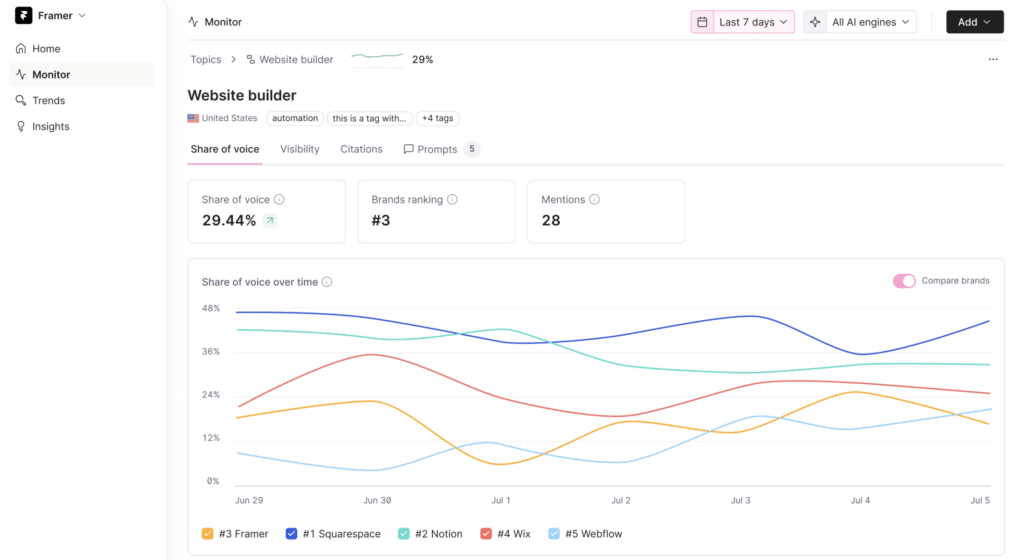
Track brand mentions in AI-generated answers
Analyze sentiment and tone in AI replies
Monitor visibility across platforms and prompts
Compare AI mentions against competitors
Identify gaps and optimization opportunities for AI search
Together, these insights reveal visibility gaps, explain why brands appear or disappear, and guide optimization for AI tools.
How LLMs Decide Which Brands to Mention?
LLMs decide which brands to mention by evaluating relevance, authority, and contextual fit when generating an answer. Rather than ranking brands, they aim to produce the most useful and credible response to a user’s prompt.
Content quality matters more than ever. Because LLMs synthesize information instead of ranking pages, clear, accurate, and consistent brand representation across trusted sources strongly influences whether a brand is included and how it is described.
Content relevance and clarity around specific topics or use cases
Topical authority built through consistent coverage across trusted sources
Entity associations that clearly link a brand to products, categories, or problems
Source credibility and presence on authoritative websites
Sentiment and reputation, reflected in neutral or positive brand references.
LLMs don’t intentionally select brands. They reflect patterns in the data and sources they rely on. As a result, consistent, high-quality brand representation strongly influences whether a brand shows and how it is described in AI search results.
LLM Visibility Tools, GEO and Traditional SEO: What’s the Difference?
Traditional SEO, GEO, and LLM visibility create brand exposure in different ways. Understanding this difference is essential as AI-driven discovery grows.
SEO focuses on rankings and clicks, measuring success through traffic and SERP position. In contrast, AI-generated answers replace rankings with mentions.
Brands gain visibility by being cited or referenced directly within AI replies, often without links or website visits.
This shift introduces zero-click exposure, where AI answers influence awareness, trust, and decisions before users ever reach a site. As a result, traffic alone no longer reflects true visibility or impact.
Generative Engine Optimization (GEO) defines how brands should adapt content, entities, and positioning so AI systems understand and select them. Best AI visibility tools then measure the outcome by tracking mentions, sentiment, and competitive presence in automated responses.
SEO and LLM visibility work together: SEO builds authority and accessibility, while LLM exposure shows how brands are represented inside AI-generated responses.
How We Chose the Top LLM Tracking Tools
We built this list based on hands-on testing, product research, and a close review of each platform’s features and documentation.
Every tool was evaluated using the same criteria, including LLM visibility capabilities, ease of use, reporting, pricing, and overall value. We also considered who each tool is best suited for, such as agencies, SaaS teams, enterprises, or small businesses.
Rankings are not sponsored or paid. Features and pricing reflect information available at the time of writing and may change.
Top 15+ LLM Visibility Tools in 2026
After reviewing and testing a wide range of platforms, we selected the top 12 LLM tracking tools in 2026 based on features, usability, and overall value.
1. Allmond: #1 LLM Visibility Tool for SaaS, E-Commerce, and Startups
Allmond is an intuitive AI visibility tracking tool built for agencies, SaaS businesses, e-commerce brands, and startups.
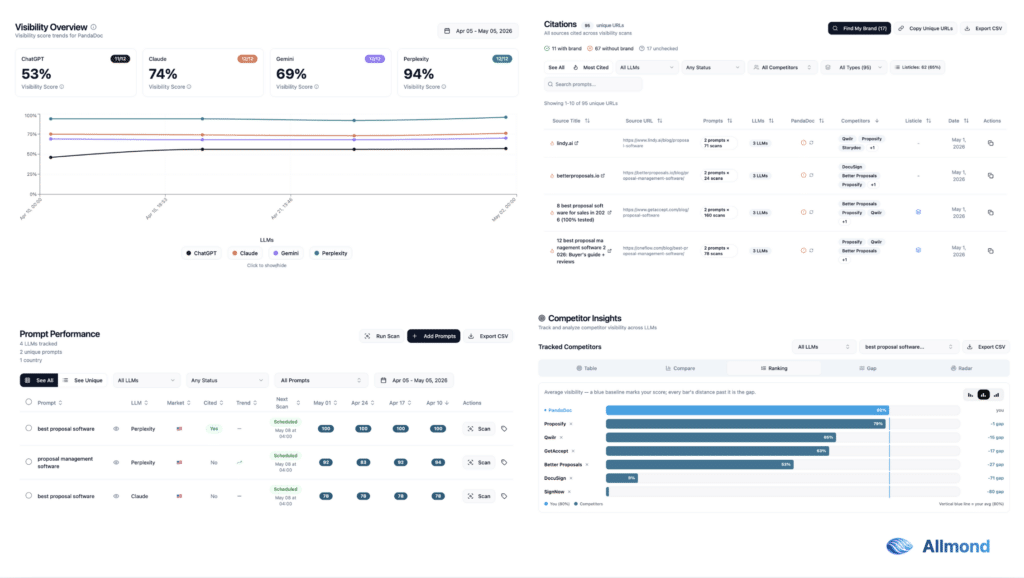
It shows whether your brand is presented when ChatGPT, Claude, Gemini, and Perplexity answer industry questions across 67+ countries, with reports ready in seconds.
Designed for simplicity, Allmond delivers powerful AI exposure insights without complexity. Whether you’re managing multiple clients or growing your own brand, it offers professional visibility tracking at an affordable price.
Key Features
Multi-LLM brand visibility tracking across ChatGPT, Claude, Gemini, and Perplexity, with coverage in 67+ countries.
Powerful competitor intelligence showing competitors in AI answers and how they perform across the same prompts
Citation scans – Alllmond.app shows you whether your brand or competitor’s brand is present in the Citations URL that LLMs use to pull their answers from
Automated visibility scoring and trend tracking with weekly scans and clear 0–100 visibility scores.
Client-ready dashboards and reporting, custom branding, and no-login sharing. Team and agency-focused workflows supporting unlimited projects, prompts, and clients.
Pros and Cons
Allmond Pros include:
High confidence in data accuracy, based on real AI replies rather than simulated or proxy data.
Affordable pricing, fast time to value, with no technical setup and AI visibility monitoring starting within minutes.
Intuitive design, making multi-brand management and instant report sharing simple and efficient.
Clear action prioritization, highlighting visibility gaps and guiding outreach or content efforts effectively.
Highly scalable and flexible usage, supporting unlimited projects and prompts for growing teams and agencies.
Its cons include:
Focused on AI visibility, so teams looking for broader SEO, analytics, or marketing automation features may need additional tools.
Simplified reporting, better suited for users who prefer clarity over deep metric customization.
A weekly scan cadence may feel limiting for teams that prefer daily or real-time updates.
Best value at scale, making it more attractive for agencies and multi-brand teams than for single-project users.
Allmond Pricing Structure
Allmond offers transparent, predictable pricing based on scan volume, with all features included in every plan. The website helps you estimate how many scans you need. While there’s no permanent free plan, a 7-day free trial is available.
If you need more scans mid-month, you can upgrade instantly or purchase a one-time scan pack without changing your plan.
The paid plans include:
Starter – $29 per month for up to 240 scans.
Growth – $99 per month for up to 825 scans.
Pro – $199 per month for up to 1660 scans.
2. Omnia: The Best LLM Visibility Tool for Teams That Want to Act on Their Data
Omnia is an AI visibility platform built for marketing and growth teams at scale-ups who need more than monitoring. It tracks brand presence, share of voice, and competitor benchmarking across ChatGPT, Google AI Overviews, Google AI Mode, and Perplexity, then converts that data into a prioritized action backlog so teams know exactly what to do next. Where most tools stop at showing you where you stand, Omnia closes the loop between tracking and execution through its agentic layer.
Key Features
AI Visibility Tracking across ChatGPT, Google AI Overviews, Google AI Mode, and Perplexity with daily refresh via real browser simulations, not API calls. Includes competitor benchmarking on all plans.
AI Prompt Discovery surfaces real AI search prompts with volume and difficulty scores, giving marketers the keyword-research equivalent for AI-native search.
Actionable Insights Engine runs citation analysis and turns findings into a prioritized backlog: what content to create, where to publish, and what gaps to fix. Insights feed directly into agents that can execute on the recommendations.
AI Sentiment Analysis tracks how AI models describe your brand at the feature level compared to competitors, so you can spot positioning gaps before they widen.
Unlimited countries and brands included across all plans, with no extra charges for multi-market tracking.
Pros and Cons
Omnia Pros include:
Goes beyond monitoring by turning citation data into specific, prioritized actions your team can execute on immediately.
Real browser simulations produce high-fidelity results that reflect what real users see in AI engines.
Prompt discovery with volume and difficulty scoring fills a gap most visibility tools ignore entirely.
Competitor benchmarking and sentiment analysis included on all plans, not gated behind enterprise tiers.
Proven results: one customer (TUIO, insurtech) went from 8.55% to 11.79% global share of voice, surpassing legacy incumbents. Another (OkTicket) saw a 30% increase in AI-driven inbound leads.
Its cons include:
The action-oriented features deliver the most value when paired with a team that has capacity to execute on recommendations.
Pricing is in EUR, which may require currency conversion for non-European teams.
Newer entrant compared to some competitors, so the community and third-party integration ecosystem is still growing.
Omnia Pricing Structure
Omnia offers a 14-day free trial with no credit card required, so teams can evaluate the full platform before committing.
The paid plans include:
Starter — €79 per month, suited for teams beginning to track AI visibility across a focused set of prompts.
Growth — €279 per month, designed for marketing teams actively working to improve their AI presence with a larger prompt volume.
Scale — €499+ per month, built for teams running multi-brand or multi-market AI visibility programs at higher prompt volumes.
All plans include unlimited countries and brands. Pricing scales based on the number of prompts monitored.
3. OtterlyAI: The Best All-round LLM Visibility Tool
OtterlyAI is a lightweight LLM tracking tool designed to help brands understand whether and how they appear in AI-powered answers.
It focuses on core monitoring features, making it accessible for teams that want visibility insights without complexity or high costs.
OtterlyAI is particularly useful for early-stage brands or teams new to LLM exposure. This AI monitoring tool provides a simple way to track brand references across AI search engines and identify basic visibility gaps, without deep technical analysis or advanced workflows.
Key Features
AI search monitoring across major platforms, tracking brand citations in AI-generated responses.
Prompt-based monitoring, translating relevant queries into conversational prompts for AI-focused strategies.
Brand visibility and sentiment analysis, showing appearance frequency, positioning, and tone in AI-driven responses.
Link and citation tracking, identifying source URLs, and AI-driven referral opportunities.
Competitive visibility analysis, highlighting share of voice, competitor presence, and visibility gaps.
Pros and Cons
OtterlyAI Pros include:
Affordable pricing, making LLM visibility tracking accessible for small teams and startups.
Lightweight setup, enabling quick AI visibility monitoring without technical expertise or complex onboarding.
Valuable visibility insights, supporting faster, more informed decision-making.
Time-saving AI monitoring tool capabilities, allowing quick audits and efficient LLM tracking across AI platforms.
Focused feature set, ideal for teams needing essential LLM tracking without added complexity.
Its cons include:
Limited depth in analysis and reporting, with minimal guidance to help users improve content visibility in AI-generated results.
Costs increase at higher tiers, which can reduce affordability as monitoring needs grow.
No integrated content creation or optimization tools, requiring users to rely on external platforms for execution.
Weekly data updates limit real-time visibility, preventing rapid response to sudden changes in brand references.
Basic sentiment analysis, which lacks the deeper citation-level available in more advanced tools.
OtterlyAI Pricing Structure
OtterlyAI offers lower-cost plans designed for small teams and individuals. There’s no permanent free tier, but users can start with a 14-day free trial that includes premium features. Paid plans also offer optional add-on packages for expanded functionality.
The paid plans include:
Lite – $25 per month (billed annually) or $29 per month (billed monthly) for up to 15 prompts tracked.
Standard – $160 per month (billed annually) or $189 per month (billed monthly) for up to 100 prompts tracked.
Premium – $422 per month (billed annually) or $489 per month (billed monthly) for up to 400 prompts tracked.
Enterprise – Contact the OtterlyAI team to get pricing.
4. Arobis AI: Best for AI Visibility Optimization and Actionable GEO Insights
Arobis AI is an AI visibility tracking tool and agency designed to help brands understand, measure, and improve how they appear across leading AI search engines and answer platforms. This includes ChatGPT, Gemini, Claude, Perplexity, and Google AI Overviews.
Unlike many AI visibility tools that focus primarily on reporting mentions and citations, Arobis AI combines visibility tracking with actionable recommendations to help brands improve their presence in AI-generated answers. The platform tracks brand mentions, recommendations, citations, Share of Model (SOM), and competitor visibility while identifying opportunities to strengthen AI search performance over time.
It is best suited for SaaS companies, agencies, marketing teams, and brands that want to move beyond monitoring and actively improve their visibility across AI-powered search experiences.
Key Features
AI Visibility Tracking across ChatGPT, Gemini, Claude, Perplexity, and Google AI. Overviews using prompt-level monitoring and multi-model analysis.
AI Visibility Checker that quickly evaluates how often a brand appears, is cited, and is recommended across major AI platforms.
Competitor Benchmarking and Share of Model (SOM) analysis to compare AI visibility against competing brands and identify market gaps.
Citation and Source Analysis that reveals which websites, pages, and sources AI models rely on when generating recommendations.
Actionable GEO Recommendations that help brands improve discoverability, strengthen citations, and increase visibility within AI-generated answers.
Pros and Cons
Arobis AI Pros include:
Comprehensive tracking across leading AI search engines and answer platforms from a single dashboard.
Combines monitoring with actionable optimization recommendations rather than reporting visibility metrics alone.
Fast AI Visibility Checker that provides immediate insights into brand presence and discoverability.
Strong competitor benchmarking and Share of Model analysis for measuring market position in AI search.
Designed specifically for brands, agencies, and SaaS companies focused on AI search growth and Generative Engine Optimization (GEO).
Its cons include:
Primarily focused on AI visibility and AI search performance rather than traditional SEO metrics such as backlinks and keyword rankings.
The AI visibility category is still emerging, making benchmarks less established than conventional SEO reporting.
Organizations new to AI search may require time to understand AI visibility metrics and their business impact.
Best results are achieved when combined with broader SEO, content marketing, and digital PR efforts.
Some advanced monitoring and reporting capabilities may require higher-tier plans.
Arobis AI Pricing Structure
Arobis AI offers a free AI Visibility Checker that allows businesses to assess their visibility across major AI platforms. Paid plans are designed for growing startups, SaaS brands, and enterprises that require ongoing monitoring, competitor benchmarking, citation tracking, and AI visibility optimization at scale Starting at a monthly retainer.
5. Wellows: The Best LLM Visibility Tool for Teams That Want to Craft Their Citations, Not Just Watch Them
Wellows is the “Result Crafter” for AI search, an AI visibility platform built for B2B brands and agencies that want to move their standing in AI answers, not just monitor it. Instead of a visibility number that drifts with model retrains and prompt phrasing, it’s built on your Citation Score and Citation Rank: how much answer engines actually cite you, and where that ranks you against competitors across ChatGPT, Gemini, Perplexity, Google AI Mode, and AI Overviews. Where most tools stop at showing you where you stand, Wellows runs a full See, Craft, Proof loop (plus a Sell layer for agencies) that turns citation gaps into content and outreach, so you stop watching your visibility and start crafting it.
Key Features
Citation Score and Citation Rank, Wellows’ signature metric: how much answer engines actually cite you, ranked daily against competitors. The one number in AI search you can move.
Explicit plus Implicit citation tracking with sourced sentiment catches both outright mentions and citations inside cited pages, and reads how you’re characterized.
The Result Crafter loop turns the citation gaps behind your rank into ranked Content Opportunities, with the intent and citations each could earn.
KIVA, the built-in writing agent, drafts content in-platform against your Google Search Console data, built to earn a citation.
Performance History and Competitive Rank Movement show the exact lift in Citation Score and Rank between any two dates, next to a named rival.
Unlimited verified outreach and Quick Wins surface a ready-to-send template for every cited URL that leaves you out, on the C.I.T.A.T.I.O.N.® method.ns.
Pros and Cons
Wellows Pros include:
Built on Citation Score and Rank, a metric you can actually move, unlike numbers that swing with model updates you can’t control.
The See, Craft, Proof loop closes the gap between tracking and execution: gaps become drafted content and sent outreach.
A dedicated agency Sell layer packages the loop as a white-labeled, multi-client service.
Its cons include:
The loop delivers the most value when your team has capacity to execute on it.
Full platform coverage (Gemini, Perplexity, and AI Mode) unlocks on higher-tier plans rather than the entry tier.
A slight learning curve for beginners getting up to speed with the workflows.
Wellows Pricing Structure
Wellows offers a 7-day free trial on all plans, so teams can evaluate it before committing.
The paid plans include:
Lite, $37 per month, for teams starting to track AI visibility and citations on a focused set of engines.
Essential, $97 per month, for brands and small agencies tracking a focused set of prompts across two answer engines.
Starter, $297 per month, which unlocks all five AI engines for teams working to craft and improve their Citation Score.
Pro, $497 per month, for large brands and agencies running high prompt volumes across all five answer engines.
All plans include daily monitoring and performance history, with fuller coverage on higher tiers.
6. Sedestral: Best for Agentic SEO & GEO Execution
Sedestral is an agentic SEO and GEO platform designed to help brands improve their visibility across traditional search engines and AI-generated answers.
Unlike LLM visibility tools focused mainly on monitoring, Sedestral combines AI visibility tracking with execution. It monitors the prompts customers use across AI platforms, identifies where a brand is missing from generated responses, and uses autonomous AI agents to address those gaps through content creation, on-page optimization, technical SEO, competitor research, and link building.
Its content agent, Alya, can create and publish content structured for both search engines and LLM citations, while integrations with Shopify, PrestaShop, WordPress, Wix, and Webflow make it particularly relevant for e-commerce brands and agencies looking to turn AI visibility data into action.
Key Features
Combined SEO and GEO workflows
AI visibility and prompt tracking across AI search platforms
AI-generated content designed for search and LLM discoverability
Autonomous agents for content, technical SEO, competitors, optimization, and backlinks
Direct publishing through major CMS and e-commerce integrations
Pros and Cons
Sedestral Pros include:
Combines AI visibility monitoring with execution, helping teams not only identify GEO gaps but also act on them through autonomous AI agents.
Five specialized AI agents cover content creation, on-page optimization, technical SEO, competitor monitoring, and backlink workflows.
Tracks brand visibility and customer prompts across AI-powered search experiences, including ChatGPT and Google AI Overviews.
Direct CMS and e-commerce integrations with Shopify, PrestaShop, WordPress, Wix, and Webflow simplify content publishing and optimization.
Strong fit for e-commerce brands, agencies, and larger websites that want to manage both traditional SEO and GEO from one platform.
Its cons include:
Broader SEO and GEO functionality may be more than teams need if they are only looking for lightweight AI visibility monitoring.
Pricing is higher than entry-level standalone LLM tracking tools, which may make it less accessible for small businesses or solo marketers.
Autonomous workflows still require strategic oversight to ensure generated content and optimization decisions align with brand and business goals.
The platform’s broader agent-based workflow may require more onboarding than simpler visibility dashboards.
Teams focused purely on analytics may prefer a more specialized monitoring tool with deeper reporting customization.
Sedestral Pricing Structure
Sedestral offers tiered pricing based on website scale, support level, content volume, and the number of sites or languages managed. The platform combines its SEO and GEO agents within each plan, with higher tiers adding greater publishing capacity and more advanced support.
The paid plans include:
Professional – $144 per month, designed for businesses taking control of their SEO and GEO strategy. It supports up to 2 languages or websites and includes up to 20 blog articles per month.
Max – $288 per month, designed for larger websites that need priority support. It supports up to 6 languages or websites and includes up to 60 blog articles per month.
Enterprise – $601 per month, built for larger organizations requiring a comprehensive SEO/GEO strategy, dedicated expert support, unlimited languages and websites, and up to 200 blog articles per month.
7. CrowdReply: Best for AI Visibility Monitoring and Active Optimization
CrowdReply is an AI search visibility platform designed to help brands monitor and improve how they appear across ChatGPT, Google AI Overviews, Gemini, Perplexity, Claude, Grok, and other AI-powered search engines.
Unlike platforms focused primarily on tracking, CrowdReply combines AI visibility monitoring with tools designed to improve brand presence. Teams can track prompts, citations, competitors, and AI share of voice while using social listening, engagement workflows, and an editorial backlink marketplace to strengthen authority and increase opportunities for AI citations.
It is best suited for marketing and SEO teams looking for an end-to-end AI visibility platform that connects monitoring with active optimization.
Key Features
AI visibility tracking across ChatGPT, Google AI Overviews, Gemini, Perplexity, Claude, Grok, and other platforms.
Prompt and citation tracking to see where and how brands appear in AI-generated answers.
Competitor benchmarking and AI share of voice to compare brand visibility.
AI-powered social listening to identify relevant conversations and visibility opportunities.
Engagement workflows and an editorial backlink marketplace to strengthen authority and increase citation opportunities.
Pros and Cons
CrowdReply Pros include:
Combines AI visibility monitoring with active optimization tools rather than focusing only on reporting.
Broad AI platform coverage provides visibility across major LLMs and AI-powered search experiences.
Citation, prompt, and competitor tracking helps teams understand where visibility gaps exist.
AI-powered social listening helps identify relevant conversations and emerging opportunities.
Built-in engagement workflows and editorial backlink opportunities give teams additional ways to act on visibility insights.
Its cons include:
The broad feature set may be more than teams need if they only want basic AI mention or citation tracking.
Some optimization workflows require active execution rather than providing a completely automated solution.
Pricing starts higher than some lightweight AI visibility monitoring tools.
Teams primarily focused on traditional SEO metrics may still need a separate SEO platform.
The combination of monitoring, social listening, and optimization features may require some onboarding for new users.
CrowdReply Pricing Structure
CrowdReply offers tiered pricing based on the level of AI visibility monitoring and optimization functionality required. A 7-day free trial is available.
The paid plans include:
Starter – $99 per month
Growth – $299 per month
Enterprise – $499 per month
8. Peec AI: Best for Simple, Practical LLM Visibility Tracking
Peec AI is one of the early dedicated LLM tracking tools, specifically built to track brand visibility across major AI search engines and LLMs. This refers to ChatGPT, Perplexity, Gemini, Claude, and Google AI Overviews.
It captures daily visibility data to show which prompts trigger brand references and where citations originate. It also shows how a brand’s visibility compares to competitors.
It’s best suited for brands with existing AI presence that want to monitor, benchmark, and refine it over time.
Key Features
Daily brand presence tracking across ChatGPT, Perplexity, and Google AI Overviews using multi-model prompt testing.
Clear dashboards and prompt management with AI-assisted suggestions, exportable reports, and API integrations.
Competitive benchmarking to identify which competitors appear in automated responses instead of your brand.
Source and citation analysis revealing URLs AI models rely on for PR, content, and link strategies.
Sentiment insights and recommendations to prioritize high-impact improvements and strengthen AI mentions.
Pros and Cons
Peec AI Pros include:
Clean, intuitive interface with quick setup, enabling teams to start tracking visibility with minimal onboarding.
Comprehensive brand presence tracking across major AI platforms, including position, sentiment, and geographic context.
URL-level citation and source analysis to show why specific results appear and how content influences automated responses.
Strong competitive benchmarking and gap analysis, highlighting where competitors are featured instead.
Flexible, scalable pricing, with major LLMs included by default, a free tier available, and paid plans that support unlimited users.
Its cons include:
The platform reports brand citations and visibility metrics. However, it offers limited guidance on how to interpret the data or act on it to improve visibility.
Tracking begins at sign-up, with no access to historical data from before the subscription, which restricts long-term analysis.
Frequent daily updates can create data overload without clear prioritization or recommendations.
Pricing may be high for small teams or solo founders relative to the available feature set.
The tool focuses primarily on brand and entity tracking. It offers limited support for broader positioning or deeper analysis.
Peec AI Pricing Structure
Peec AI’s pricing is based on the number of prompts you track and the number of AI-generated responses analyzed each month. There’s no permanent free tier, but users can try the Peec AI platform during a free trial without providing a credit card.
The paid plans include:
Starter – €75 (around $87) per month (billed annually) or €89 (around $104) per month (billed monthly) for up to 25 prompts tracked and 2250 AI answers analyzed.
Pro – €169 (around $197) per month (billed annually) or €199 (around $232) per month (billed monthly) for up to 100 prompts tracked and 9000 AI answers analyzed.
Enterprise – €424+ (around $493+) per month (billed annually) or €499+ (around $580+) per month (billed monthly) for up to 300 prompts tracked and 27000 AI answers analyzed.
9. Addlly AI: Best for Enterprise GEO & AI Content Operations
Addlly AI is an enterprise-focused GEO and AI visibility platform designed to help brands improve how they appear in AI-generated answers across ChatGPT, Google AI Overviews, Perplexity, Gemini, and Claude.
Unlike traditional SEO platforms that mainly focus on rankings and traffic, Addlly AI is built around AI discoverability and citation visibility. The platform combines AI visibility tracking, citation analysis, GEO recommendations, and AI-powered content generation into one centralized workflow for SEO and marketing teams.
Addlly AI is particularly well suited for enterprise organizations, agencies, and multi-market brands that want to scale GEO strategies across regions, languages, and content workflows while maintaining brand consistency.
Key Features
AI visibility tracking across ChatGPT, Google AI Overviews, Gemini, Perplexity, Claude, and other LLM-powered search environments.
Citation analysis and competitor benchmarking showing where brands are mentioned, which competitors dominate AI answers, and which sources AI systems rely on most.
GEO recommendations focused on improving citation likelihood, AI interpretation, and brand discoverability in generative search.
Brand-trained AI agents capable of generating GEO-optimized blogs, social posts, newsletters, and multilingual marketing content aligned with brand tone.
Workflow automation that helps teams run audits, generate recommendations, and create optimized content without complex prompt engineering.
Enterprise-grade infrastructure with SOC 2 and ISO 27001 compliance, governance controls, scalable deployment, and multi-LLM support.
Pros and Cons
Addlly AI Pros include:
Combines AI visibility monitoring, GEO optimization, and content execution in one platform.
Strong enterprise support with multilingual workflows, governance controls, and scalable AI operations.
Built specifically for AI search visibility across multiple LLMs including ChatGPT, Gemini, Claude, and Perplexity.
Brand-trained AI agents help maintain consistent messaging across campaigns and regions.
Allows teams to create and optimize content directly inside the platform instead of relying on multiple external tools.
Its cons include:
Enterprise-focused workflows may feel overly complex for smaller businesses or solo marketers.
Advanced GEO analytics and citation tracking can require onboarding time for teams new to AI visibility strategies.
Some advanced features and managed services require custom pricing discussions.
Businesses looking for lightweight SEO-only tooling may find the platform broader than necessary.
Addlly AI Pricing Structure
Addlly AI offers custom pricing for businesses, agencies, and enterprise teams based on usage volume, GEO workflows, AI visibility tracking requirements, and managed services.
The paid plans include
Standard Plan – Includes GEO query actions, recommendation reports, and AI content generation features.
Advanced Plan – Custom pricing based on visibility audits, citation analysis, and content generation requirements.
Enterprise Plan – Custom pricing for enterprise-scale GEO operations, multilingual workflows, governance controls, and managed AI visibility services.
Agency & Managed GEO Services – Custom pricing based on client volume, tracking requirements, and managed optimization support.
10. Profound: Best for Enterprise-Scale AI Visibility and Strategic Insights
Profound is an enterprise-focused LLM tracking tool built for organizations that require depth, scale, and customization. It helps brands understand how they are surfaced, described, and compared in AI-generated responses across major LLMs and AI-powered search interfaces.
Unlike lighter tools, Profound is built for complex brand ecosystems. It supports large prompt libraries, multiple regions and languages, and detailed competitive analysis.
It is best suited for brands that already invest heavily in SEO tools and content strategies, as it scales into generative search.
Key Features
Comprehensive brand visibility tracking across ChatGPT, Google AI Overviews, Perplexity, and Claude.
Competitive and category insights showing share of voice, competitor presence, and AI search visibility gaps.
Source and citation analysis to identify websites and content AI systems that they rely on for answers.
Conversation Explorer, which uses real user prompts to estimate AI demand and uncover emerging topics.
Agent Analytics, which provides server-level insights into AI crawler behavior and indexing signals.
Pros and Cons
Profound Pros include:
Built for enterprise and global brands, with security and infrastructure for complex data environments.
Links data insights to content strategy, connecting Conversation Explorer findings with audience and market research.
Action-oriented sentiment and prompt insights, including topic-level analysis and proactive visibility recommendations.
Comprehensive visibility and citation metrics showing how AI systems reference and attribute content.
Purpose-built for AI search and GEO, delivering deeper insight into AI behavior and indexing patterns.
Its cons include:
High cost compared to many competitors, with enterprise pricing in the thousands, which can be less accessible for SMEs.
Complex, data-heavy interface that requires time and expertise to use effectively.
Limited built-in content creation and execution capabilities, as the platform is primarily focused on intelligence.
Advanced features are only available on higher-tier plans, including full AI model coverage and API access.
Some users report occasional technical issues, such as slow data exports and integration reliability problems.
Profound Pricing Structure
Profound offers pricing plans for brands and agencies, based on the number of prompts tracked. There’s no permanent free plan, but the Growth plan includes a free trial, allowing users to test the platform.
The paid plans include
For Brands:
Starter – $82.50 per month with 2 months free (if billed annually) or $99 per month (if billed monthly) for up to 50 prompts tracked.
Growth – $332.50 per month with 2 months free (if billed annually) or $399 per month (if billed monthly) for up to 100 prompts tracked.
Enterprise – custom pricing available upon request.
For Agencies:
Agency Growth – starting with $99 per month + add-ons
Agency Enterprise – custom pricing available upon request.
11. AIclicks: #1 LLM Visibility Tool for Brands and Agencies
AIclicks is a Generative Engine Optimization (GEO) platform built for brands and agencies tracking, analyzing, and growing their visibility across AI-powered search. It monitors brand mentions across 10+ platforms including ChatGPT, Perplexity, Gemini, Claude, Grok, DeepSeek, Meta AI, and Google AI Overviews, with daily data refresh.
Where most tools stop at tracking, AIclicks goes further. It surfaces the real prompts buyers ask AI tools, maps where competitors beat you, and delivers a done-for-you action plan to close visibility gaps. Trusted by 900+ brands and 400+ agencies, the platform pairs GEO intelligence with built-in AI content agents that write, optimize, and track, all in one place.
Key Features
Multi-platform brand visibility tracking across 10+ AI engines with daily refresh and country-level monitoring.
Competitor benchmarking and share of voice tracking, showing which prompts competitors dominate and why.
Citation and source analysis revealing which URLs AI engines trust and reference in your category, including Reddit threads, review sites, and third-party guides.
AI content agents that generate blogs, FAQs, and guides structured for AI extraction.
Done-for-you weekly action plans tied directly to visibility gaps, not raw data.
Pros and Cons
AIclicks pros include:
Broadest AI engine coverage on the market, tracking 10+ platforms including Grok, DeepSeek, and Meta AI alongside the four major engines. Daily data refresh instead of weekly, giving teams faster signal on what’s working. Built-in AI content generation removes the need for external tools to act on insights. Actionable recommendations tied to prompt-level gaps, not just aggregate scores. Scales from solo founders to agencies managing hundreds of client brands. Tracks Reddit citations, which is the second most-cited source in ChatGPT after Wikipedia, alongside traditional web sources.
Its cons include:
Higher starting price than lightweight trackers, which may not suit very small teams with minimal tracking needs. Feature depth requires some onboarding time to use effectively. AI content generation limits vary by plan, which can restrict output volume on lower tiers.
AIclicks Pricing Structure
AIclicks offers three main plans based on prompts tracked and AI answers analyzed per month. All plans include a 3-day free trial with no credit card required.
The paid plans include:
Starter: $59 per month for 30 prompts tracked and up to 4,650 AI answers analyzed monthly, covering ChatGPT, Perplexity, and Gemini.
Pro: $189 per month for 150 prompts tracked and up to 18,600 AI answers analyzed monthly, adding Google AI Overviews and unlimited team seats.
Business: $499 per month for 300+ prompts tracked and up to 55,800 AI answers analyzed monthly, adding Claude and Grok coverage plus a dedicated account representative.
Agency and Enterprise plans are available with custom pricing for teams managing multiple client brands at scale.
12. Rankshift AI: Best for Marketing teams & agencies focused on AI visibility tracking
Rankshift AI is an AI visibility tracking platform built to monitor how brands appear inside AI-generated answers across tools like ChatGPT, Gemini, AI Overviews, AI Mode, Copilot, Perplexity, Claude, Meta AI and Mistral. Instead of traditional keyword rankings, Rankshift works with prompt-based tracking, analyzing AI responses to detect brand mentions, citations, and competitor presence.
The platform also provides share of voice metrics, historical tracking, and unique crawler analytics that show how AI bots interact with your website and which pages are used in answers.
Key Features
Tracks brand mentions, citations, and competitor visibility across multiple AI platforms using prompt-based monitoring.
Includes share of voice tracking to measure visibility against competitors over time.
Sentiment analysis showing how AI perceives your brand, strengths, themes, and areas for improvement.
Provides crawler analytics that show when AI bots visit your site and which pages are used in AI-generated answers.
Supports integrations with tools like Looker Studio, BigQuery, and Power BI for advanced reporting.
UI-based tracking (chat interface, not API)
Unlimited users and projects on every plan
Pros and Cons
Rankshift AI Pros include:
Strong multi-LLM coverage across major generative platforms rather than focusing on one ecosystem.
Direct insight into AI answer positioning, not just traditional SEO metrics.
Competitor visibility benchmarking within the same AI-generated responses.
Granular citation tracking and gap analysis, useful for GEO strategy development.
AI crawler analytics, providing log-level insight into how generative engines discover and process site content.
Flexible credit-based pricing, allowing prompt scheduling control and cost optimization.
Unlimited users and projects, making it viable for agencies and larger teams.
Focused product scope, avoiding feature bloat common in broader SEO platforms.
Its cons include:
Requires thoughtful prompt setup: As with most LLM tracking tools, results depend heavily on the quality and coverage of chosen prompts. Poor prompt strategy limits signal quality.
Credit-based system requires management: While flexible, improper scheduling or excessive prompt runs could deplete credits quickly if not planned strategically.
Rankshift AI Pricing Structure
Rankshift AI uses a credit-based pricing model. Unlike tools that force daily checks for every tracked prompt, Rankshift allows control over frequency, which can significantly improve cost efficiency.
13. Scrunch AI: Best for Persona-Based LLM Visibility Insights
Scrunch AI focuses on how brands are presented in AI-driven responses across different personas, intents, and audience segments. Instead of treating AI visibility as one-size-fits-all, Scrunch AI analyzes how answers change depending on who is asking the question and why.
This makes Scrunch AI especially useful for brands with multiple customer segments or complex buyer journeys.
This LLM tracking tool helps teams understand not just whether they appear in AI-driven responses, but which audience sees them, in what context, and alongside which competitors.
Key Features
Persona-based LLM tracking across AI-generated responses, showing how brand presence varies by audience segment and intent.
Analysis of brand citations by intent, audience type, and use case, revealing how positioning changes across different buyer contexts.
Competitive visibility insights within persona-specific AI-driven responses, highlighting which competitors appear for different audiences and scenarios.
Monitoring across major LLMs, ensuring consistent visibility and insights across platforms where users ask AI queries.
Agent Experience Platform (AXP), which enables brands to create and evaluate a separate website optimized specifically for AI engines.
Pros and Cons
Scrunch AI Pros include:
Strong focus on visibility across different audience types, providing deeper insight than traditional brand citation tracking.
Clean, intuitive dashboard with an easy setup and workflow, making prompt management and metric interpretation accessible for non-technical teams.
Insightful competitor analysis that clarifies how brands feature and compete in AI-generated responses.
Actionable insights and advanced monitoring help teams improve and strengthen brand visibility across AI search engines.
Responsive, collaborative customer support that improves onboarding and overall user experience.
Its cons include:
Limited technical and crawl-level analysis, reducing usefulness for infrastructure or AI crawler insights.
Less effective for single-audience brands, where persona-based insights add limited value.
Limited execution and optimization workflows, requiring external tools to act on insights.
Prompt data lacks volume metrics, limiting understanding of demand and user intent.
Restricted exporting and visualization options, often requiring manual reporting workarounds.
Scrunch AI Pricing Structure
Scrunch AI’s pricing depends on the number of users and tracking scope. There is no permanent, no-cost plan, but the entry-level plan includes a 7-day free trial to test the platform. This AI visibility tracking tool offers benefits for agencies, with pricing available upon request.
The paid plans include:
Explorer – $83 per month (billed annually) or $100 per month (billed monthly) for up to 100 prompts tracked.
Growth – $417 per month (billed annually) or $500 per month (billed monthly) for up to 700 prompts tracked.
Enterprise – custom pricing available upon request.
14. Hall: Best for Citation-Level LLM Brand Tracking
Hall focuses on where and how brands are cited in AI-powered answers. Instead of limiting analysis to prompt-level mentions, this LLM tracking tool identifies which domains, pages, and brands LLMs reference and how consistently they appear across models.
This LLM tracking tool connects LLM visibility directly to content authority, citations, and source-level performance.
This makes Hall especially valuable for SEO teams, publishers, and content-led brands seeking to understand why they appear in AI replies, not just whether they are mentioned.
Key Features
Citation-level LLM tracking, showing which domains and pages are referenced by AI engines in generated answers.
Source and authority analysis, revealing which content formats, domains, and publishers LLMs consistently rely on when generating answers.
Brand and competitor citation monitoring, showing which brands are referenced together and in what informational context.
Multi-model coverage, tracking visibility across leading LLMs and AI-powered search experiences.
Historical LLM tracking and trend analysis, allowing teams to monitor gains or losses in AI citations over time.
Pros and Cons
Hall Pros include:
Deep focus on citations and sources, providing clearer insight into how LLMs evaluate authority and trust.
Strong alignment with SEO and content strategy, making it easier to tie AI visibility back to specific pages and publishers.
Clear competitive insights that show which competitors are earning AI citations and why.
Clean reporting around references and mentions, useful for audits, benchmarks, and stakeholder reporting.
Particularly valuable for publishers, media sites, and content-heavy brands.
Its cons include:
Limited persona or intent-based analysis compared to tools focused on audience segmentation.
Less guidance on execution, requiring teams to translate insights into content or technical changes themselves.
Users report data limitations in the free version, especially when tracking multiple sites or APIs at scale.
May feel overly granular for teams looking for high-level brand visibility summaries only.
Smaller teams may find it takes longer to master it, especially if they are unfamiliar with citation-based analysis.
Hall Pricing Structure
Hall offers a permanent free plan with basic functionality. Pricing is transparent and predictable. It’s based on tracking scope, number of projects, supported platforms, and data depth requirements.
The paid plans include:
Starter – $199 per month (billed annually) or $239 per month (billed monthly) for up to 500 tracked questions.
Business – $499 per month (billed annually) or $599 per month (billed monthly) for up to 1000 tracked questions.
Enterprise – starting from $1499 per month.
15. Clearscope: Best for AI-Informed Content Optimization
Clearscope is one of the tools for AI visibility that focuses on improving content relevance and topical authority using AI-driven keyword and semantic analysis.
While not a pure LLM tracking tool, it helps brands optimize content in ways that align closely with how AI engines evaluate information.
This makes Clearscope especially useful for content, SEO, and editorial teams that want to strengthen content quality and authority. These factors increasingly influence how brands feature in AI-generated responses and AI-powered search experiences.
Key Features
AI-powered content optimization, providing keyword, topic, and semantic recommendations based on top-performing content.
Content grading and scoring, showing how well a page aligns with expected topical coverage and relevance.
Competitor content analysis, revealing which terms and topics competing pages include.
Integration with writing workflows, including Google Docs and popular CMS platforms.
SERP-based insights, helping teams align content with real search and informational intent.
Pros and Cons
Clearscope Pros include:
Strong emphasis on content quality and topical depth, enabling teams to create authoritative, AI-friendly content with higher relevance and credibility.
Clean, intuitive, user-friendly interface that fits seamlessly into existing editorial and content workflows.
Actionable, data-driven recommendations with smooth integrations for tools like Google Docs and WordPress.
Automated competitor analysis that reveals outlines, word counts, and topic coverage. This significantly reduces manual research time.
Responsive customer support, quick to help with guidance that goes beyond basic how-to questions.
Its cons include:
No direct tracking of brand references or citations, limiting insight into how content is surfaced or referenced by AI engines.
Limited visibility into content performance across different LLMs or AI-powered search platforms.
Narrow focus on content optimization, without broader SEO capabilities offered by all-in-one SEO tools and platforms.
Higher pricing compared to lightweight SEO tools, which may present challenges for smaller teams or individual creators.
Less suitable for brands prioritizing prompt-level insights or real-time AI visibility monitoring.
Clearscope Pricing Structure
Clearscope does not offer a permanent no-cost plan. Pricing is based on user seats and feature access. This LLM tracking tool’s paid plans include optional add-on packages that unlock additional features and expanded functionality.
The paid plans include:
Essentials – $129 per month for up to 20 tracked topics and topic explorations.
Business – $399 per month for up to 20 tracked topics and topic explorations.
Enterprise – pricing available upon request.
16. BrandLight: Best for Brand Mention and Sentiment Tracking in AI Answers
BrandLight focuses on monitoring how brands are mentioned, positioned, and described in AI-powered answers.
It analyzes brand presence, sentiment, and contextual framing across LLMs, helping teams understand how AI narratives shape brand perception.
This makes BrandLight especially useful for marketing, PR, and brand teams that want visibility into how their brand is represented in AI-driven responses, alongside competitors, and across different query types and platforms.
Key Features
Brand citation and positioning monitoring across AI-generated responses to track visibility trends.
Content gap identification for topics where brands are absent or weakly represented.
Source and publisher analysis showing which references influence AI brand inclusion.
Technical visibility insights into how AI systems access and interpret brand content.
Alerting and reporting capabilities for brand references and sentiment changes in AI-driven replies.
Pros and Cons
BrandLight Pros include:
Strong focus on brand mentions and sentiment, helping manage AI-driven brand narratives.
Intuitive dashboards for marketing and PR teams, with fast onboarding and minimal setup.
Valuable competitive insights into brand positioning and co-mentions across AI platforms.
Clear visibility into brand exposure trends, supporting messaging and reputation decisions.
Enterprise-ready design, offering centralized oversight across brands, regions, and teams.
Its cons include:
Limited insight into citations and sources behind AI responses. This makes it less helpful for content and SEO analysis.
Minimal support for content optimization or technical SEO tasks. This means teams need other tools to act on the insights.
Sentiment analysis stays at a high level and may miss deeper context or nuance in how brands are described.
Less useful for teams focused on building content authority or analyzing publishers and sources.
Non-transparent pricing makes early cost comparison more difficult.
BrandLight Pricing Structure
BrandLight does not publicly list detailed pricing. Plans are typically customized based on tracking volume, number of monitored brands, and feature access. Pricing details, demos, or trials require contacting the sales team.
17. Nightwatch: Best for Hybrid SEO and AI Visibility Tracking
Nightwatch combines traditional SEO rank tracking with emerging AI and LLM tracking. This gives teams a comprehensive view of how their content performs in both search interfaces and AI-generated responses.
Its dual focus helps brands understand visibility across classic SERPs and modern conversational search formats.
This makes it easier to align SEO strategy with evolving AI-driven discovery.
Key Features
AI & LLM tracking, measuring how often your brand and keywords appear in responses from models like ChatGPT and Claude.
LLM tracking metrics like average position, share of voice, and sentiment to compare performance against competitors.
Advanced rank tracking, monitoring keyword positions across search engines, locations, and devices.
Competitor benchmarking, showing visibility trends versus rivals in both SEO and AI search contexts.
Custom dashboards and reporting, designed for internal analytics and client communication.
Pros and Cons
Nightwatch Pros include:
Clean, intuitive dashboards for SEO teams, with fast onboarding and flexible tracking setup.
Combines SEO rank tracking with AI visibility insights across search engines and AI platforms.
AI visibility metrics, including share of voice, average position, and sentiment across models.
Clear performance trend visibility across organic search and AI results for better decisions.
Scalable for professional and enterprise teams, with robust reporting, APIs, and centralized project management.
Its cons include:
Features like AI and LLM tracking may feel less detailed than more advanced tools for AI visibility.
The platform focuses on tracking and reporting, offering limited guidance for on-page optimization, backlink analysis, or hands-on SEO recommendations.
With many features and configuration options, new users may need some time to fully use the platform.
Less suitable for teams that need deep citation, source-level, or authority analysis within AI-powered answers.
Pricing scales with the number of keywords tracked, which can become costly for teams tracking large keyword sets or multiple markets.
Nightwatch Pricing Structure
Nightwatch offers tiered pricing based on tracked keywords, locations, and feature access. There is no free tier, but a 14-day free trial is available, so users can test this LLM tracking tool. Paid plans scale with usage and analytics depth.
The paid plan starts with $32 per month (billed annually) or $39 per month (billed monthly) for up to 250 tracked keywords.
1. Similarweb: Best for Market and Traffic Intelligence at Scale
Similarweb is an LLM tracking tool that provides deep data on website and app traffic, audience behavior, and competitive performance.
Recently, it expanded into AI Brand Visibility and Gen AI Intelligence, enabling brands to track how they influence AI outputs.
This makes Similarweb especially useful for marketing and strategy teams seeking a unified view of performance across traditional search and AI platforms. Backed by rich behavioral and competitive data, teams can better understand how AI visibility connects to real traffic.
Key Features
AI Brand Visibility tracking shows when, how often, and where brands appear in LLM-generated responses and the prompts driving that visibility.
AI Traffic insights reveal how much referral traffic AI tools like ChatGPT generate and which pages benefit most.
Prompt and citation analysis help teams understand what queries lead to visibility and which sources influence AI citations.
Competitive benchmarking highlights how a brand’s AI visibility compares to rivals for the same topics or prompts.
Traditional digital intelligence includes web traffic metrics, audience behavior, and market performance across channels.
Pros and Cons
Similarweb Pros include:
Combines traditional web and AI search visibility data for a complete view of brand performance.
Comprehensive prompt and topic insights, revealing what users ask and why it matters.
Competitive benchmarking across AI visibility and referral traffic for strategic context.
Intuitive dashboards and visualizations that simplify trend analysis and insight sharing.
Rich digital intelligence beyond AI, including audience behavior and market trend insights.
Its cons include:
AI visibility and prompt analysis are newer, offering less depth than LLM-only tools.
Focused on insights and benchmarking, with limited support for hands-on SEO execution.
Traffic and engagement data are estimated, which may reduce accuracy for smaller websites.
Less specialized for deep citation or source authority analysis in AI-powered answers.
Advanced features are expensive, limiting accessibility for small teams and early-stage businesses.
Similarweb Pricing Structure
Similarweb does not offer a permanent no-cost plan, but a free trial is available to test the platform. Pricing is customized based on features, data depth, and usage needs, with enterprise tiers and custom options available through the sales team.
The paid plans include:
Competitive Intelligence – $125 per month (billed annually) or $199 per month (billed monthly).
Competitive Intelligence & SEO – $335 per month (billed annually) or $399 per month (billed monthly).
Competitive Intelligence, SEO & Ads – $540 per month (billed annually) or $649 per month (billed monthly). This plan is currently not available and will launch soon.
Comparison Table of All Top 15+ LLM Visibility Tools
Choosing the right AI visibility tracker depends on what you want to track, how many brands or clients you manage, and how quickly you need clear, usable insights. Some tools focus on deep analysis, others on enterprise reporting, and some prioritize simplicity and speed.
To make the decision easier, here’s a quick comparison of the best AI visibility tools:
Tool
Best for
Main Capability
Key Features
Pricing
Allmond
SaaS, E-Commerce & Startups
Real AI response scanning
• Unlimited projects, prompts, and clients • Coverage in 67+ countries • Weekly scans • Custom branding
$29/month 7-day free trial All features included in every plan
Omnia
Marketing teams, scale-ups, SaaS companies, and growth teams
AI visibility tracking & action prioritization
• Tracks visibility across major AI search platforms • Daily scans via real browser simulations • Competitor benchmarking on all plans • AI prompt discovery with search metrics • Citation analysis & recommendations
SaaS companies, agencies, marketing teams, and brands focused on AI search visibility
AI visibility optimization & actionable GEO insights
• Tracks visibility across major AI platforms • AI Visibility Checker • Competitor benchmarking & Share of Model analysis • Citation and source tracking • GEO recommendations to improve AI visibility
Free AI Visibility Checker Paid plans available Custom pricing based on needs
• AI visibility tracking across major LLMs • Citation & competitor analysis • GEO recommendations • AI content generation workflows
Custom pricing
Profound
Enterprise / complex data environments
Strategy & Citations
• Competitive & category insights • Real user prompts analysis • Source and citation analysis • Deep insights into AI behavior & indexing patterns
$82.50/month + free trial
AIclicks
Brands & agencies tracking AI visibility
AI visibility & GEO intelligence
• 10+ AI engines tracking • AI prompt competitor analysis • Citation & source insights • AI content generation • Weekly GEO action plans
$59/month + 3-day free trial
Rankshift AI
Marketing teams & agencies focused on AI visibility tracking
Prompt-based AI visibility tracking & share of voice analysis
• Tracks brand mentions, citations, and competitors across multiple AI platforms • Prompt-based monitoring instead of keyword tracking • Share of voice and historical visibility tracking
€69/month + 30-day free trial
Scrunch AI
Brands with complex buyer journeys
Audience intent
• Persona-based LLM tracking • Brand citation analysis per buyer contexts • Competitor analysis • Creating a website optimized for AI
• AI traffic insights • Prompt & citation analysis • Competitor analysis • Web traffic metrics & audience behavior
$125/month + free trial
How to Choose the Best Visibility Tool for You?
All of the covered LLM tracking tools can help you understand how your brand shows in AI-generated responses. However, Allmond stands out for teams that want results without complexity.
Allmond focuses on what most teams actually need: seeing whether their brand appears in real AI responses. It helps teams understand visibility gaps and share clear reports with clients or stakeholders. There’s no technical setup, no feature overload, and no lengthy onboarding.
Because all features are included in every plan, costs are predictable and easy to manage. This makes Allmond a strong fit for agencies, SaaS companies, e-commerce brands, and startups that want professional AI search visibility tracking without enterprise friction or cost.
If you’re looking for a practical, easy-to-use LLM tracking tool that delivers clear insights fast and scales as your needs grow, Allmond is a strong choice.
LLM Visibility Tools FAQ
What is LLM visibility and why does it matter?
LLM visibility shows whether your brand is present in AI-generated responses. It matters because users increasingly rely on AI tools, not search engines, to discover brands and products.
Who should care about LLM visibility?
Anyone with a website, product, or brand should care about LLM visibility to avoid competitors gaining visibility in AI outputs while they remain focused only on traditional SEO strategies.
Is technical knowledge required for LLM tracking?
No. Most LLM tracking tools are designed for non-technical users and provide simple dashboards, prompts, and reports without requiring coding or complex setup.