Olga Mykhoparkina
Founder, CEO

Olga Mykhoparkina
Apr 09, 2026Not that long ago, the B2B buying process was pretty predictable. Someone would open Google, search for a solution, click a few results, skim a comparison article, maybe visit a couple of vendor sites. The shortlist came from there.
That still happens. But more and more often, the process starts somewhere else entirely.
A founder opens ChatGPT and types, “What’s the best tool for X?” A VP of Marketing asks Perplexity to compare two platforms before booking a demo. The AI gives them an answer. They start their evaluation from that response. If your product isn’t in that answer, you’ve already missed the shortlist.
This is why so many SaaS companies want Answer Engine Optimization for their B2B product. And if you’ve been trying to make sense of what AEO means and how it’s different from SEO, GEO, LLMO, and the rest of the acronyms floating around LinkedIn, you’re not alone. The terminology is all over the place right now. Every agency seems to have their own name for roughly the same idea, and the definitions shift depending on who you ask.
Know more about Top 9 Generative Engine Optimization (GEO) Agencies of 2026
Over the past few weeks, I spent time looking at agencies working in this space. The goal was to figure out who is doing meaningful work and who just updated their website copy to sound more “AI-focused.”
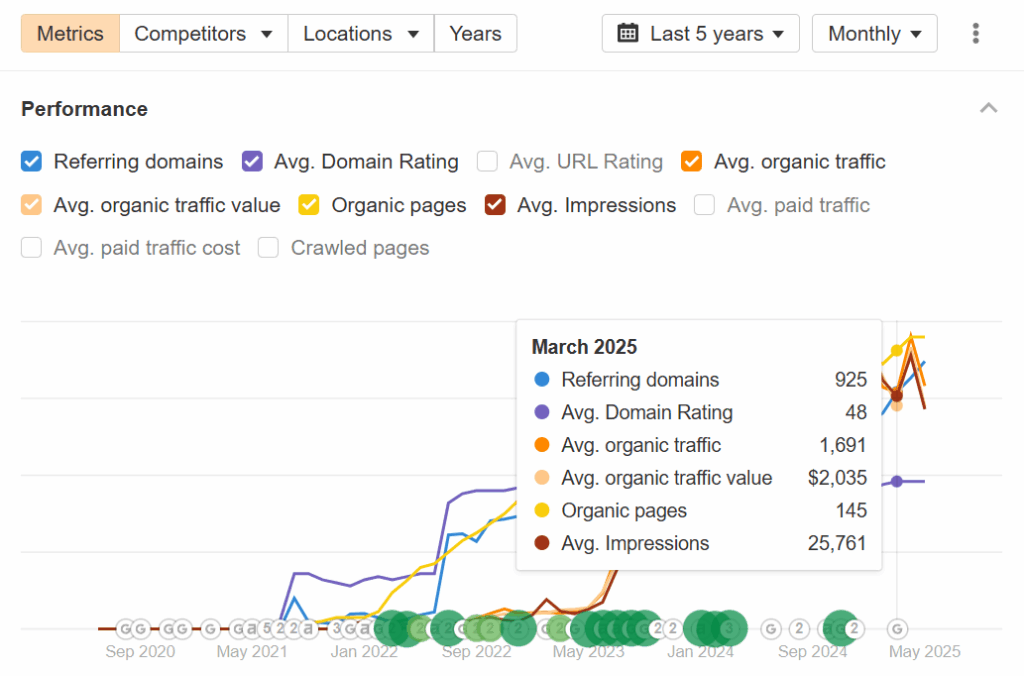
Quoleady is a B2B SaaS-focused content marketing and AI SEO agency helping tech companies get found in both traditional Google search and AI-generated answers. With over six years working exclusively with SaaS and tech brands, the team builds strategies that connect SEO fundamentals with LLM visibility. As a result, their clients show up where buyers are doing their research. They work primarily with product-led and B2B SaaS teams that rely on organic and AI-powered search as core growth channels.
Quoleady builds AEO into strategy from the start. Their work covers the full picture: content positioning, listicle placements, brand mentions in trusted publications, and technical implementation, all mapped to what actually influences AI recommendations in a given category. They monitor AI visibility for clients using dedicated tooling, so the work is measured against real AI appearances, not just keyword rankings.
B2B SaaS companies that want to grow both traditional organic traffic and visibility inside AI-generated answers at the same time.
Companies looking for a full-service marketing agency covering paid media, branding, and outbound.
Omniscient Digital is an organic growth agency founded in 2019 and based in Austin, Texas, focused on B2B SaaS. Their leadership team comes from in-house roles at HubSpot, Shopify, and Workato. They operate as growth partners along with being content producers. They’ve worked with companies like Jasper, Loom, Hotjar, Asana, Adobe, and SAP, and are known for tying organic efforts directly to pipeline, qualified leads, and ARR.
Omniscient has expanded beyond SEO into Generative Engine Optimization (GEO), aligning their approach with how AI systems evaluate and recommend brands. Their focus on authority, topical depth, and high-quality content is combined with their proprietary OmniscientX research framework. This helps position clients for visibility in both search engines and AI-generated answers.
Growth-stage and enterprise B2B SaaS companies that want a long-term organic growth partner with depth in both SEO and generative search.
Early-stage startups that need fast output or are working with tighter budgets.
Discovered Labs is a pure-play AEO and GEO agency built for B2B SaaS companies focused on visibility in AI-generated answers. It was co-founded by Liam Dunne (who scaled Instantly.ai to $20M ARR) and Ben Moore, an AI/ML engineer with experience at Stripe, Coinbase, and Brex. This blend of growth and technical expertise gives them a strong understanding of how LLMs retrieve and cite content in practice.
Discovered Labs is purpose-built for AEO. Their proprietary CITABLE framework structures content for AI extraction, verification, and recommendation. They actively test content against AI systems to see what gets cited and run Reddit campaigns to influence category narratives on platforms LLMs rely on.
B2B SaaS companies ($2M–$50M ARR) that want to quickly improve AI answer visibility with a technically focused approach.
Enterprise companies needing complex governance, compliance, or a full-service marketing partner.
Related: LLM Optimization vs SEO: What’s Changing in Search Discovery
NoGood is a New York–based growth marketing agency with a strong AEO practice embedded in its full-service offering. They work across SaaS, fintech, healthcare, and consumer brands, including ByteDance, Intuit, Spring Health, and Inflection AI. A key differentiator is Goodie, their proprietary platform for tracking AI visibility across ChatGPT, Gemini, Claude, and Perplexity, which they use directly in client work.
NoGood treats AEO as part of a broader growth system, not a standalone channel. Their approach combines schema, structured content, entity optimization, and prompt-gap audits to make content machine-readable and more likely to be surfaced by AI. With Goodie, they measure real AI visibility instead of relying on assumptions.
Growth-stage SaaS and B2B companies that want AEO integrated into a broader, data-driven growth program.
Brands looking for a lean, SaaS-only agency focused purely on organic and AI search.
MADX Digital is a London-based SEO agency focused on B2B SaaS, working with funded startups and mid-market scale-ups. They prioritize revenue outcomes like demos, signups, and ARR over vanity traffic metrics. As AI search has evolved, they’ve expanded into Generative Engine Optimization (GEO) and were recognized in 2025 with a Global Recognition Award for innovation in AI-driven search.
MADX has introduced GEO as a core service alongside SEO, content, and link building. They use proprietary tracking to monitor visibility across both traditional and AI search. They focus heavily on authority-building through PR, backlinks, and brand mentions, which directly influences AI recommendations.
Funded B2B SaaS startups and scale-ups looking to combine organic growth with AI visibility, backed by clear pipeline reporting.
Enterprise companies needing large-scale content operations or deep paid media capabilities.
Team 4 is a London-based B2B SaaS marketing agency focused on early- and growth-stage companies in niche tech markets. They operate as a small, senior-only team with no account managers, so strategy and execution stay with the same people. Founded by former in-house SaaS marketers, they prioritize pipeline impact over traffic and understand board-level reporting expectations.
Team 4 has integrated LLM optimization into its core offering alongside SEO, with a structured, measurable approach. Their focus on building Webflow sites with AI-readable architecture from day one, combined with practical AEO content like FAQ optimization, positions clients well for AI visibility.
Early- and growth-stage B2B SaaS companies in niche markets looking for a hands-on, strategic partner focused on pipeline impact.
Enterprise SaaS companies needing large-scale production or a full multi-channel agency.
| Quoleady | Omniscient Digital | Discovered Labs | NoGood | MADX Digital | Team 4 | |
| SaaS focus | Focused entirely on B2B SaaS and technology companies | Works mainly with B2B software and SaaS companies | Focused on B2B SaaS companies in the $2M–$50M ARR range | Works across SaaS, fintech, and consumer brands | Specialized in B2B SaaS | Works with early-stage and niche B2B SaaS companies |
| AI answer / AEO work | AI visibility built into the overall SEO and content strategy | Offers Generative Engine Optimization as a dedicated service | Positions itself as an AEO-focused agency with its own CITABLE framework | Uses an internal platform to monitor how brands appear in AI responses | Provides GEO services alongside traditional SEO | Integrates LLM visibility work into broader SEO programs |
| Prompt tracking | Tracks prompts across ChatGPT, Perplexity, and Google AI Overviews | Includes monitoring of AI search results within GEO work | Tracks prompts across ChatGPT, Claude, Perplexity, and AI Overviews | Uses the Goodie platform for real-time AI visibility monitoring | Tracks brand presence across tools like ChatGPT and Perplexity | Includes AI visibility signals in SEO reporting |
| Comparison and listicle strategy | Creates comparison pages and alternatives content and works on placements in third-party roundups | Focuses heavily on topic clusters and authority content | Produces high-volume content that often targets comparison-style queries | Content audits identify gaps in comparison and evaluation content | Content strategy includes buyer-intent and comparison pages | Builds content around evaluation queries and buyer research |
| Brand mentions | Digital PR focused on publications and sources AI tools often reference | Digital PR and link building used to build authority | Focus on third-party validation signals including communities like Reddit | Focus on brand authority and entity recognition across the web | Digital PR and mentions in relevant industry publications | Mentions built naturally through content and SEO work |
| Link building | Targeted outreach in SaaS and technology publications | Included within broader organic growth strategy | Backlink campaigns aimed at increasing third-party validation | Included as part of a broader growth marketing stack | Strong outreach and link-building campaigns | Link building included within general SEO work |
| Best fit | SaaS companies that want AI answer visibility and SEO handled together | Growth-stage or enterprise SaaS looking for a long-term organic growth partner | B2B SaaS teams that want to move quickly on AI visibility | SaaS companies looking for AEO as part of a wider growth marketing program | Funded SaaS startups and scale-ups focused on pipeline growth | Early-stage SaaS companies operating in smaller or niche categories |
Read also: Does Reddit influence LLMs responses? (The 2025 Research)
Right now, AI-referred traffic still makes up a tiny slice of overall website sessions, which is well under 1% in most datasets. Organic search still drives 30% or more of traffic for most companies, and around 95% of Americans still use search engines regularly. That number has barely moved even as AI tool usage has exploded.
If someone’s telling you to cut your SEO budget and go all-in on AI visibility, I’d push back on that hard.
At the same time, something interesting is happening underneath those numbers.
According to the Previsible State of AI Discovery Report, traffic from AI tools grew 527% year over year between January and May of 2025. The total volume is still small, but that growth rate is hard to ignore.
What makes this especially interesting for SaaS is the conversion data.
In that same report, LLM traffic converted at 6.69%, while organic search converted at 6.71%. In other words, visitors coming from AI tools converted almost exactly the same as visitors coming from Google.
No other industry category came close to that parity.
This combination of small total volume, massive growth rate, and conversion parity with organic search is why this is worth paying attention to now rather than waiting until the channel is crowded.
Rand Fishkin and Patrick O’Donnell ran a large experiment where they tested nearly 3,000 prompts across tools like ChatGPT, Claude (AI assistant), and Google Gemini.
They wanted to see how consistent AI recommendations actually are. The headline result was surprising. The chance of getting the exact same list of brands twice was less than 1 in 100.
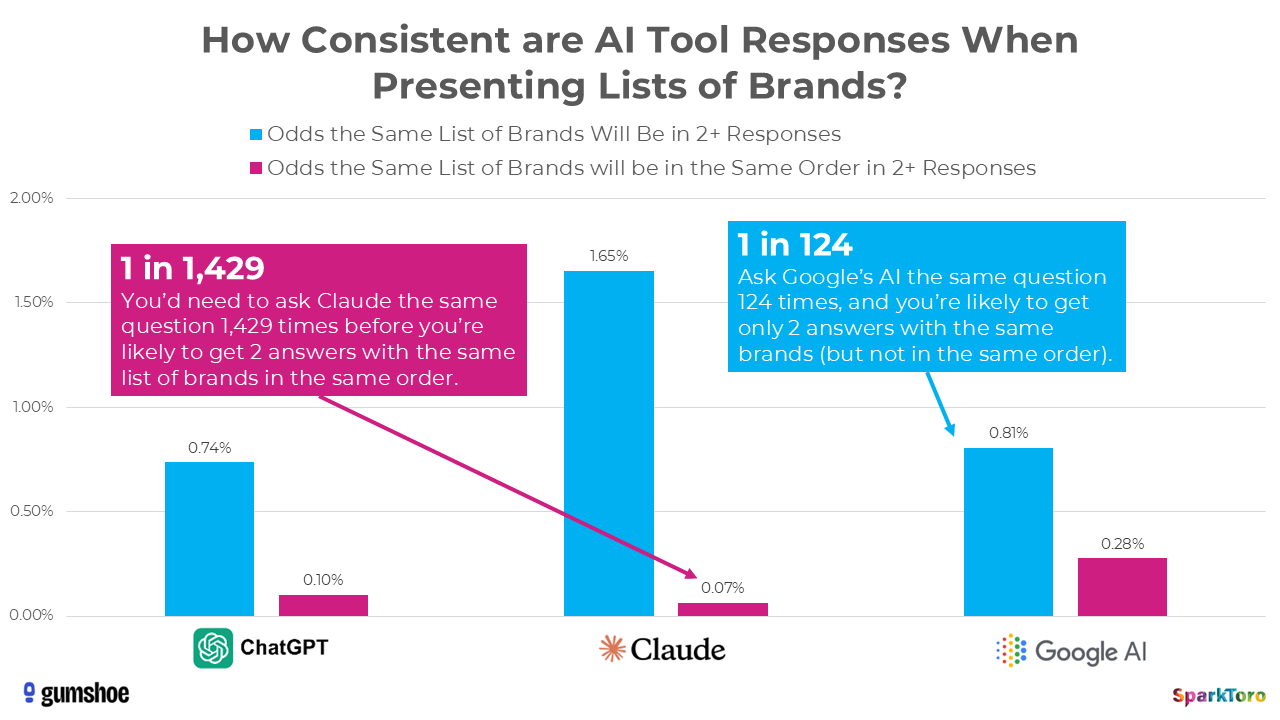
Image Source: Search Engine Land
But in tighter B2B SaaS categories, the same brands kept appearing even when the question was phrased completely differently. The AI wasn’t pulling random results, it had a default shortlist. And once a company becomes part of that default set in a category, it tends to stay there.
That compounding effect is exactly what early AEO work is trying to capture. Iit’s one of the strongest arguments for getting into this now rather than once the category is already settled.
You might be interested in LLM SEO: Guide to ranking in AI search results
Almost every SEO agency now claims they “do AEO.” The real signal usually appears during a conversation, not on a homepage. Here’s what I look for.
AI tools often pull from comparison pages, “best of” lists, and alternatives content. Strong agencies prioritize getting you featured in these and building similar assets on your site. They don’t just focus on top-of-funnel blogs.
AEO agencies test real buyer prompts in tools like ChatGPT or Perplexity, then track how often your brand appears, how it’s described, and how that changes over time.
Beyond backlinks, AI systems look at how your brand is discussed across the web. Strong agencies actively build mentions in review sites, publications, comparison pages, and community platforms.
Consistent AI visibility comes from three things working together: high-quality, well-structured content; strong brand authority across credible sources; and a technical setup that makes content easy for AI to access and interpret.
Keep this framework in mind as you evaluate any agency, it’s a useful lens for every conversation you’ll have.
AEO messaging is everywhere now, so focus on how agencies answer, not what they claim.
“How do you help brands appear in AI answers?”
Look for specific tactics: comparison content, prompt tracking, placements in roundups, and building presence in sources AI tools reference. Vague answers are a red flag.
“How do you measure AEO performance?”
They should go beyond keyword rankings and track real prompts across tools like ChatGPT, Perplexity, or Gemini while measuring visibility, positioning, and changes over time.
“Can you show real examples?”
Ask for proof like screenshots, live prompts, or case studies. If they can’t show actual results, they’re likely still early in their AEO maturity.
AI answers are now a part of how SaaS buyers research tools. For many of them, it’s becoming the first step; a quick prompt to get a starting point before they open anything else.
Someone opens ChatGPT, asks for recommendations, sees three or four tools mentioned, and begins their shortlist from there.
AEO agencies help SaaS companies become part of that moment.
The teams doing this well are not abandoning SEO. They are evolving how the work is done so that strong content, credible authority signals, and clear site structure support both traditional search and AI-generated answers at the same time..
If you are evaluating agencies right now, start with one simple test. Ask them to show you real examples of their clients appearing in AI answers. That question alone filters out a lot of noise. If an agency passes it, the conversation is worth having.
If you want to explore how Quoleady approaches AEO for B2B SaaS, book a call and we’ll walk you through it.
AEO (Answer Engine Optimization) is a strategy to make your brand appear in AI-generated answers from tools like ChatGPT, Perplexity, or Google Gemini. Instead of competing for clicks and impressions on search engines, AEO focuses on being one of the few products mentioned when users ask high-intent questions related to your product.
SEO drives clicks to your website through search engine results. AEO directly recommends your product in AI-generated responses. While SEO earns visibility on search pages, AEO earns visibility inside answers.
SEO, AEO, and GEO are not separate strategies but they work together. SEO builds strong foundations through content and authority. AEO focuses on getting your brand mentioned in AI-generated answers. GEO (Generative Engine Optimization) goes deeper by optimizing how AI models interpret, group, and recommend brands. Together, they increase your chances of being surfaced in AI-driven results.
It varies a lot depending on the agency and scope. Boutique SaaS-focused agencies tend to start somewhere between $3,000 and $8,000 per month for a combined SEO and AEO program. More established full-service agencies can start at $10,000 or higher.
Run a few prompts yourself before you talk to any agency. Open ChatGPT, Perplexity, and Google’s AI Overviews and ask the questions your buyers would ask. See who shows up, how consistently, and how your product is described if it appears at all. That gives you a baseline and makes every agency conversation more grounded.
If you already have decent SEO foundations, some categories start showing movement within two to three months. More competitive categories take longer, and there’s no reliable shortcut. Any agency giving you a specific guarantee on timing is oversimplifying how these systems work.
Comparison pages, alternatives content, and category roundups tend to carry the most weight, both on your own site and as third-party placements. Deep, well-structured articles that directly answer the questions buyers ask also perform well. Short blog posts optimized for top-of-funnel awareness tend to have less influence on what AI tools actually recommend.
Ask your current agency the same question you’d ask any new one. Can they show you a client appearing in AI answers? If they can, they’ve adapted. If they can’t, it’s worth having an honest conversation about whether they’re actively building that capability.
Olga Mykhoparkina
Founder, CEO
Read also



Finding a top-notch SaaS marketing agency to help you achieve your business goals can take time and
Olga Mykhoparkina
Apr 01, 2026
B2B buyers have been using AI tools to research software for a while now. ChatGPT, Perplexity, Googl
Olga Mykhoparkina
Mar 30, 2026
We spent several days (and quite a few AI credits) scanning hundreds of high-intent SaaS prompts acr
Olga Mykhoparkina
Mar 05, 2026 Let us know what you are looking to accomplish.
We’ll give you a clear direction of how to get there.
All consultations are free 🔥