Olga Mykhoparkina
Founder, CEO

Olga Mykhoparkina
Sep 28, 2026Most founders we talk to have already tried SaaS content. They published 20 posts, hired a writer, ranked for a few keywords. But they couldn’t trace a single closed deal back to any of it. The blog became a line item on the budget that everyone felt uncomfortable defending.
A SaaS content marketing strategy is the system that decides what you create, who it’s for, where it’s published, and how it connects to revenue. Without that system, you’re producing content in the same way a restaurant might cook without a menu, which is technically possible, but commercially unsustainable.
This guide is built on eight years of working exclusively with B2B SaaS companies on content, SEO, and now GEO. These are actual decisions we’ve made, mistakes we’ve watched clients repeat, and approaches we’ve seen convert readers into pipeline.
To build a SaaS content strategy that adapts to AI search and GEO shifts while delivering real results, you need a solid framework. These steps take you from keyword research to performance measurement, making sure every content asset has a clear purpose.
The most common pattern with SaaS founders is when they hire a writer or agency and start publishing broad, educational blog posts like “What is customer success?” or “The importance of onboarding”.
A few years ago, this could drive traffic. But now, these queries are answered by Google AI Overviews. With LLM-based search, users get instant answers without visiting any website. That’s why well-written top-of-funnel content struggles to generate meaningful traffic, let alone pipeline.
Ryan Law, Director of Content Marketing at Ahrefs, put it clearly on his LinkedIn post: “In the next 10 years, the value of educational blog content as a marketing strategy will go to zero. Almost all informational queries will be resolved by LLMs.”
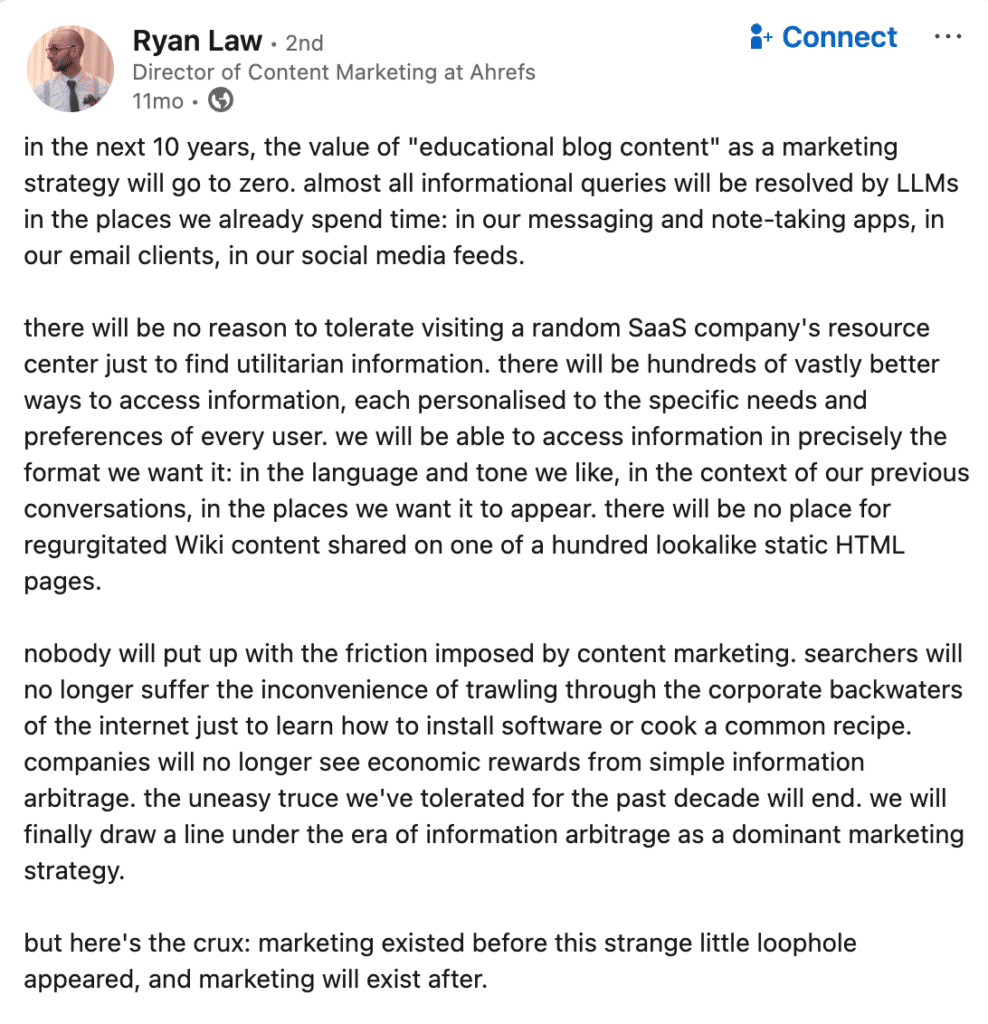
His argument is that generic how-to content is being commoditised by AI. So the content that survives is the content that includes your product’s specific context, real workflows, and actual outcomes that LLMs can’t replicate from training data.
Another issue is that the readers at TOFU stage aren’t looking to purchase anything. They’re curious. They’ll read, nod, and leave. The people who are actually ready to buy your product are searching for completely different things, and most SaaS companies aren’t creating that content.
If you want content to drive revenue in 2026, you need to start where intent already exists.
Bottom-of-funnel (BoFu) content targets people who already understand their problem and are actively evaluating solutions. These are the queries that still lead to clicks, get cited by AI systems, and convert.
More importantly, this type of content has become critical for GEO (Generative Engine Optimization). AI platforms don’t recommend brands based on generic definitions, they surface companies in the context of comparisons, alternatives, use cases, and buying decisions. If you’re not creating BoFu content, you’re effectively invisible in AI discovery.
The formats that do this well include:
BoFu content gives both search engines and LLMs the structured, high-intent context they need to recommend your product.
We ran exactly this playbook for FullSession, a heatmap and session recording tool. Instead of starting with broad UX content, we led with comparison and use-case articles targeting buyers who were already evaluating tools. As a result, we received 500 leads from 16 articles in four months. This also helped them increase their domain rating from zero to 48.
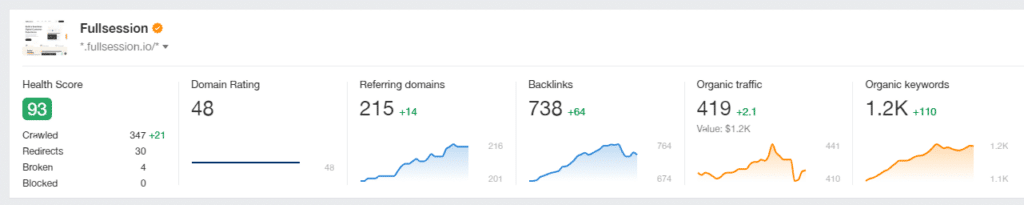
However, this doesn’t mean you should never write top-of-funnel content. But you should start building content that converts, so you have evidence that the channel works before you invest in content with a 12-month payoff horizon.
Not all keywords are equal, and the volume printed in your SEO tool is often the least useful number on the screen. A keyword with 10 monthly searches from someone typing “Salesforce alternative for 50-person SaaS” is worth more to you than a keyword with 20,000 searches from someone doing general research.
A practical framework for mapping your SaaS keyword universe across three tiers:
Tier 1: Problem-aware searches
These are top-of-funnel queries where buyers know something is wrong but haven’t defined the solution yet.
Examples:
“Why is SaaS churn so high”
“How to reduce CAC for SaaS”
“Customer retention strategies SaaS”
These are worth targeting later, once you’ve covered higher-intent queries.
Tier 2: Category (solution-aware) searches
The buyer knows what type of tool they need but hasn’t chosen a product yet.
Examples:
“Best customer success software”
“Onboarding automation tools”
“User onboarding software”
This is where buyers enter the market and evaluate options. These queries usually have the highest volume and should drive most of your content investment over time.
Tier 3: Vendor-level (comparison) searches
“[Competitor] alternatives”
“[Your product] vs [competitor]”
“[Competitor A] vs [Competitor B]”
“[Your product] pricing”
“[Your product] reviews”
These are high-intent queries from buyers comparing specific tools or considering a switch. If you don’t create this content, review platforms will take those positions.
A lot of SaaS companies start with competitor-driven queries like “[competitor] alternatives” to capture early demand. These are faster to rank and don’t depend on existing brand awareness.
But long-term growth comes from category-level queries, that’s where buyers enter the market and where most of your content investment should go.
Once your brand is part of that consideration set, Tier 3 content becomes critical to convert demand.
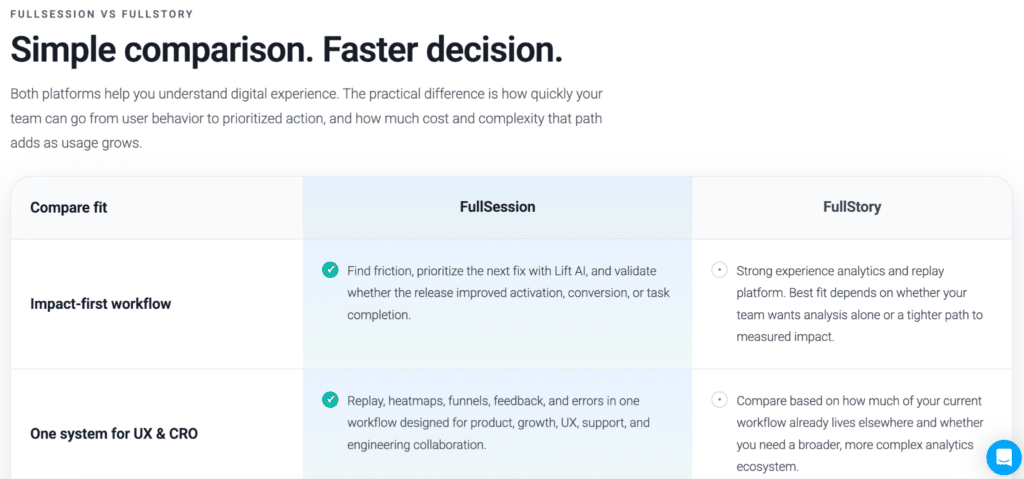
An example of comparison article on our client’s website
When doing keyword research, use Ahrefs or Semrush to run a content gap analysis against your two or three closest competitors. Look at what high-intent keywords they rank for that you don’t – especially solution-aware and comparison queries. That gap shows you exactly where the untapped opportunities are.
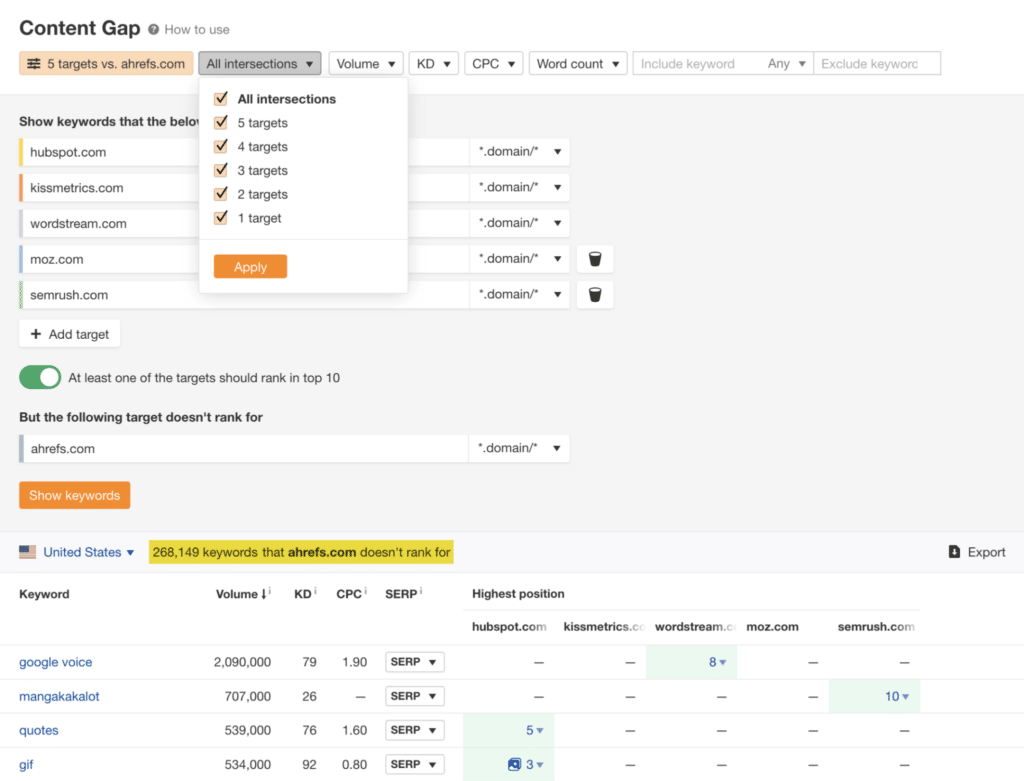
Content gap on Ahrefs
I always say that search intent matters more than search volume. Before you go after a keyword, ask yourself what the buyer is actually trying to do. If they’re just learning, it’s Tier 1. If they’re evaluating tools or comparing options, it’s Tier 2 or 3 — and that’s where content is more likely to drive pipeline.
You might be interested in: SEO vs GEO: Why Your Content Might Be Invisible in AI Search (And How to Fix It)
Product-led content is one of those terms that gets misunderstood as a format when it’s actually a philosophy.
The idea is very simple. All you have to do is write an article that teaches the reader something genuinely useful. Your product appears as the natural tool for solving the problem being discussed. It is not a subject of the post or a sales pitch at the end. The reader arrives at “I should try this” through their own reasoning, not because you’ve asked them to.
Here are three examples to understand it better:
In each case, the article stands on its own. The product is mentioned, but it’s not the entire point of the blog.
Product-led content works at every stage of the funnel:
The tactical version: for every article you plan, ask “where does our product naturally fit in this workflow?” If the answer is “it doesn’t,” you’re probably writing content for the wrong keyword. Content platforms like HubSpot Content Hub can support this process by helping teams create, manage, and optimize content within a connected marketing workflow.
SaaS marketers have always used multiple channels, but SEO has historically been the most cost-efficient and scalable one. That’s still true. What’s changed is how content gets discovered and distributed beyond traditional search, which now requires a more deliberate, multi-channel approach.
A well-targeted article that ranks in the top three positions for a buying-intent keyword can generate qualified traffic for years. Nothing else has that payoff curve. But it’s not passive. Competitive keywords require ongoing investment like link building, content updates, and continuous optimization to maintain and improve rankings. But – and this is the important part – organic search is no longer just about Google. More on that in the next section.
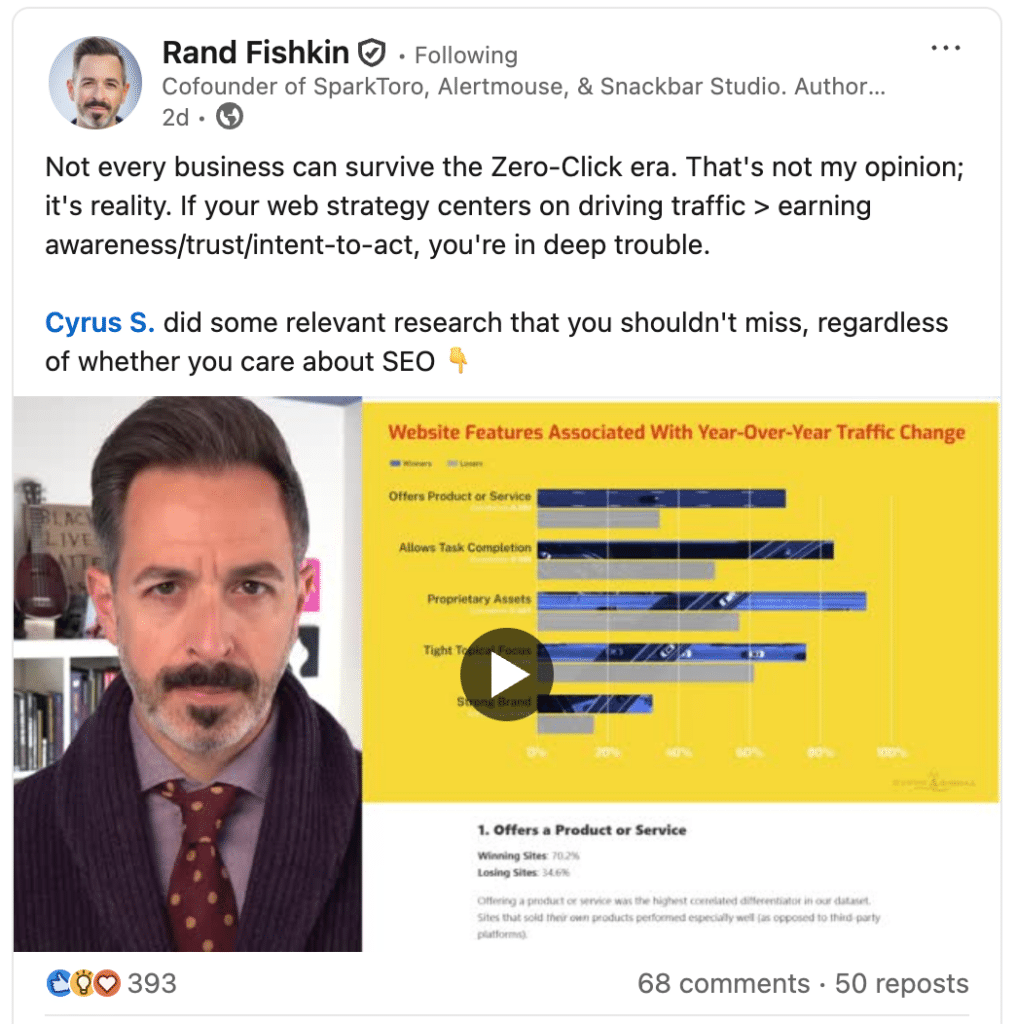
Rand Fishkin from SparkToro is very active on LinkedIn and shares his opinion.
For B2B SaaS, a single LinkedIn post from your CEO or a subject matter expert that links to a well-targeted article can outperform your entire newsletter. It can be an honest take on the industry or a simple product walkthrough. Your founder already has a network of the people you are trying to reach.
If they do not, it is not a blocker. Their profile can still grow into a strong channel over time by consistently sharing insights, engaging, and building a point of view. In parallel, you can activate other voices inside the company such as sales, product, and marketing to expand your reach.
Companies that treat LinkedIn as a distribution channel have a clear advantage.
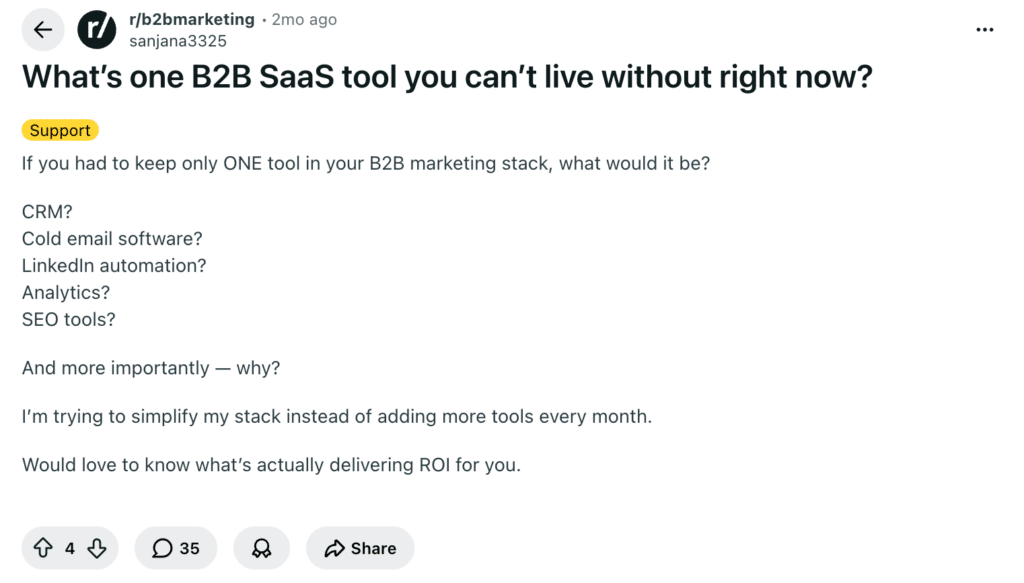
A lot of B2B buying decisions start with someone asking “What tool does your team use for X?” in a private community like Reddit or online forums. Your content needs to be the thing someone shares in response to that question. You can’t control this directly, but you can influence it by creating genuinely useful resources like templates, calculators, benchmarks, that people save and share in those contexts.
Owned audience is the only distribution channel that can’t be taken from you by an algorithm update. Even a small, well-segmented list of 500 qualified subscribers beats 50,000 organic visitors who forget you exist. If you’re not building this in parallel with your SEO content, you’re leaving your most engaged readers with no path back to you.
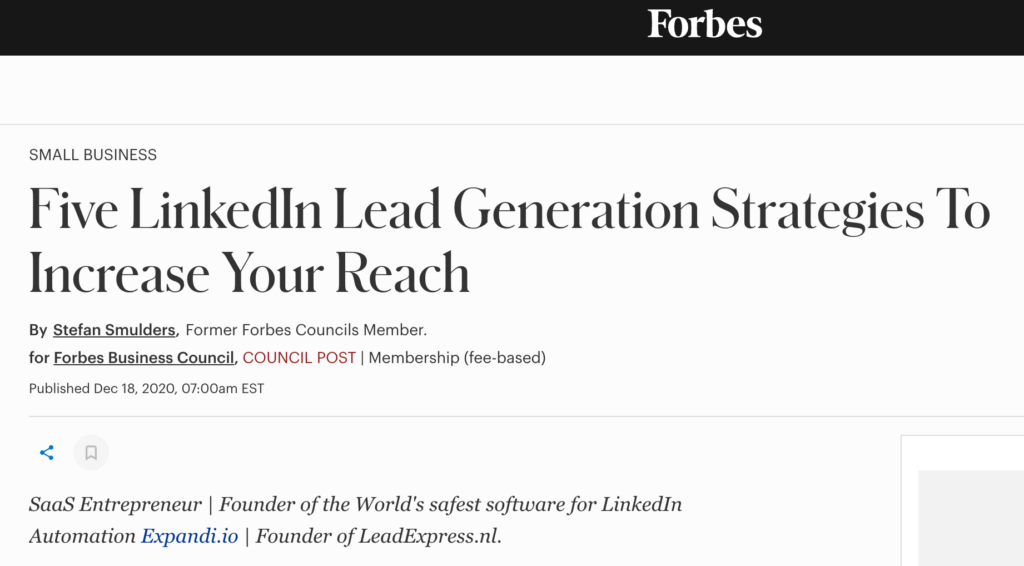
Quoleady’s client, Expandio’s article published on Forbes
Getting your content published in industry publications your buyers already read serves two purposes: direct referral traffic, and the authority signal that search engines and AI platforms use to evaluate credibility. This is where Quoleady’s Forbes and Entrepreneur placements deliver compounding value. These are not just the link, but the entity association that signals expertise.
Recently, Ahrefs did a case study of 3000 sites to understand the size of AI traffic. They found out that 63% of websites now report traffic originating from AI-based search engines. 98% of AI traffic is sent by three chatbots (ChatGPT, Perplexity, and Gemini) with ChatGPT being the biggest referrer. In another research done by CapGemini in 2025, they found out that 58% of consumers have replaced traditional search engines with Gen AI tools for product/service recommendations, up significantly from 25% in 2023.
For B2B SaaS specifically, this matters because your buyers, who are technical, research-driven, time-poor, are precisely the users who adopted AI search first.
That’s why Generative Engine Optimization (GEO) should be a part of your SEO strategy. It is the practice of writing and structuring content so that AI platforms, like ChatGPT, Perplexity, Google AI Overviews, Gemini, can cite your content in their answers. Traditional SEO optimises for Google’s ranking algorithm. GEO optimises for whether an LLM has the right raw material to recommend your brand when someone asks about products like yours.
We’ve been running our own research to understand how this works. In our 10,000 LLM citations study for SaaS, we dug into where AI platforms pull their data from for SaaS high-intent prompts.
In a separate LLMO research about G2 and Capterra influence, we analysed hundreds of SaaS tools and dozens of high-intent “alternatives” prompts across ChatGPT and other LLMs. We found that 100% of the tools mentioned in ChatGPT answers had reviews on Capterra, and 99% had reviews on G2.
Having a Wikipedia page also correlated with higher placement, so tools with a Wikipedia presence averaged a rank of 5.07 versus 6.91 for those without one. And in our Reddit influence research, we found that Reddit ranks in Google’s top five for 76% of high-intent SaaS searches.
This makes it an indirect but measurable factor in LLM visibility. Perplexity showed the strongest influence from Reddit’s content of any model we tested.
Your on-site content, your presence on review platforms, your mentions in community discussions all of it feeds into whether LLMs surface your brand when a buyer asks “what’s the best tool for X?”
Here’s a checklist you can apply to every article:
Put the direct answer in the first one or two sentences of every section. LLMs extract the clearest, most direct statement of a fact. If your answer is buried in paragraph four after three sentences of context-setting, the model may pull a competitor’s cleaner version instead. This is exactly what we covered in our guide on AI-first indexing. You should structure your pages so that both humans and AI tools can extract what they need quickly, without wading through filler.
Statistics, named examples, specific numbers, real outcomes. Strong E-E-A-T signals (Experience, Expertise, Authoritativeness, Trustworthiness) still remain critical for GEO because AI ranking algorithms favour authoritative voices when assembling answers. A post that says “How Quoleady helped Fuelfinance get 3x more MQLs with quality SaaS content marketing” is far more citable than “How content marketing drives significant organic growth.”
Be explicit about who you are, what you do, and what problem you solve. LLMs build knowledge graphs, so consistent positioning across the internet matters.
Vague positioning like “a content solution for growth teams” makes it harder for a model to know when to recommend you.
For example, “Quoleady is a B2B SaaS SEO and LLM visibility agency that helps software companies get discovered in Google and AI tools through quality content and digital PR” is clear and easy to extract.
Structured question-and-answer blocks are directly consumed by AI answer engines. If you’re not adding these schema and structures data for LLM visibility to your most important pages, you’re leaving one of the most controllable GEO levers unused. Five to seven well-phrased questions that your buyers actually ask will improve AI visibility faster than most technical changes.
A named author, a clear bio, sources, and original data all help build credibility for both Google and AI tools. If your content is anonymous and has no data or sourcing, it’s hard for these platforms to trust it. Expert quotes alone can increase LLM visibility by 30–40%, especially when they come from credible, relevant sources.
Additionally, you can also perform a self-test. Open ChatGPT or Perplexity and type your primary buying-intent keyword, something like “best [your category] software for [your ICP].” Does your product appear? You can also use Allmond to track how often you’re mentioned across these prompts at scale. If a competitor with weaker SEO is being cited and you’re not, the gap is almost always one of the five factors above.
GEO doesn’t replace SEO. The best current approach combines both. That’s why you should create content that ranks well on Google and is structured so that AI can extract, cite, and recommend it. They’re not competing disciplines. But SEO builds the foundation of authority that GEO requires.
Every agency or in-house team will tell you they create content briefs. Few of them will show you one (we will!).
A brief sits between “we should write about this keyword” and “here’s the draft.” It’s where strategy turns into something a writer can actually work with.
When the brief is weak, the content ends up generic no matter how good the writer is. They don’t know what the article is supposed to do, what questions it needs to answer, or how the product should show up.
A good brief includes:
If you’re evaluating a content agency, ask to see a sample brief before you ask to see a portfolio. A good portfolio tells you a writer can write. A good brief tells you the team knows how to think about content strategically. The brief is where the commercial intent lives.
At Quoleady, every piece of content goes through brief approval with the client before writing begins. This step alone prevents the most common failure mode in agency relationships: the client hates the direction after 2,000 words have already been written, because no one aligned on it first.
Check out our content brief from one of our clients below:
The metrics that matter for B2B SaaS content fall into three buckets:
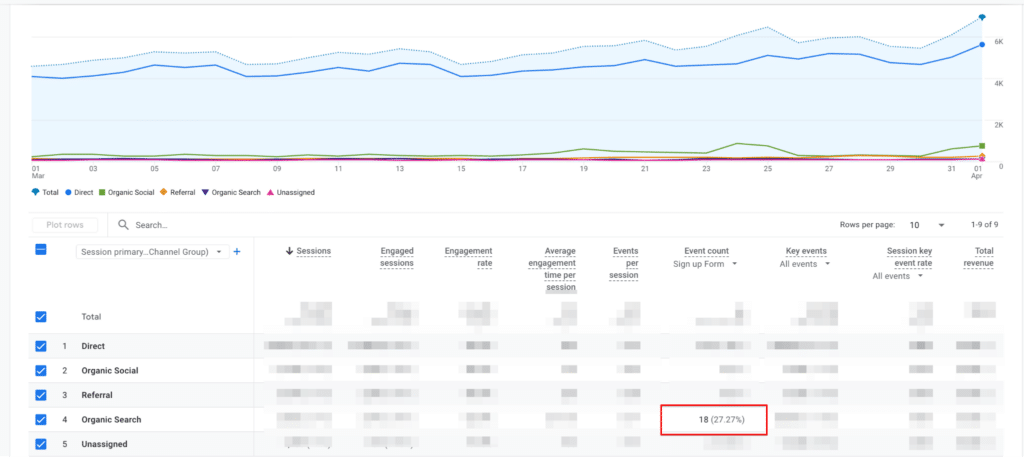
This is when a reader becomes a lead. Track signups, demo requests, and other conversion events, and tie them back to organic traffic.
Most companies already have this data, but it’s not connected to content. Once you link conversions to specific articles, it becomes clear what’s actually driving the pipeline.
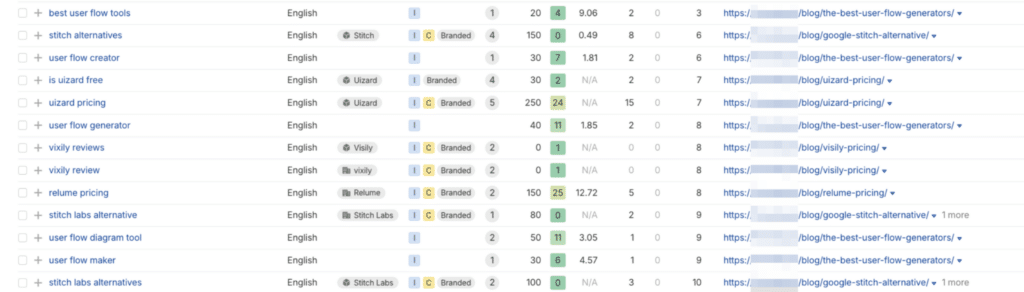
How quickly do new articles start ranking in the top 10?
If content reaches meaningful positions within 60 to 90 days, you’re on the right track. If nothing moves, it usually points to a mismatch in intent, weak authority, or technical issues.
Which deals included content somewhere in the journey?
Look beyond last-click attribution. Check whether buyers interacted with your content before converting. This is what shows whether content is actually helping close deals, not just generating traffic.
A note on timelines, because this is where a lot of founder expectations get set wrong. Organic content compounds.
When ResponseScribe came to us, they had a brand new domain, zero organic traffic, and a very specific ICP of small business owners who needed a call answering service but didn’t want to hire a full-time receptionist.
We started with high-intent content aimed at buyers in the evaluation stage, rather than prioritizing awareness content. We built out a content architecture around comparison keywords, “best [category]” roundups where ResponseScribe could legitimately be included, and use-case content targeting the specific industries they served.
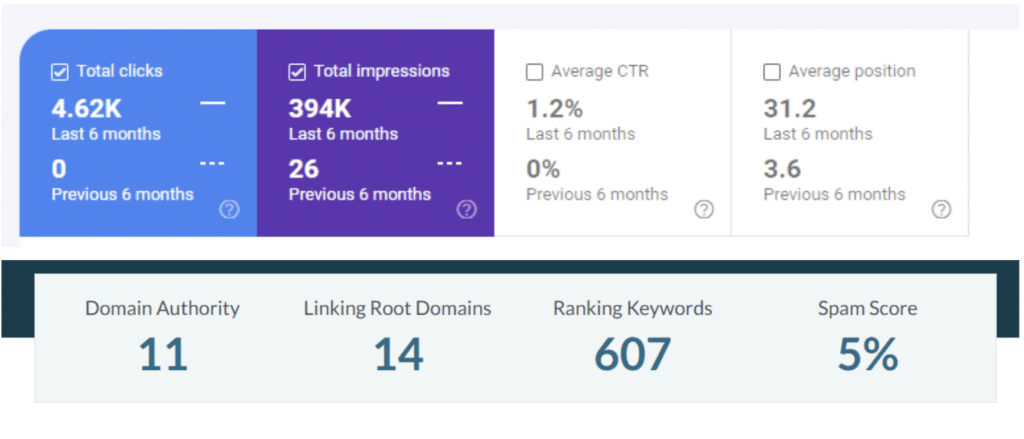
We also built every article to be GEO-ready from the start with answer-first headers, explicit entity descriptions, concrete numbers from the product, and structured FAQ blocks at the end of each page. As a result, they went from 0 to 4,620 clicks per month in organic search within six months on a brand new domain.
The content strategy is a set of decisions made before a single article is written. Which keywords, in which order, targeting which stage of the buyer’s journey, structured in which way, distributed through which channels. The writing executes the strategy. The strategy determines whether the writing ever connects to revenue.
Read the full case study about how ResponseScribe went from 0 to 4.62k clicks in 6 months (with a new domain).
One thing separates SaaS companies with good content from those with blogs full of articles that nobody links to or reads is a strategic production system.
This doesn’t have to be complicated. At minimum you need: a keyword-prioritised content calendar for the next 90 days, a brief process that specifies intent and structure before writing begins, an editor who understands both the product and the audience, and a monthly check on which articles are ranking and converting.
If you publish content without a system and pick topics on the fly, you’ll likely say in six months, “content doesn’t work for us.”
Content works. But it’s almost always the process and the strategy around it.
A SaaS content marketing strategy that generates pipeline comes down to a sequence of decisions. Start with buying-intent keywords at the bottom of the funnel. Build topical authority through a structured keyword map. Write articles where your product is the natural solution to a real problem. Distribute through channels your buyers actually use, including AI search. Structure every piece so it’s extractable by LLMs and measure the conversions.
If you want a second set of eyes on your current content setup and want to understand what’s working, what’s wasting your budget, and what you should do first, book a call with Quoleady. We’ll give you a clear picture of where you stand and what a realistic content strategy looks like for your stage and ICP.
Realistically, you’ll see early ranking signals within 60–90 days of publishing well-optimized content. Meaningful traffic and lead attribution typically appear at the 6–9 month mark. Compounding results, where content becomes a primary growth channel, happen at 12+ months with consistent publishing.
It depends on stage and speed. In-house gives you product depth and response time; an agency gives you a system that’s been proven across multiple SaaS clients and doesn’t require you to build the process from scratch. For most companies at the 50–200 employee stage, a specialist SaaS content agency is faster and more cost-effective than hiring and training a team, especially in the first 12 months.
The main differences are the sales cycle length, the multi-stakeholder buying process, and the need for product-led content. B2B SaaS buyers do more research, involve more people in the decision, and need content that maps to each stage of that journey – from problem awareness to vendor comparison. Generic content marketing frameworks don’t account for the evaluation complexity of a SaaS purchase.
Quality and intent matter more than volume. Four well-structured, buying-intent articles per month will outperform sixteen generic posts. The right number depends on your domain authority, your target keyword difficulty, and your production capacity.
Bottom-of-funnel content consistently converts at the highest rate: competitor alternative pages, “best [category] software” roundups, use-case pages, and product comparison articles. These formats target buyers who are actively evaluating tools, which is why their conversion rates are measurably higher than awareness-stage content.
Olga Mykhoparkina
Founder, CEO
Read also


I don’t know about you, but these days, every time I need to find a product or service, I go to Cl
Olga Mykhoparkina
Oct 01, 2026
A SaaS company can rank well in Google and still be absent when a buyer asks ChatGPT for the best pr
Olga Mykhoparkina
Oct 01, 2026
You already have the numbers. HubSpot, GA4, your CRM and Stripe are throwing dashboards at you every
Olga Mykhoparkina
Oct 01, 2026 Let us know what you are looking to accomplish.
We’ll give you a clear direction of how to get there.
All consultations are free 🔥