Olga Mykhoparkina
Founder, CEO

Olga Mykhoparkina
Aug 24, 2026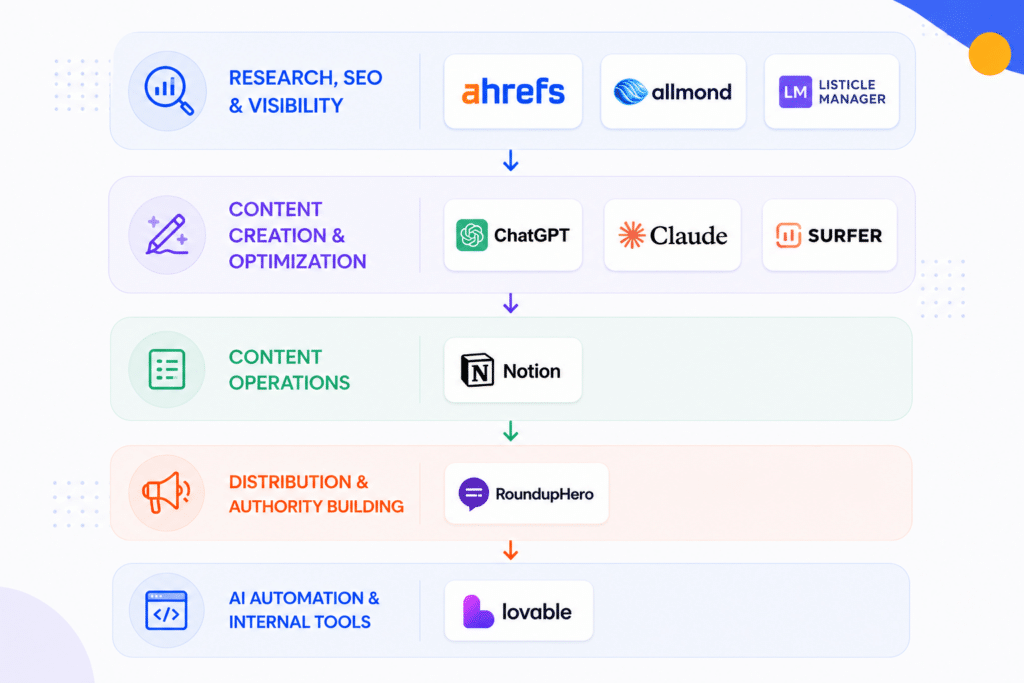
I often see teams paying for 15–20 different marketing tools while still struggling to publish consistently, rank in Google, or get mentioned in AI answers.
The opposite is usually true as well.
Some of the most successful SaaS content programs we’ve worked with run on surprisingly few tools.
Over the past six years, we’ve grown Quoleady into a SaaS-focused content marketing agency that has worked with more than 200 SaaS companies, from early-stage startups to established brands. Along the way, we’ve tested dozens of SEO, content, AI, project management, and distribution tools across hundreds of campaigns.
Some became part of our daily workflow. Others looked impressive in demos but never delivered enough value to justify another subscription.
This article covers the content marketing stack we actually use at Quoleady.
I’ve grouped the tools into four categories:
For each category, I’ll share what we use, why we use it, and when I’d choose an alternative.
If we had to keep only one SEO tool, Ahrefs would probably be it.
We’ve used it for years across hundreds of SaaS campaigns, and it’s still the platform we rely on most for keyword research, competitor analysis, backlink audits, content gap analysis, and rank tracking.
When we’re building a content strategy for a client, Ahrefs is usually where the process starts. It helps us understand what topics competitors rank for, where backlink opportunities exist, and which content opportunities we’re missing.
We don’t actively use Semrush in our day-to-day workflow, but it’s one of the strongest alternatives to Ahrefs.
Many teams prefer it because it combines SEO, PPC, advertising research, and competitive intelligence in one platform. If your responsibilities extend beyond SEO, Semrush is worth considering.
For our agency workflows, however, Ahrefs has remained the better fit.
Allmond is our AI visibility tracking tool.
We built it because we wanted a simpler and more affordable way to monitor how brands appear in ChatGPT, Claude, Gemini, and Perplexity. While larger SEO platforms have started adding AI visibility features, we wanted something focused specifically on tracking brand mentions, competitor visibility, and AI search presence.
We use it internally to monitor how clients perform across AI platforms and identify opportunities to increase visibility.
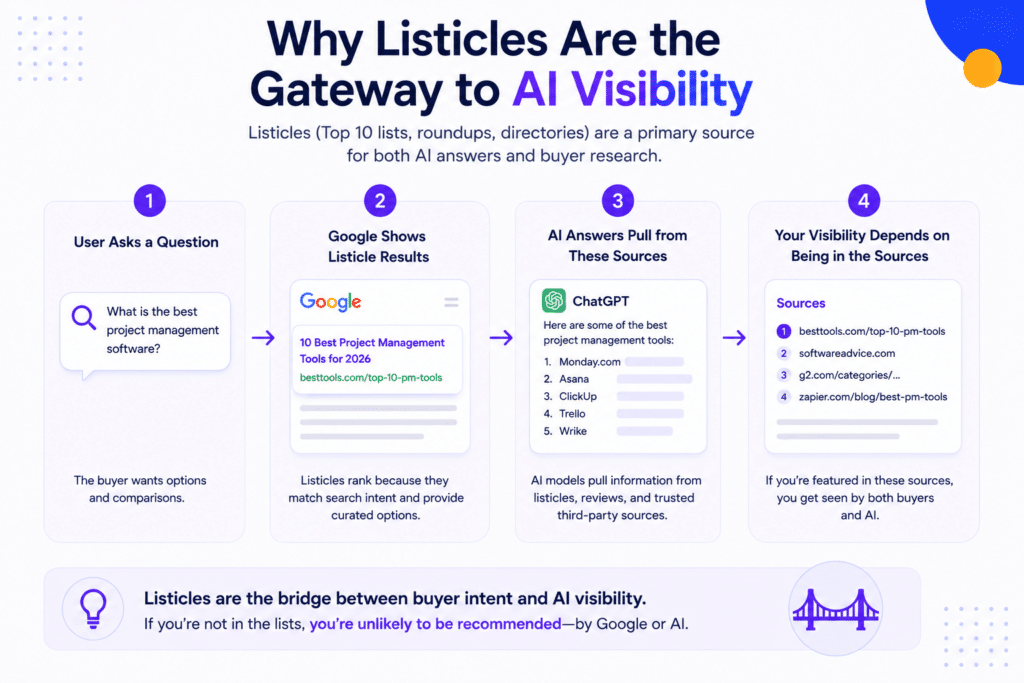
If there’s one visibility tactic that’s become significantly more important over the last few years, it’s getting featured in third-party listicles.
We use Listicle Manager to identify relevant “best tools” articles, track where our clients are already featured, discover opportunities they’re missing, and manage outreach campaigns.
When we’re working with a SaaS company, one of the first things we look at is whether they’re present in the listicles that rank for their category and appear in AI-generated recommendations. In many cases, these articles influence buying decisions more than a company’s own blog.
Listicle Manager helps us find those opportunities faster and build a systematic outreach process around them.
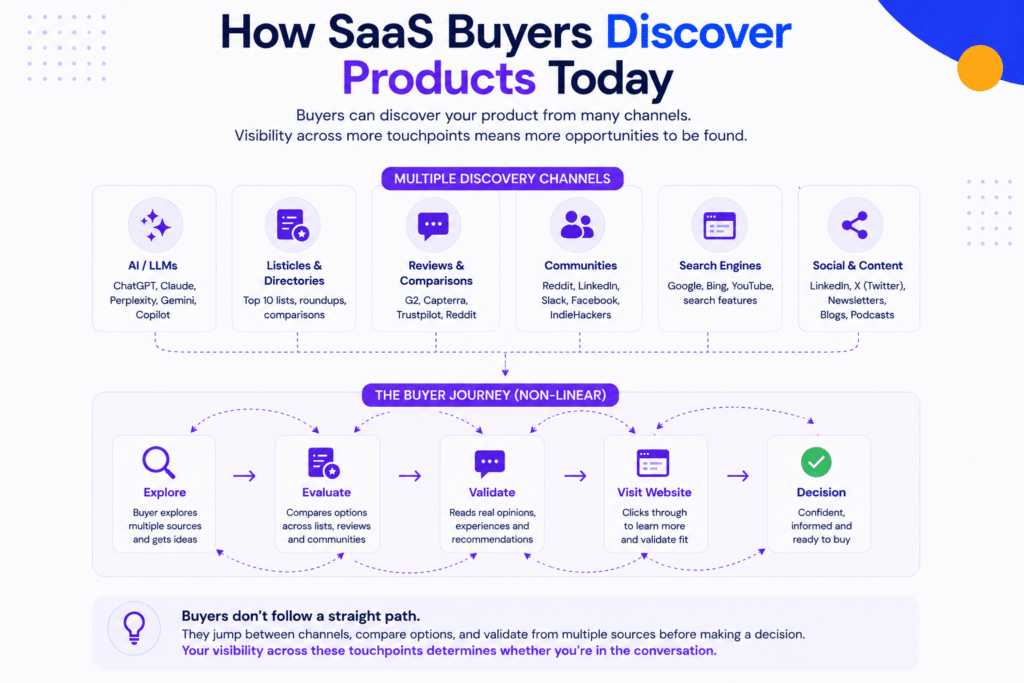
AI engines like Gemini, Perplexity, and ChatGPT have become huge. AI and traditional search optimization often go hand-in-hand and focusing on both search engine types can yield massive benefits.
But their actual optimization practies differ: traditional keyword research turns into prompt research, while backlink analysis turn into citation analysis, for example. For that you’ll need specialized AI optimization tools.
One such example is HubSpot AEO: it provides the features needed to measure visibility across AI engines, and create content that boosts AI citations or brand mentions.
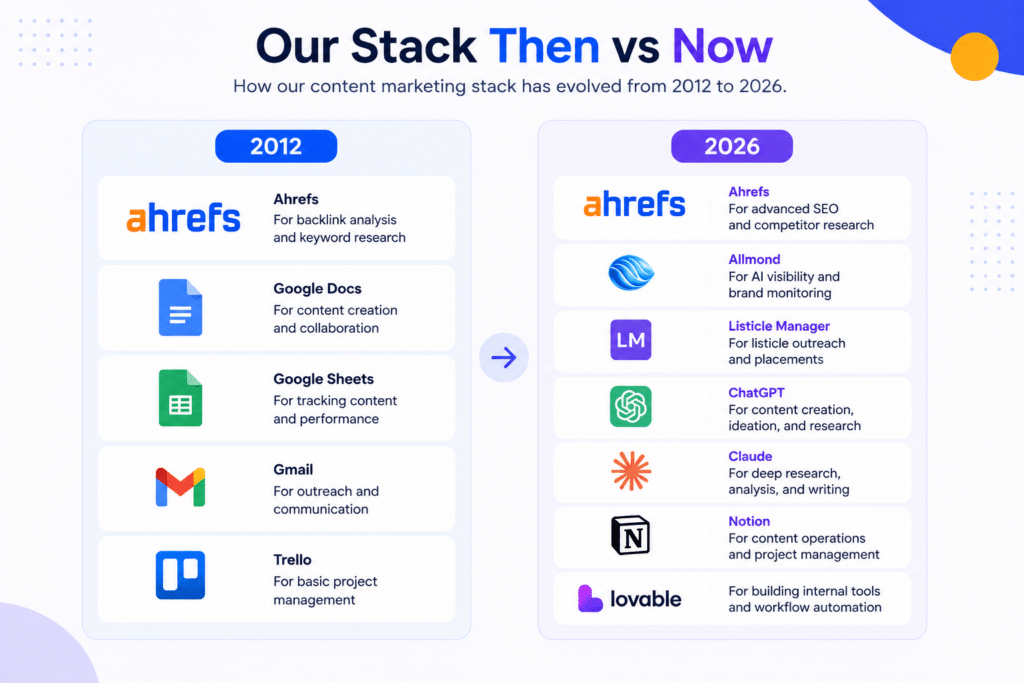
ChatGPT is one of the tools we use most often throughout the content creation process.
It’s particularly useful for research, brainstorming, finding content gaps, analyzing competitors, building outlines, and pressure-testing ideas before we start writing.
It can also help improve clarity, suggest alternative approaches, and speed up repetitive tasks that would otherwise take much longer manually.
We don’t use ChatGPT to generate entire articles and publish them as-is. Instead, we use it as a research and thinking assistant that helps our team work more efficiently.
If we had to choose one AI tool specifically for content work, Claude would probably be our pick.
We use it extensively during the editing process to improve structure, strengthen arguments, identify logical gaps, simplify complex sections, and improve the overall flow of an article.
It’s particularly good at working with long documents and maintaining context across large pieces of content.
Like ChatGPT, we don’t use Claude to write articles from scratch. The value comes from helping us research topics, challenge assumptions, refine ideas, and improve content that has already been created by our team.
We use SurferSEO as a final optimization layer before publishing.
It helps us identify important topics, entities, and subtopics that may be missing from an article and provides a useful check before content goes live.
We don’t write for Surfer scores, but we do use the platform to make sure we’ve covered the topic comprehensively and aren’t overlooking important search intent elements.
We don’t actively use Clearscope, but it’s one of the strongest alternatives to SurferSEO.
Many larger content teams prefer it for its cleaner interface and content optimization recommendations. If you’re evaluating content optimization platforms, it’s worth comparing both before making a decision.
Creating content is one challenge.
Keeping content projects organized is another.
When you’re managing content calendars, briefs, drafts, reviews, approvals, client feedback, and publishing schedules, things can quickly become chaotic without a central system.
For us, that system is Notion.
Notion is the center of our content operation.
We use it for editorial calendars, content briefs, client documentation, SOPs, content workflows, and project management.
Every article starts in Notion. Writers, editors, project managers, and clients work from the same workspace, making it easier to track progress and keep projects moving.
One reason we like Notion is its flexibility. We’ve built custom workflows for content production, client onboarding, link building, AI visibility projects, and internal knowledge management without needing multiple tools.
If you’re building a content program from scratch, Notion is one of the first tools I’d recommend.
Another platform worth considering is EasyContent, especially for teams that need a more structured editorial workflow.
EasyContent is a content operations platform designed for agencies and marketing teams that manage the entire content production process – from idea to publication.
The platform helps teams organize content workflows by providing customizable briefs, templates, approval stages, real-time collaboration, version history, and dedicated projects for different content types. It’s particularly well suited for organizations working with multiple writers, editors, clients, and review cycles.
EasyContent also includes AI features powered by Claude. EasyAI Writer can assist with topic research, outline creation, and long-form content generation based on your templates, guidelines, and brand voice. Meanwhile, AI Editor helps improve existing content through SEO optimization, readability enhancements, fact-checking, compliance checks, and brand voice alignment, while keeping humans in full control of every suggested change.
If your team needs more structured content production, review, and approval workflows than general-purpose project management tools provide, EasyContent is worth considering.
Text-only content is becoming harder to distribute.
A blog post can often become a LinkedIn carousel, infographic, social media post, or visual summary that reaches a completely different audience.
These are the tools we use most often for creating visual content.
This might be the newest addition to our visual content workflow.
We use ChatGPT to turn articles into infographics, LinkedIn carousel drafts, diagrams, charts, and custom illustrations.
What previously required multiple tools and a designer can now often be done in a single workflow.
For content marketers, this is one of the biggest productivity improvements we’ve seen in recent years.
Canva is still one of the easiest ways to create social media graphics, presentations, simple infographics, and marketing visuals.
While we’re increasingly using ChatGPT for image generation, Canva remains useful when we need quick edits, branded templates, presentations, or assets that require more manual control.
For more advanced visual projects, custom diagrams, or assets that require a designer, Figma is still the standard.
We use it less frequently than Canva or ChatGPT, but it’s a great option when a project requires a higher level of customization.
One of the biggest changes in content marketing over the last few years isn’t AI writing.
It’s the ability to build your own tools.
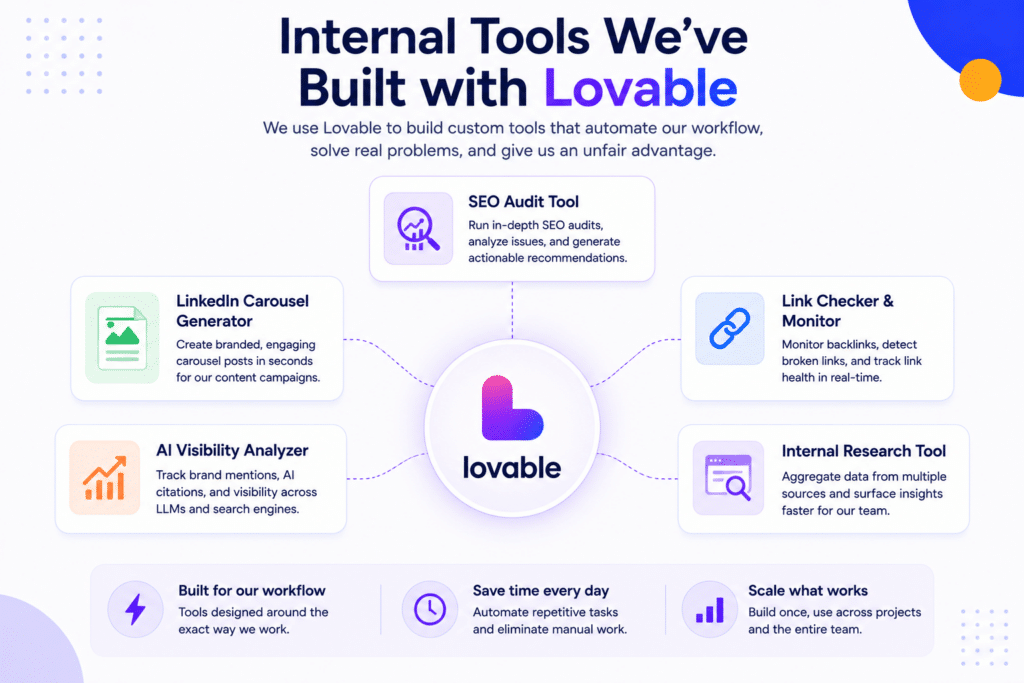
Instead of forcing our processes into existing software, we’re increasingly creating small internal tools that solve very specific problems.
The platform we use most for that is Lovable.
Lovable allows us to build internal marketing tools without a dedicated development team.
We’ve used it to create a variety of custom workflows that save our team hours every week.
For example, we’ve built:
The biggest advantage is flexibility.
Most SaaS tools are designed for thousands of companies with different needs. Lovable allows us to build something specifically for our own processes.
As AI becomes a bigger part of content marketing, I believe more teams will move in this direction. Instead of buying another subscription, they’ll create lightweight internal tools that automate repetitive tasks and fit their workflow exactly.
The tools above make up most of our day-to-day workflow. Depending on your goals, team size, and content strategy, these tools can also be valuable additions to your stack.
We run most content through Grammarly before publishing. It’s a simple way to catch grammar issues, improve clarity, and maintain consistency across multiple writers.
RoundupHero helps marketers collect expert insights and create expert roundup content at scale. We use it when creating articles that benefit from outside perspectives and industry expertise.
A popular outreach platform for managing link building and digital PR campaigns. Useful for teams running larger-scale outreach programs and managing hundreds of relationships.
Respona combines prospecting and outreach in a single platform. It can help you discover relevant websites, find contacts, and manage outreach campaigns without switching between multiple tools.
Qwoted connects journalists with subject matter experts. It’s a useful way for founders and marketing teams to earn media mentions, expert quotes, and brand visibility.
Featured helps experts contribute insights to articles, blogs, and publications looking for source material. It’s one of the easier ways to build authority and earn third-party mentions.
Muck Rack is designed for teams running a more structured digital PR program. It helps identify journalists, monitor media coverage, and manage media relationships at scale.
We often use Perplexity during the research stage. Because it pulls information from live web sources and provides citations, it’s useful for validating information and finding recent industry developments.
People often ask which tools we actually use.
While we’ve tested dozens of platforms over the years, these are the tools that make up most of our workflow today.
We use additional tools depending on the project, but if we were starting from scratch today, this is the stack we’d build again.
Over the past six years, we’ve tested dozens of tools while helping more than 200 SaaS companies grow through content marketing, SEO, and AI visibility.
The stack has changed many times. Some tools became industry favorites and disappeared from our workflow a few months later. Others have remained part of our process for years.
The tools in this article are the ones we continue to use because they’ve proven useful across hundreds of content projects and client engagements.
That doesn’t mean you need every tool on this list.
Start with the tools that solve your biggest bottlenecks today, build a workflow your team can follow consistently, and expand your stack as your content program grows.
If you’d like to discuss your content marketing tool stack, AI visibility, SEO performance, or overall organic growth strategy, feel free to reach out.
You can connect with me on LinkedIn or book a call here:
Olga Mykhoparkina
Founder, CEO
Read also



At Quoleady, we’ve believed in content marketing for years. After working with more than 200 B2B S
Olga Mykhoparkina
Jul 27, 2026
At Quoleady, we’ve worked with more than 200 B2B SaaS companies, from early-stage startups to
Olga Mykhoparkina
Jul 10, 2026
High-quality content can help you improve your brand authority, increase traffic, attract leads and

Ardak Yeshniyazova
Jun 15, 2026 Let us know what you are looking to accomplish.
We’ll give you a clear direction of how to get there.
All consultations are free 🔥