Jelena Ilic
Senior content writer and analyst

Jelena Ilic
Oct 08, 2026There are already too many “best SaaS SEO agencies” roundups online. They show you a short agency summary, pricing, clients and “the best fit”. From what I read, they are usually based on what ChatGPT has generated or (if you are lucky), an actual visit to the agency website.
We didn’t feel that was very useful anymore. When I chatted with Olga, founder at Quoleady about this article, she mentioned that SaaS clients come to the calls with a bunch of questions:
So we decided there’s a huge gap of knowledge in the SaaS SEO agency space that we need to fill in. We ran an interview with 20+ questions and covered everything from minimum deal size to contract length to who will be working on the project and where those people would communicate with the client.
Before we dive in, we want to thank all the founders who took the time to participate and contribute thoughtful, detailed answers to this piece. The goal of this article is not to declare a single “winner,” but to help SaaS founders understand which agencies are the best fit for different stages, budgets, and growth goals.
Ideally, this helps you narrow down your options much faster, understand how different agencies actually think, and avoid sitting through ten discovery calls.
The answers turned out to be genuinely interesting and, honestly, even as an agency ourselves, we learned a lot from the interviews.
It was interesting to see how much overlap there is between agencies in terms of what actually works in SEO and AI visibility today, while at the same time realizing that each agency still has its own distinct philosophy, strengths, and way of approaching growth.
Here are some of the most interesting takeaways:
Deal sizes range from around $1,500/month to enterprise engagements in the $250K–$500K annual range, depending on the agency’s positioning, scope, and target clients.
A 3-month minimum seems common, while some agencies require 6-12 months, especially for more strategic SEO/GEO work.
Most agencies mentioned GEO, AI search, LLM visibility, citations, listicles, or AI tracking in some form.
Some focus on prompt tracking, some on Google Analytics, some on listicles and citations, and some on broader authority building.
Agencies mentioned guest posts, digital PR, original research, media outreach, listicles, review platforms, Reddit, creator partnerships, and citation building.
Several answers emphasized pipeline, leads, revenue, sign-ups, sales, and conversions over traffic alone.
Most agencies mentioned expert-led, research-driven, experience-based, or SME-written content instead of generic SEO articles.
Agencies that answered this tend to use AI for research, editing, structure, ideation, or production support, while humans handle strategy, insights, and final direction.
Some founders stay directly involved after the sale, while larger agencies usually involve senior strategists, account managers, or editorial leads instead.
Most agencies are flexible and can also work in tools like Asana, WhatsApp, Telegram, or the client’s own setup.
They may provide estimates, ranges, audits, or opportunity models, but they usually explain that SEO/GEO results depend on many variables.
First indicators can show up earlier, but meaningful SEO/GEO results usually take 5–8 months, especially for new websites.
Common differentiators include revenue focus, strong editorial quality, expert content, senior involvement, client-first communication, and deep strategic thinking.
Before we get into the findings, here’s the founders we talked to.

Founder at Quoleady
Quoleady is a B2B SaaS SEO and GEO agency helping software companies grow through strategic content, digital PR, authority building, and AI search visibility.
The agency focuses on expert-driven and research-backed content that helps SaaS brands get discovered in both Google and LLM search results.

Founder at Growth Hackers
Growth Hackers is a growth marketing agency working with tech startups, B2B SaaS companies, and e-commerce brands. Their services include SEO, GEO, digital advertising, email marketing automation, and conversion rate optimization to help clients generate traffic, leads, and sales.

Founder at Omniscient Digital
Omniscient Digital is an organic growth agency for B2B brands, helping marketing teams turn SEO, content, AI search, and digital PR into channels that drive pipeline and revenue. The leadership team previously held senior roles at HubSpot, Shopify, and Workato.

CEO at Animalz
Animalz helps B2B software companies grow through content strategy, content production, AI workflow development, and executive thought leadership. Their services support SEO, AEO, GEO, and LinkedIn visibility programs.

Founder at Rank Wizards
Rank Wizards is a SaaS-focused SEO and content marketing agency serving B2B companies. The agency works with subject-matter experts rather than generalist writers and operates Expertys.co, a platform dedicated to sourcing industry specialists for content creation.

Founder at Skale
Skale is an organic growth agency for tech and SaaS brands, helping clients improve their visibility across Google and AI search through SEO, content, and digital PR. The agency focuses on generating qualified leads, pipeline, and revenue rather than solely on traffic and rankings.
Founder at Growthner
Growthner is a B2B SaaS SEO and GEO agency helping software companies improve their visibility across Google and AI-generated answers. Its services include SaaS SEO, GEO and LLM optimization, AI citation outreach, brand mentions, Reddit marketing, link building, and technical SEO. The agency treats community mentions and citation placements as separate disciplines rather than folding them into link building.
Let’s start with important – budgets, plans and contract terms. Here’s what agencies told us about how they price and structure their work.
Quoleady has both standard and customized pricing. The standard packages can be found on the Quoleady pricing page. They’re mostly meant as a reference point so clients can understand the typical scope, deliverables, and pricing ranges.
They also have a Quoleady calculator, where you can understand how your package may looks like depending on your goals, market, competition, and growth direction. The minimum deal size is $3K, with a 3-month minimum contract length.
You can also check out an example of their custom proposal built around competitor research, SEO opportunities, AI visibility analysis, and market positioning to better understand how Quoleady approaches strategy development.
Growth Hackers only create custom growth plans and proposals. Their retainers start at $1,500/month with a 3-month minimum contract length, and they are the only agency we spoke to that offers performance-based pricing, but only when running advertising campaigns with a minimum ad spend of $10,000/month.
Each company, its product or services, market, and industry has goals and needs that are unique and should be treated accordingly.
Alex Birkett, founder of Omniscient Digital, tells a similar story. Every proposal is customized, but built from a consistent menu of workstreams: strategy and roadmap, content production, technical and on-page SEO, AI search, link building and digital PR, conversion rate optimization, analytics, and program management. A typical proposal includes:
Typical engagements are $250-500k per year, and minimum retainers start at $10,000 per month, with a 12-month minimum contract requirement.
Animalz takes a similar approach: bespoke over productized.
We have program components that we mix and match depending on the customer’s needs, and rely on the experience of our team to determine what’s going to maximize long-term growth.
Rank Wizards offers standardized packages alongside customized pricing models, depending on specific requirements, goals, and scope of work. They don’t have a minimum deal size, but require a minimum 6-month contract.
Skale prices per engagement rather than from a fixed package list. Scope and budget are set against the outcome a company is targeting and adjusted for its current AI search and SEO visibility and the gaps holding that number back. The process starts with a strategy call to review the existing setup, identify where the brand is missing from AI answers and search results, and agree which services are most relevant before moving into scope and budget.
Growthner creates custom scopes based on the visibility gaps identified during its initial assessment rather than relying on fixed packages. Retainers start at [confirmed minimum], with flexible cancellation or pausing available with 30 days’ notice.
Every SaaS is different, so our pricing should reflect the growth gaps we uncover, not force you into a fixed package.
Here’s what agencies told us about their team structures, communication, reporting, and how they manage day-to-day relationships with clients.
We also asked agencies:
Who actually works on client accounts day-to-day and how their teams are typically structured behind the scenes?
At Quoleady, several people are usually involved across strategy, execution, and authority-building. The Visibility Expert leads the SEO and AI visibility strategy and is also heavily involved in research, positioning, and content creation. The Operations Director oversees coordination and delivery, while the Partnership Manager handles authority-building, digital PR, and external placements. For highly technical topics, the agency may additionally bring in writers with deeper subject-matter expertise.
Growth Hackers assign a Performance Manager as the main point of contact, supported by an in-house team that may include creative strategists, video editors, copywriters, designers, and data analysts.
Omniscient Digital builds a dedicated team around each account, usually including an Account Manager, Organic Growth Strategist, Digital PR Strategist, and Editorial Lead, backed by analysts, engineers, and designers. Their model combines both in-house specialists and freelancers depending on the project.
Rank Wizards work with dedicated strategists, subject matter expert writers, and link building specialists, with founder Saleh Ahmed staying closely involved in operations and delivery.
Animalz provides a broader editorial and strategy-focused setup that can include strategists, writers, project managers, and link building support. Their team is primarily in-house, with freelancers brought in selectively when needed.
One thing almost every agency agreed on: the way they work depends heavily on the client’s stage, internal team, and goals. Some SaaS companies want the agency to plug directly into their existing marketing team, while others prefer handing over most of the SEO and content operation entirely.
Skale assigns a cross-functional team to each account, sized to the client’s scope and goals. An Organic Growth Strategist leads AI search and SEO strategy, while in-house content and off-page teams handle execution across content, link building, and AI brand mentions. A Senior Account Manager owns client communication and reporting. Clients work directly with the specialists on the account rather than through the account manager alone, with delivery teams joining client calls so context is heard first-hand.
Growthner assigns an account manager as the primary contact, with communication handled through email, WhatsApp, or Slack.
Delivery is organized around specialized service areas, including technical SEO, content, link building, AI citation outreach, and community placements. Founder Amit Kakkar remains involved in strategy after onboarding and is directly accessible throughout the engagement.
Here’s what agencies told us about forecasting, LLM strategy, and how they actually track AI visibility.
Some agencies avoid hard numbers entirely, while others build custom tools around them.
Growth Hackers don’t make predictions. They say there are too many variables, so instead, they share estimates and ranges.
Omniscient Digital takes a similar stance: audits yes, forecasts very rarely, and only when the data supports it.
Rank Wizards built an internal SEO ROI forecaster and typically shares projections in the first month, once they have real data based on the client’s plan and budget.
Animalz goes further: they hold themselves accountable for driving growth against their forecast, using it as the basis for planning, reporting, and program iterations.
Skale models the client’s own target backward into the inputs required to hit it, then commits to early proof over projection: a two-month fast-win sprint, followed by three-month sprints re-planned against performance data.
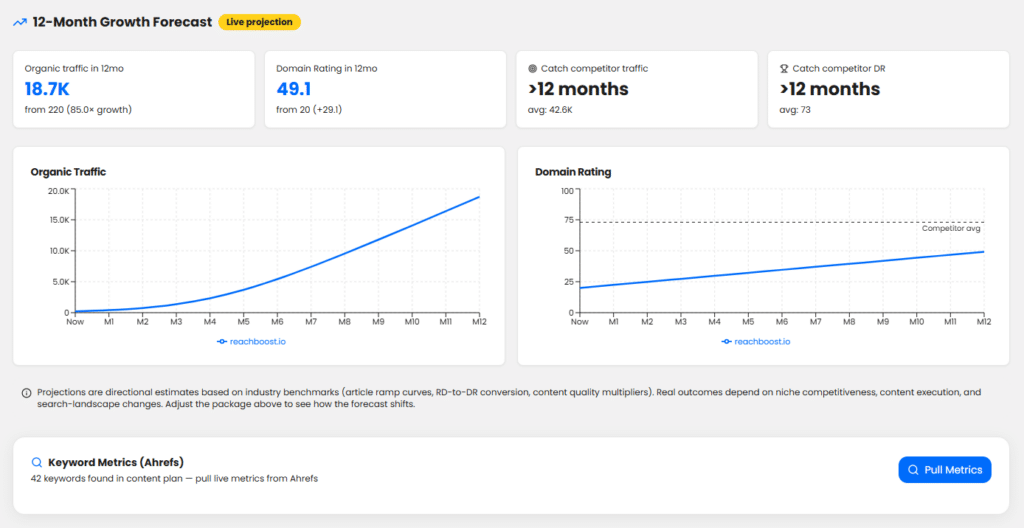
Growthner uses a free AI visibility assessment instead of making fixed forecasts. It analyzes 20 buyer prompts to identify competitor visibility, citation gaps, and initial opportunities, which then inform the recommended scope and priorities.
Quoleady runs a live competitor analysis during client calls using an internal strategy tool.
It analyzes competitor SEO performance, identifies content and link building gaps, and estimates monthly investment ranges and traffic potential. But Olga Mykhoparkina is upfront about the limits:
Forecast numbers are approximate. Even with strong data behind it, the system is still AI-assisted, and there are many factors we can’t fully predict or control.
We asked agency founders what they would recommend a newly launched SaaS focus on first when it comes to SEO and AI visibility. To make the answers more concrete, we used an LLM visibility tool as the example scenario.
While their approaches differed, several common ideas appeared consistently across the interviews: strong SEO foundations, authoritative content, third-party mentions, and building visibility on platforms AI systems already trust and cite.
Quoleady emphasized starting with website architecture and positioning before scaling content production. Their approach focuses heavily on internal linking, landing page structure, topical authority, and experience-based content designed to stand out from generic SEO articles. The agency also highlighted the growing importance of appearing in high-ranking listicles, SaaS review platforms, and websites already frequently cited by LLMs.
Growth Hackers shared a similar view around starting with SEO fundamentals. Jonathan Aufray mentioned focusing first on service pages, listicles, and long-term content foundations, while combining them with broader growth tactics such as funnels, advertising, and email marketing depending on the company’s goals.
Omniscient Digital approaches LLM visibility through a broader organic growth lens. Their strategy combines AI search optimization, digital PR, original research, and editorial content designed to answer questions about the product and category directly. The agency also places strong emphasis on earning mentions through media relationships, creator partnerships, and community visibility rather than relying purely on outreach campaigns.
Rank Wizards described a more tactical framework centered around three pillars:
Animalz focused more on content quality and strong positioning. Their team emphasized expert-led content, thought leadership, and building content systems where SEO, GEO, and AI workflows all work together rather than treating AI visibility as a completely separate channel.
Overall, the interviews showed that most agencies now see LLM visibility as part of broader authority-building. The recurring focus was on creating genuinely useful content, building a strong brand presence on trusted websites, and becoming authoritative enough for AI systems to mention and reference the company consistently.
Skale starts with the commercial target and works backward into what’s needed to hit it, usually fewer, better-matched clicks over volume. Measurement comes first, since AI-driven discovery often shows up as direct traffic, so attribution needs to be in place early. From there, execution favors evaluation-stage content and off-page presence, with citation-based mentions prioritized over link building when budget is tight.
For a newly launched SaaS company, Growthner would first identify the buyer prompts the brand wants to appear for, the competitors currently being recommended, and the sources cited in those answers.
The initial roadmap would prioritize the most important visibility gaps through targeted citation outreach, relevant comparison content, and community participation. This gives the company a clearer starting point than immediately committing to a large content calendar.
One of the most common questions founders ask is how long it realistically takes to see results from SEO and LLM visibility efforts. Across the interviews, most agencies gave fairly similar timelines, especially for newly launched SaaS companies starting without existing authority.
Several agencies estimated that meaningful traction usually starts appearing somewhere between 3–8 months, depending on the competitiveness of the market, the quality of execution, existing brand authority, and how aggressively the company invests in content and authority building.
Quoleady said they often start seeing early signals within the first three months, including LLM citations, ranking improvements, initial clicks, and sign-ups. More stable and compounding results typically take around 6–8 months for brands starting from scratch.
Growth Hackers gave a similar estimate, placing the timeline at roughly 5–8 months for SEO and GEO traction. Rank Wizards also emphasized that clients should generally expect at least a six-month commitment before evaluating meaningful results.
Omniscient Digital framed the timeline more around momentum and market positioning than fixed dates. Alex Birkett explained that leading indicators can appear relatively early, while stronger long-term advantages take much longer to build:
You’ll see meaningful leading indicators in the first weeks to months, but ‘pop champagne, write a case study’ moats take longer.
Animalz approached the question from another angle, noting that timelines depend heavily on how a company defines “meaningful results” in the first place. For some teams, that may mean initial traffic growth or AI citations, while others may only consider pipeline growth or market authority as real success.
Skale separates early signals from business results rather than giving one timeline. Visibility can shift within the first weeks, since third-party mentions move faster than content ranking. Compounding gains typically build over the following months, with pipeline impact lagging further behind.
Overall, the interviews showed that most agencies now see SEO and LLM visibility as long-term authority building rather than quick growth hacks. You may start seeing early results fairly quickly, but building strong visibility in Google and AI systems still takes time and consistent work.
Growthner separates early visibility signals from longer-term SEO results. Mentions and citations may begin appearing for less competitive prompts before meaningful ranking changes occur.
More established visibility usually requires three to six months, particularly when the strategy depends on building third-party mentions, community presence, and authority across multiple sources.
Tracking LLM visibility is still highly fragmented, and agencies approach it very differently depending on what they believe actually matters most.
Some focus heavily on visibility monitoring itself, while others combine AI visibility data with attribution, authority signals, and business outcomes.
Growth Hackers said they primarily rely on Google Analytics to monitor traffic and visibility trends connected to AI platforms and organic discovery.
Rank Wizards use Promptwatch to monitor AI visibility and brand presence across LLM-generated answers.
Animalz mentioned using platforms such as AirOps and Profound as part of their AI visibility and workflow systems.
Quoleady approaches tracking through a combination of AI visibility monitoring, citation analysis, and competitor benchmarking. The agency tracks how brands appear across high-intent prompts tied to lead generation and compares visibility against direct competitors across ChatGPT, Claude, Gemini, and Perplexity.
Their platform, Allmond.app, helps identify which websites, listicles, and third-party sources are most frequently cited in AI-generated answers for high-intent prompts. The broader goal is not just to monitor mentions, but to understand which authority signals actually correlate with visibility and conversions over time.
Omniscient Digital described measurement through an attribution framework. Their view is that AI search makes attribution less direct, but still measurable when looking at multiple layers together.
The agency separates tracking into three categories:
Skale consolidates AI visibility and organic performance into custom client dashboards pulling GA4, GSC, Otterly, and CRM data, tracking which prompts surface AI answers and whether the brand is cited.
Dashboards report against pipeline, not rankings, with an attribution mix blending AI referrals, branded search, direct traffic, and self-reported data where in place, since much of today’s organic impact can’t be captured by clicks alone.
Across the interviews, agencies consistently emphasized that LLM visibility should not be measured purely through rankings or mentions alone. Most now combine visibility tracking, citation analysis, referral traffic, brand authority, and business outcomes to evaluate whether their strategies are actually influencing discovery and conversions.
Growthner monitors visibility at the prompt level across ChatGPT, Claude, Gemini, and Perplexity.
The team tracks whether the client is mentioned, which competitors appear instead, and which external domains are cited in those answers. These citation gaps help determine where off-site outreach and authority-building efforts should be focused.
We also asked agencies how they approach content creation, backlinks, and authority building for SEO and LLM visibility campaigns.
Another area we wanted to understand was how agencies handle highly technical or expert-driven industries where generic SEO writing usually falls apart. We asked how they create content for niches that require deep product knowledge, industry expertise, or subject matter specialists.
The answers revealed very different operational models. Some agencies rely heavily on in-house strategists and SMEs, while others build dedicated editorial and outreach teams around each client engagement.
We gave every agency the same scenario: a newly launched LLM visibility tool approaches you with a $5,000/month budget. We asked where they would focus first, what kind of content they would prioritize, and how they would approach SEO and AI visibility growth realistically at that stage.
While the strategies differed quite a bit, several themes appeared consistently across the interviews: strong SEO foundations, strategic positioning, authoritative content, third-party mentions, and building visibility on websites AI systems already trust and cite.
Quoleady said they would begin with deep competitor and positioning research to understand how the product differs from other tools in the market. Their strategy would focus on strategic landing pages targeting different ICPs and use cases, experience-based comparison content, expert-driven insights, original research, and authority-building across trusted industry sources.
The agency also emphasized the importance of appearing in high-ranking listicles, SaaS review platforms, and websites already frequently cited by AI systems.
One thing we’re seeing in 2026 is that genuinely useful, experience-based content performs significantly better than mass-produced SEO articles — both in Google and AI-generated answers.
Quoleady also highlighted the importance of consistent brand positioning across websites, review platforms, and third-party mentions to strengthen SEO and AI visibility signals over time.
Growth Hackers shared a broader growth marketing approach combining SEO foundations with paid acquisition and funnel optimization.
Their recommendation included service pages, listicles, email marketing, landing pages, and around 8 monthly website content pieces alongside roughly 20 monthly social assets across LinkedIn, Meta, X, and Telegram.
For startups seeking faster traction, the agency said they would lean more heavily into Google, LinkedIn, and Meta advertising before scaling longer-term SEO and GEO efforts.
Omniscient Digital took a different position from most agencies in the interviews. Alex Birkett explained that they typically do not work with newly launched startups or companies operating at a $5K/month level yet.
Instead, the agency emphasized the importance of first developing a strong GTM differentiator and clear market positioning before investing heavily into SEO or AI visibility programs.
Their broader approach to organic growth combines SEO, AI search, editorial content, digital PR, original research, creator partnerships, and community visibility as part of a long-term growth strategy.
Rank Wizards focused heavily on fast category ownership during the first months of growth.
Their framework centered around:
For a $5K/month startup budget, the agency proposed identifying 80–100 high-intent keywords across informational, comparison, and bottom-funnel searches, combined with 10–12 SME-written content pieces per month, authority backlinks, and technical SEO improvements.
The LLM visibility niche is brand new, which means low competition and a massive first-mover advantage for whoever publishes the right content first.
Animalz emphasized content quality, thought leadership, and strategic positioning throughout the interview. Their team highlighted expert-led content, deep research, executive thought leadership, and integrated SEO, AEO, GEO, and AI workflows as part of broader organic growth programs.
Like Omniscient Digital, Animalz also operates at a more premium engagement level, with minimum retainers starting around $10K/month.
Overall, the interviews showed that most agencies now see SEO and LLM visibility as long-term authority building rather than quick growth hacks. The recurring focus was on creating genuinely useful content, building a strong brand presence on trusted websites, and becoming authoritative enough for AI systems to consistently mention and reference the company.
Skale doesn’t run a fixed playbook at $5K. That budget covers off-page only (link building and AI brand mentions), since it’s around their minimum for that scope. Full GEO + SEO management costs more.
Instead of a set deliverable list, they assess where the brand’s SEO and AI visibility currently stand, and whether the on-page foundation supports off-page work, then build recommendations backward from the client’s goals.
With a $5K monthly budget, Growthner would begin with a prompt audit across ChatGPT, Claude, Gemini, and Perplexity to identify priority buyer questions, competitor visibility, and frequently cited third-party sources.
Based on those findings, the budget would be allocated across comparison content, citation outreach to relevant listicles and review platforms, and community visibility on Reddit and other buyer-focused forums. For a new SaaS brand, the agency would prioritize the most important on-site gaps while beginning longer-term work on third-party mentions and citations.
Most agencies said link building and brand mentions are included in their retainers, though some price them separately depending on campaign scope and goals.
Quoleady focuses heavily on authority-building across sources frequently cited by both search engines and AI systems. Their strategy includes placements in top-ranking listicles, industry publications, SaaS review platforms, guest posts, digital PR campaigns, and editorial mentions across high-authority websites.
Growth Hackers primarily use guest blogging and competitor backlink analysis to identify outreach opportunities and secure relevant backlinks.
Omniscient Digital combines several authority-building methods, including Surround Sound SEO, media outreach, original research, syndication, creator partnerships, and community visibility across platforms such as Reddit.
Rank Wizards rely mainly on outreach-driven backlink acquisition and brand mentions through email outreach campaigns, authority publications, and SaaS-focused placements.
Animalz said backlink and mention-building can be included as part of broader organic growth retainers, though they did not go deeply into specific acquisition methods.
Across the interviews, agencies approached link building very differently. Some focused more heavily on digital PR and authority signals, while others leaned toward outreach, editorial placements, or community visibility. But one theme appeared consistently: agencies increasingly view brand mentions, listicle placements, reviews, and third-party visibility as important not only for SEO, but also for influencing how AI systems discover and reference brands.
At $5K/month, Skale would scope off-page work only, not full organic management. Their position: when budget is limited, AI brand mentions are the higher-leverage starting point, since they move AI visibility faster than link building compounds.
Before scoping, they’d check whether the on-page foundation can actually support off-page work, since placements and links underperform on a site that isn’t legible to search and AI crawlers. If the foundation isn’t there yet, their view is the budget is better spent fixing it first.
Growthner distinguishes traditional link building from AI citation outreach and community visibility.
Link building focuses on authority and organic search performance, while citation outreach targets sources that influence AI-generated answers. Reddit and community placements are handled separately because they require a more conversational, platform-specific approach.
This is one of the questions clients ask us often. What happens when the niche is highly technical or expert-heavy? How do agencies handle content creation when generic writers won’t cut it? So we asked the founders how they handle it.
If Quoleady doesn’t have someone in-house with the right expertise, the agency either interviews the client directly to extract insights and experience or brings in a writer with deeper industry expertise for that specific topic.
Growth Hackers take a similar approach. In the first few weeks of a new collaboration, they do a deep dive on the industry, regulations, and specificities, create a few content pieces to test the fit, and gradually become more independent as they build context.
Rank Wizards does all content creation with subject matter experts, led by their SEO and content specialists, to ensure both quality and search performance.
Omniscient Digital sees this as one of its strengths. They rely on in-house experts who either grant interview access or produce content directly.
We have experience in many niches. We study hard to build context, hire for this skill, and work hard to use SMEs to make our content expert and genuinely additive.
Animalz believes great content starts with understanding the industry. CEO Ty Magnin explains that the team spends significant time building context, hires people who can learn complex topics quickly, and works closely with subject matter experts to ensure the content is both credible and useful.
Skale treats the client’s own experts as the primary source rather than a fallback. Content in technical categories is built from interviews with client SMEs and product teams, plus proprietary data only the client holds, which is what makes it hard for competitors to replicate. Skale’s in-house team brings category context and handles research, structure, and QA.
For technical industries, Growthner relies on client expertise rather than research alone. The team interviews founders, product specialists, and other subject-matter experts to capture original insights before structuring the material for search engines and AI systems.
AI is everywhere in content creation right now. We asked the founders how much of their process actually involves it, and where they draw the line.
Quoleady described AI primarily as a support tool rather than the creator itself.
The most important part still comes from humans: original insights, unique experience, industry knowledge, product analysis, expert opinions, and research that hasn’t already been repeated on hundreds of websites.
The agency also mentioned using internal content frameworks built around expert insights, original research, firsthand product testing, and experience-based content rather than mass-produced SEO articles.
Growth Hackers are more integrated: around 30% of their content creation is AI-assisted, spanning writing, graphic design, and video editing.
Rank Wizards currently handle content fully by hand, but are actively developing a fully automated content generation process. If it works well internally, they plan to offer it to clients who are open to it.
Skale takes a human-led approach, using AI where it speeds up research, analysis, and internal process, and keeping it out of the parts of the work that earn trust. Strategy, SME insight, original data, and the judgment about what’s worth publishing stay with people.
Growthner uses AI to support research, analysis, and content development, while keeping strategy and final editorial decisions human-led.
The agency’s view is that AI can improve efficiency, but strong positioning and credible technical content still require direct input from people who understand the product and market.
We asked every agency the same question: What makes you different from everyone else? Here’s what they said.
Quoleady emphasized business impact over traffic growth alone, focusing more heavily on sign-ups, pipeline, and revenue rather than pure traffic numbers. The agency also highlighted experience-based, strategic, and research-driven content, alongside continuous testing around SEO, AI visibility, listicles, and content distribution instead of relying on outdated playbooks.
Communication and collaboration were another recurring focus.
Quoleady also emphasized a hands-on working style, where clients have direct access to strategists, execution teams, and the founder throughout the engagement.
Rank Wizards put it this way: most agencies assign you a project manager who reads your brief once and hands it off to generic writers. At Rank Wizards, every client gets a dedicated account manager, content written by subject matter experts, and strategy led by an SEO and content specialist, with every operation personally overseen by founder Saleh Ahmed, who is a SaaS founder himself.
I understand CAC, churn, MRR, and what growth actually means for a SaaS business, not just traffic numbers. That founder perspective shapes every content and SEO decision we make.
Omniscient Digital points to their organic flywheel: a blend of SEO, editorial and design, off-page, and CRO, all tied together with revenue obsession and deep strategic pattern recognition.
We practice what we preach — if you check our blog, social media, or newsletter, you can see how active we are.
Growth Hackers also emphasize a client-first approach, starting every new relationship with a comprehensive audit of the client’s business.
Animalz keep it short: quality.
Skale runs SEO and AI Search as one growth engine, not separate workstreams, on the logic that what makes a site rank is also what earns AI citations. They build attribution before execution, and report against pipeline rather than rankings or citations.
Growthner’s main differentiator is its focus on off-site AI visibility.
Instead of treating citation outreach, brand mentions, and Reddit marketing as minor additions to an SEO campaign, the agency manages them as distinct service areas. Every engagement begins with prompt-level research, so the proposed scope is based on observed visibility gaps rather than a fixed package.
The right agency depends heavily on your stage, budget, growth goals, and the type of support you actually need.
Some agencies focus heavily on enterprise SEO and revenue attribution. Others lean more toward AI visibility, editorial quality, paid acquisition, or fast startup execution.
Here’s where each agency appears strongest based on the interviews.
Omniscient Digital stands out most clearly for enterprise and larger B2B organizations.
Their interview emphasized:
This type of setup fits companies that already have internal marketing teams and need a sophisticated long-term growth partner rather than just content production.
Growth Hackers and Rank Wizards appear more accessible for earlier-stage SaaS companies from both pricing and execution perspectives.
Growth Hackers combine SEO with paid acquisition, funnels, email marketing, and social media content, making them a stronger fit for startups that want both short-term traction and long-term organic growth.
Rank Wizards lean more heavily into aggressive SEO execution, SME-written content, and category ownership strategies designed to help newer SaaS companies compete quickly in emerging niches.
Growthner may suit early-stage SaaS companies in categories where buyers actively compare products on Reddit and other community platforms.
Its prompt-first process helps new brands understand which competitors and third-party sources currently influence their category before committing resources to content and outreach.
Quoleady, Growth Hackers, and Skale all appear well-positioned for SaaS companies that already have some traction but are trying to scale visibility, pipeline, and authority more aggressively.
Quoleady seems particularly strong for mid-sized B2B SaaS companies looking for a more strategic SEO and AI visibility partner without moving into enterprise-level agency pricing. Their interview repeatedly emphasized authority-building, AI visibility, strategic positioning, and conversion-focused content rather than traffic growth alone.
Growth Hackers may be a stronger fit for scaling startups that want broader growth support beyond SEO itself. Their approach combines content, SEO, GEO, paid acquisition, funnels, social content, and email marketing under one workflow, which can work well for companies trying to grow across multiple acquisition channels simultaneously.
Skale is a strong option for growing SaaS and tech companies that want to tie organic growth more directly to pipeline and revenue. Their services bring together SEO, GEO, content, link building, and AI brand visibility, with a focus on the opportunities most likely to drive business growth.
Several agencies in the interviews now offer GEO and AI visibility services, but they approach the category very differently.
Quoleady appeared among the most specialized around AI visibility specifically. Their workflow focuses heavily on AI search visibility, citation analysis, competitor benchmarking, authority-building, and understanding how brands appear across ChatGPT, Claude, Gemini, and Perplexity.
The agency also built its own AI visibility tracking platform, Allmond.app, which is used to monitor prompt visibility, citations, competitor presence, and authority signals across major AI platforms. This suggests a deeper operational focus on GEO and AI visibility rather than simply adding it as another SEO service line.
Omniscient Digital approaches GEO more as part of a broader organic growth and digital PR system tied to revenue and brand authority. Animalz position AI visibility inside larger SEO/AEO/GEO content workflows, while Rank Wizards focus more aggressively on LLM SEO execution and category ownership strategies.
Skale treats AI search as a first-class channel rather than an add-on to SEO. Its targeting is based on the sources AI engines actually cite, with domain rating excluded and targets reviewed monthly as citations shift. An attribution layer then combines software and self-reported data to connect AI visibility with pipeline.
Across the interviews, one thing became clear: most agencies no longer treat GEO as a completely separate discipline from SEO. Instead, they increasingly see AI visibility as an extension of authority-building, strategic positioning, high-quality content, and third-party brand signals.
Growthner approaches GEO primarily from an off-site visibility perspective. Its work focuses on earning relevant third-party citations, brand mentions, and community visibility rather than relying only on changes to the client’s own website.
Animalz and Quoleady both stand out strongly for companies prioritizing high-quality, differentiated content rather than large-scale SEO publishing.
Animalz position themselves around strategic editorial systems, executive thought leadership, deep research, and integrated SEO/AEO/GEO workflows designed for long-term organic brand growth.
Quoleady emphasized experience-based content, expert-driven insights, original research, firsthand product testing, and category-defining industry studies designed to generate both SEO visibility and AI citations. The agency repeatedly stressed that depth, originality, and genuinely useful insights outperform mass-produced SEO content in both Google and AI-generated answers.
Compared to some larger enterprise-focused agencies, Quoleady also appears more accessible for growing SaaS companies that want strategic, research-driven content without committing to enterprise-level retainers from day one.
Both agencies appear more focused on content quality, authority, and differentiation than on high-volume publishing models.
Growth Hackers stand out most clearly for companies looking for a broader growth marketing approach beyond SEO alone.
Unlike some of the more SEO-focused agencies, their model combines:
That makes them more suitable for startups that want faster acquisition channels running alongside long-term organic visibility.
Minimum retainers range from $1,500 to $10,000+ per month, depending on the agency size and scope of work. Larger, more established agencies tend to start at $10,000/month, while smaller or execution-focused agencies can start lower. Most proposals are customized rather than based on fixed packages.
First signals like improved rankings, LLM citations, and early clicks can show up within the first three months. Meaningful and stable results typically take 6–8 months when starting from scratch. If you already have an established brand and existing content, the timeline is usually faster.
Most agencies now include some form of GEO or LLM visibility in their offering, but the depth varies significantly. Some have built dedicated tools and methodology around it, while others treat it as an extension of their existing SEO work. Always ask specifically how they track and improve your brand’s presence in AI-generated answers.
Jelena Ilic
Senior content writer and analyst
Read also


I don’t know about you, but these days, every time I need to find a product or service, I go to Cl

Olga Mykhoparkina
Oct 01, 2026
A SaaS company can rank well in Google and still be absent when a buyer asks ChatGPT for the best pr
Olga Mykhoparkina
Oct 01, 2026
You already have the numbers. HubSpot, GA4, your CRM and Stripe are throwing dashboards at you every
Olga Mykhoparkina
Oct 01, 2026 Let us know what you are looking to accomplish.
We’ll give you a clear direction of how to get there.
All consultations are free 🔥