Olga Mykhoparkina
Founder, CEO

Olga Mykhoparkina
May 19, 2026You’ve published solid blog content. Done guest posts. Maybe landed a few directory links. And yet rankings barely move, traffic stays flat, and competitors keep showing up above you for high-intent keywords that drive sign ups.
If that sounds familiar, there’s a good chance you’re still doing link building based on advice that worked a few years ago.
Google has gotten much better at ignoring manipulative links and rewarding editorial mentions. At the same time, more buyers are finding software through LLMs.
So if your brand isn’t mentioned in the articles and listicles AI tools pull recommendations from, you’re missing potential customers.
This guide is based on what we’ve seen building links for 100+ B2B SaaS companies. What’s still working. What SaaS brands should probably stop spending budget on. And why listicle placements became one of the strongest channels for both SEO and AI visibility in 2026.
For the B2B SaaS industry, link building rules are a bit different.
Most of the links you’ll ever earn will point to your blog content. Nobody writes a roundup about project management tools and thinks “I should link to this company’s features page.”
Editorial links go to content that helps their readers, which is almost always an article. That’s why your content strategy and your link building strategy are inseparable. The logic is: more links to your content → higher rankings → more traffic to pages with a path to conversion → more sign-ups.
You’re also operating in a technically niche space. Fewer websites naturally write about your category. That shrinks the pool of relevant domains you can realistically target. And the ones worth targeting are being pitched by your competitors too.
Then there’s the authority baseline problem. If you’re under DR 30, some of the better link opportunities won’t take you seriously yet. Getting those early links feels like needing experience to get a job, but needing a job to get experience.
None of this is a dealbreaker but it does mean you need to be strategic. Spraying guest post outreach at hundreds of websites and hoping something sticks is low ROI and rarely leads to strong placements.
Before running any outreach, it’s worth getting clear on what you’re actually looking for. A lot of founders still optimize purely for Domain Rating (DR) or Domain Authority (DA). Those metrics are useful reference points, but they’re not the whole picture.
Here’s how we evaluate every link opportunity at Quoleady.
A DR 40 blog written for SaaS founders or B2B marketers is often more valuable than a DR 70 lifestyle site.Think about a LinkedIn automation tool. A link from a blog about outbound, lead generation, or LinkedIn growth fits naturally. A mention on a general lifestyle site feels out of place, even with higher DR.
Google evaluates the context around a link along with the domain it comes from. When we build links for clients, we focus on sites covering related topics so the links align with the content.
A site can have strong DR and almost no readers. Always check the traffic graph in Ahrefs or Semrush before pursuing a placement. You want sites with consistent, gradual growth, not sudden spikes or drops, which often signal a past penalty.
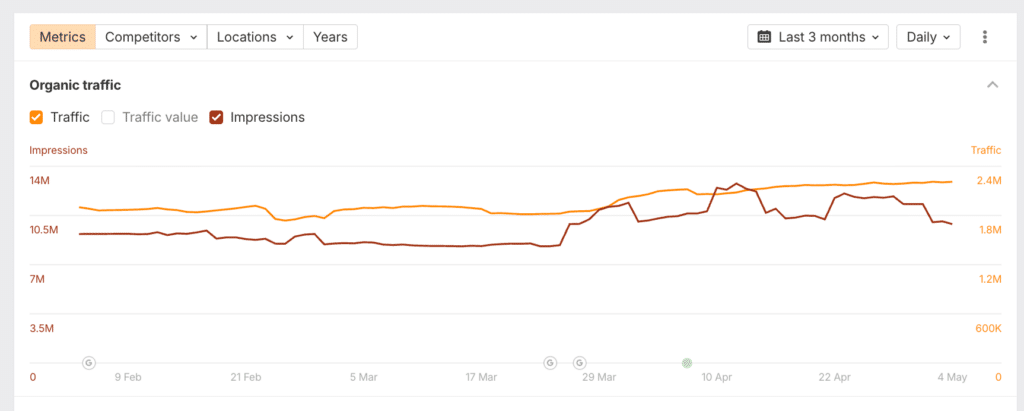
Example of a domain with strong, consistent traffic where a backlink would be valuable
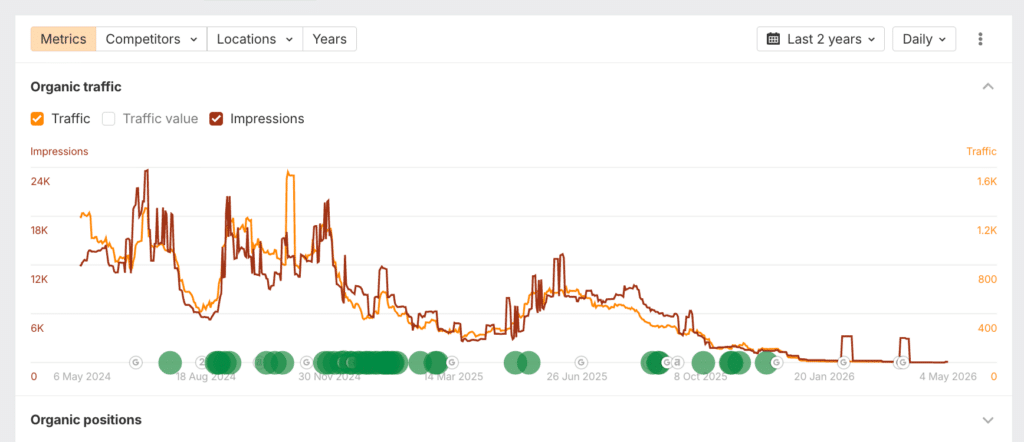
Example of a domain with unstable, declining traffic, not worth building a link on
A link embedded inside a relevant paragraph in the body of an article carries real weight. A link stuck in a footer, a sidebar, or an author bio contributes almost nothing. Aim for in-content, contextual placements every time. Also, a link in the beginning of the article is more valuable than a link at the end/middle.
Use natural anchor text. Most strong backlink profiles include a mix of branded anchors, URL anchors, topical anchors, and occasional keyword-rich anchors.
For SaaS companies, branded anchors usually make up a large share of the profile because people naturally link using the company name, product name, or URL.
Keyword-rich anchors can help, but they should be used carefully. If too many links use the same exact-match keyword, the backlink profile starts to look manufactured.
Instead of aiming for fixed percentages, compare your anchor text mix against competitors ranking for the same keywords. If your profile has a much higher share of exact-match anchors than theirs, it’s a warning sign.
At Quoleady, we prioritize fewer, higher-quality domains over volume. We adjust anchor strategy based on the existing profile – if there’s already a solid base of branded and neutral anchors, we can safely add more keyword-focused anchors.
You should absolutely avoid content farms with no clear niche. These are the sites that appear to be link repositories (every other word is an outbound link, what we call “link cemeteries”). Additionally, avoid any domain that shows or links to adult content, casino, or gambling links in its outbound profile. Getting a link there puts you in that same company.
I’m personally not a big fan of websites that show ads left and right. You’ll find plenty of those on news magazines (including Forbes, by the way). I’ve been quite skeptical about news magazines overall and didn’t really value links from them, but 2026 changed that a bit. After seeing some of these publications show up in LLM results, I realized it’s something to evaluate on a case-by-case basis.
These are the six strategies we use most consistently for our B2B SaaS clients. None of them are shortcuts. All of them compound over time.
One link building strategy that still works incredibly well for SaaS is creating original research or genuinely useful educational resources.
Ahrefs is probably one of the best examples of this.
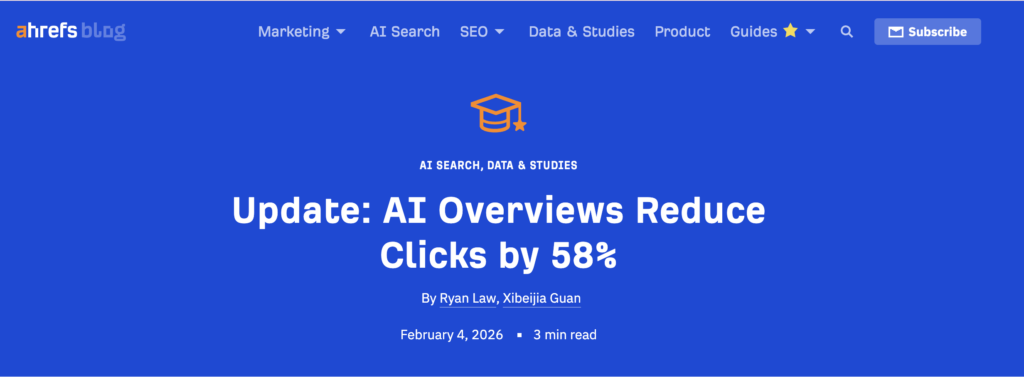
Their research studies regularly attract hundreds or thousands of backlinks because people naturally reference data in articles, presentations, LinkedIn posts, newsletters, and podcasts. Their AI Overviews study alone picked up around 1.2K backlinks.
The same thing happened with Ahrefs Academy. It became a widely referenced educational resource and accumulated more than 8K backlinks over time.
SurferSEO did something similar with Surfer Academy, which now has around 3K backlinks.
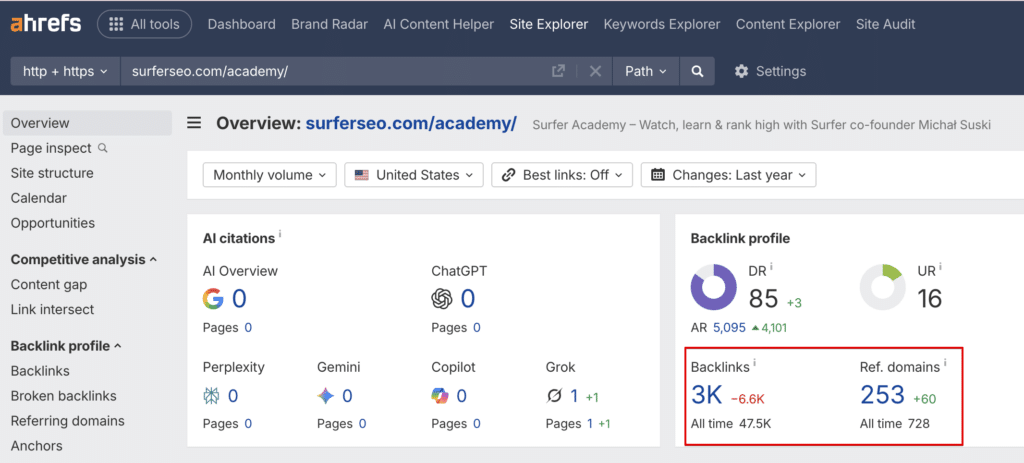
What’s interesting is that these links usually don’t come from outreach alone. The initial distribution matters, of course, but once something becomes useful inside an industry, people keep linking to it naturally for years.
I think many SaaS companies underestimate how strong this compounding effect can become. One well-executed research report or educational hub can attract more high-quality backlinks than dozens of guest posts.
For years, SaaS companies treated guest posting like a volume game. Find websites with decent DR ->
send 500 outreach emails -> publish whatever gets accepted.
The problem is that many of those links never influenced buying decisions in the first place.
Some of the best-performing guest posts we’ve done for SaaS companies were on niche industry blogs where the audience was relevant.
A workflow automation company getting featured on a blog read by operations managers is often far more valuable than getting a DR80 link from a broad marketing site nobody in that niche actually reads.
I also think founders underestimate how much editorial fit matters now.
Editors have become much pickier. AI-generated guest posts completely flooded inboxes over the last two years and many publications became exhausted with generic “10 tips for productivity” type pitches.
What still works is bringing something specific:
The outreach itself matters less than people think. What matters much more is angle.
If the topic immediately feels useful for their readers, conversations become much easier.
At Quoleady, we usually spend more time researching publications and angles than writing the actual outreach email. You can feel pretty quickly when an editor sees your pitch as just another SaaS company asking for a backlink versus something they’d want to publish for their audience.
Direct link swaps like “I’ll link to you if you link to me” are listed by Google as link schemes, especially when done at scale or without relevance. In practice, they still happen, but relying on them too heavily can make your backlink profile look unnatural.
The ABC link exchange idea is very simple. Your site (A) links to site B, site B links to site C, and site C links back to you. There’s no obvious back-and-forth, so it comes across as more natural, and when the sites are relevant and actually send traffic, it is natural.
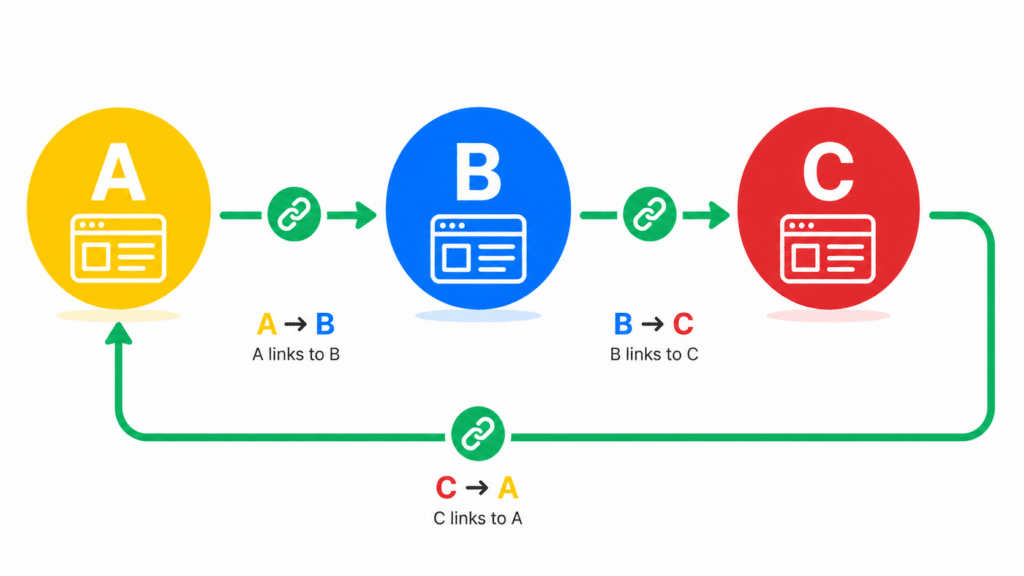
This strategy works particularly well for SaaS companies that have a blog but don’t want to partner with direct competitors. You find non-competing SaaS companies, agree on the exchange, and everyone gets a relevant, in-content link. As an agency, we get it done faster as we already have assets we own where we can get backlinks returned to our partners when they link to our clients. You can absolutely work on this on your own but if you want to scale your link building – you’ll either need an agency or an in-house team for that.
We’ve used similar approach to help one of our clients, RingBlaze. When we started working together, they had a DA of 8 and almost no backlinks. Using a combination of smart A-B-C exchanges, partnerships, and manual outreach, we published 50 guest posts and built 35 backlinks to target pages.
As a result, we grew their DA from 8 to 30 in five months. Blog traffic went from zero to 50K visits and the content generated over 650 leads. At one point, their founder Dennis reached out asking us to slow down because they couldn’t handle the volume of inbound. That’s the compounding effect of a clean, consistent link building approach done over time.
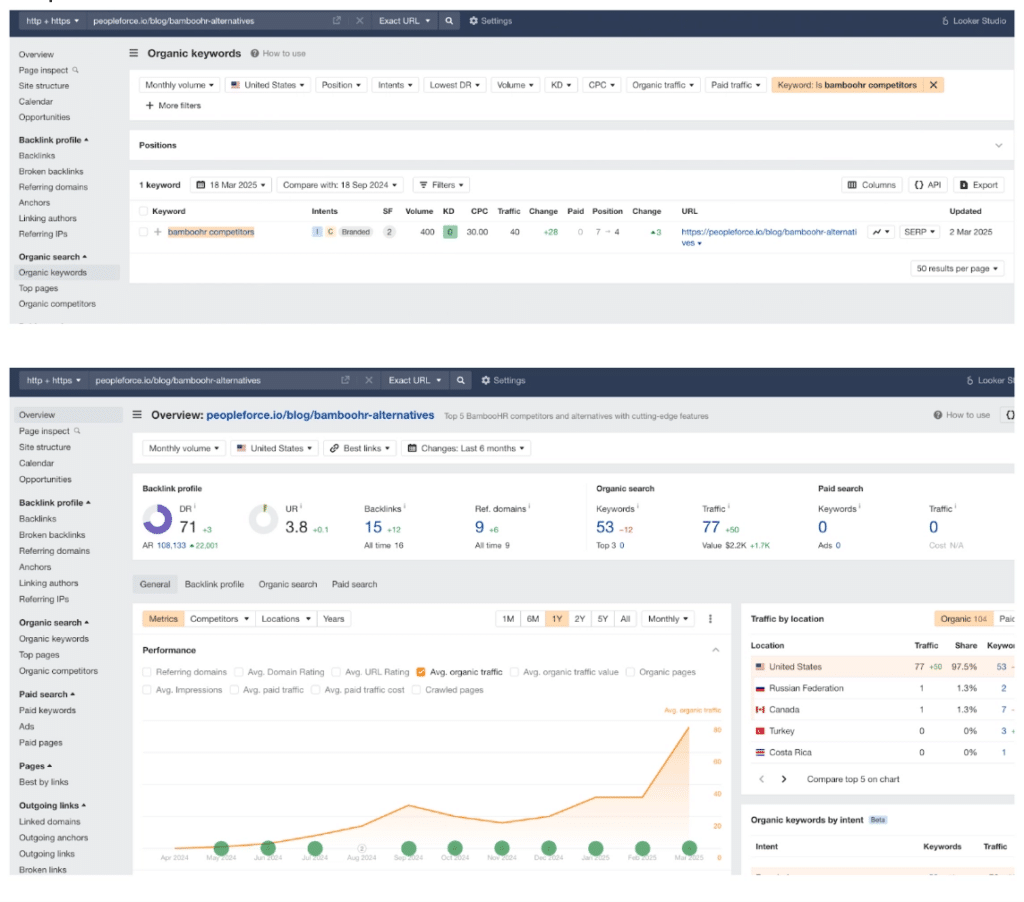
Another cool example is Peopleforce. We got them from position 7 in Google to position 4 for one of their biggest lead gen keywords with 6 powerful backlinks.
One thing you should remember is to stick to just three sites. Once you go beyond that, things get messy with more coordination, more chances for someone to drop off, and the whole setup can fall apart.
“Best [category] tools“, “Top [X] alternatives to [competitor]”, “The [Y] best software for [use case]” – all these pages rank for some of the most high-intent keywords in any SaaS niche. The people reading them are actively comparing options before making a purchasing decision. Getting your product featured in them earns you a backlink and puts you in front of buyers at exactly the right moment.
This has always been valuable for SEO. But in 2026, listicle placements have taken on a second job that makes them even more important.
We ran a study analyzing over 10,000 citations across ChatGPT, Claude, Perplexity, and Gemini. We tested hundreds of high-intent SaaS prompts to understand where LLMs actually pull their information from. Across every model, listicles were the main citation source. Claude relies on them for over 70% of its citations. Even Gemini – the least listicle-dependent model in our study – still pulls 40% of its citations from listicle-style content. When someone asks ChatGPT “what’s the best CRM for a 50-person B2B team?”, the answer it gives mostly depends on which brands show up in the listicles it trusts.
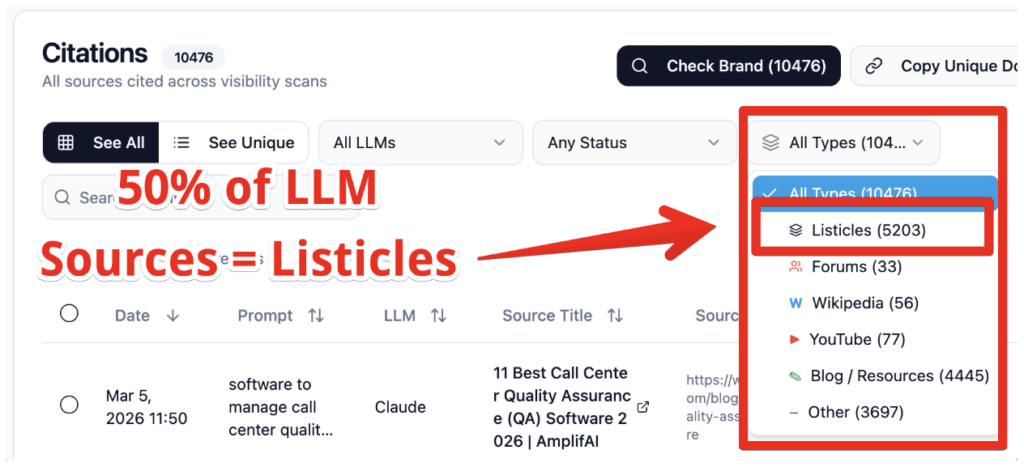
Getting featured in a well-ranking listicle in your category is your most direct path to appearing in AI-generated answers.
The execution challenge is the tricky bit. Finding the right listicles (the ones that rank and have traffic), vetting them for quality, finding contacts of the right people, writing a pitch that gets an editor’s attention, and following up without being pushy is a full process.
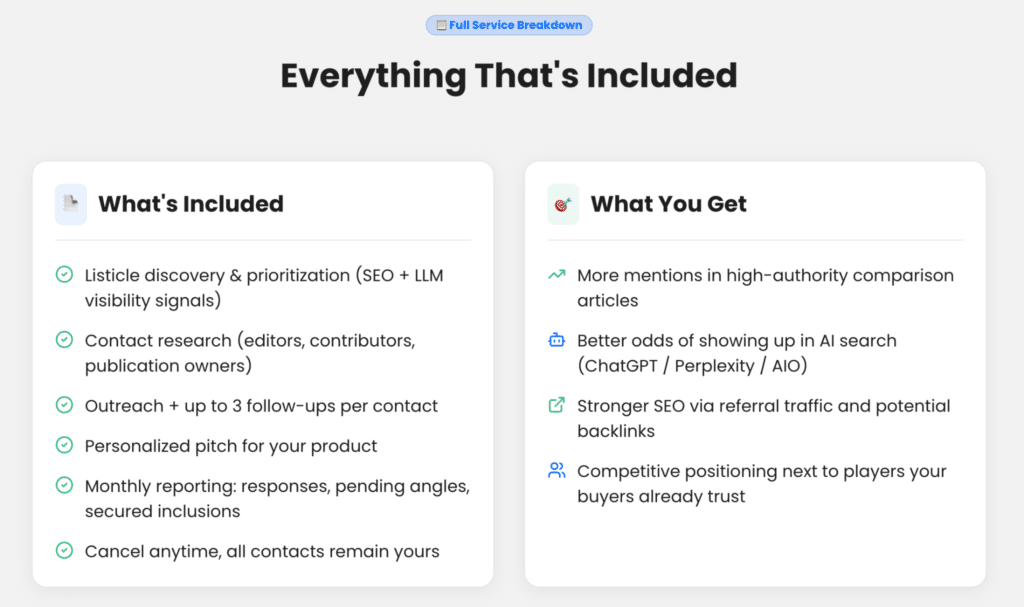
That’s exactly what our Listicle Outreach Service is built for. We find 30+ high-impact listicles per month that are relevant to your product category, and pitch editors on your behalf. It’s done-for-you, so you can focus on your product while your brand gets placed in the lists your buyers are reading. To give you an example, just last week we’ve received a positive reply from Monday.com for our cilent when asked to get featured in their roundup.
If you want to track and manage your listicle presence yourself – knowing which listicles mention you, which mention your competitors but not you, and which are worth pursuing next – you can use our tool ListicleManager.com. It replaces the spreadsheet most teams end up using to track placements, and gives you a clear, prioritized view of your listicle gap and opportunity.
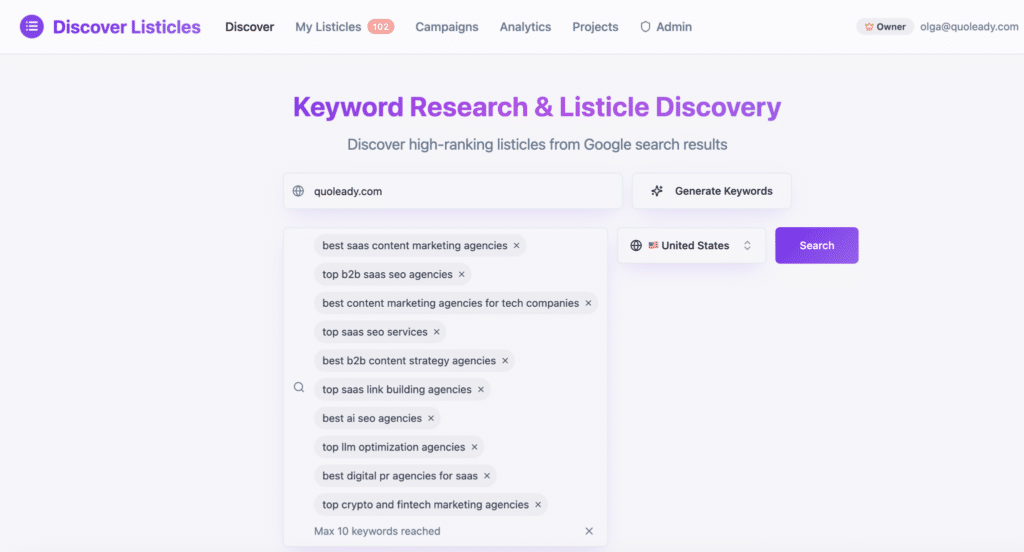
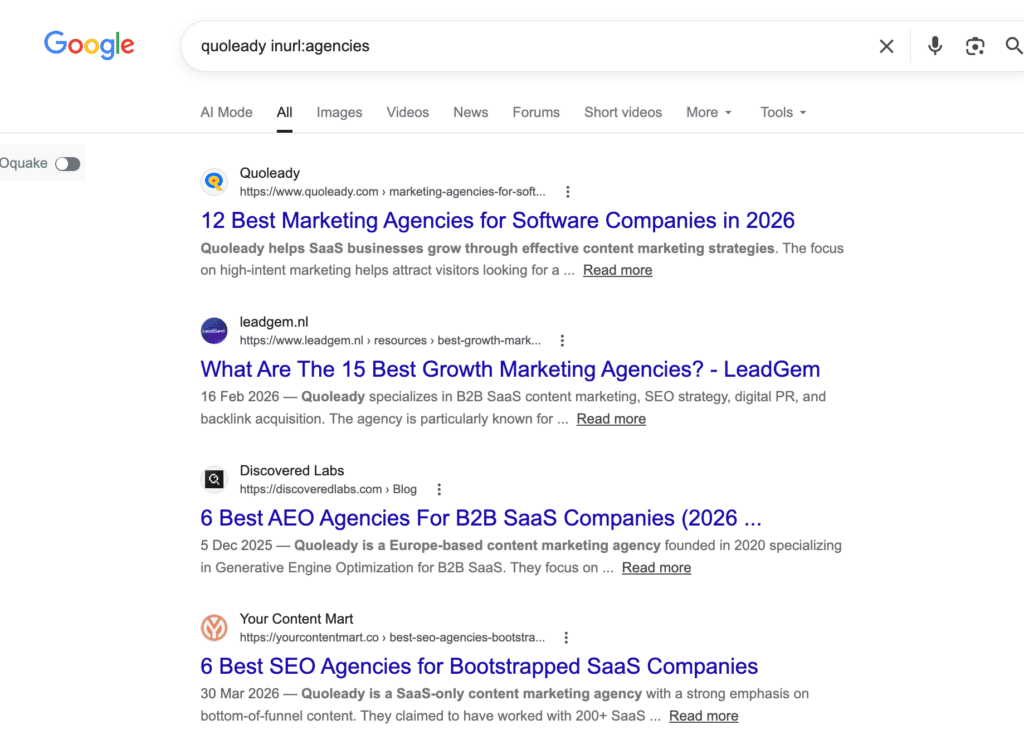
For example, most of our recent leads came from AI answers after we’ve spent months outreaching listicles on “Growth Marketing, SEO, AEO, GEO, content marketing and link building agencies”.
Works just as well for SaaS businesses – you get the top ranking listicles for your business keywords (example: proposal management software, LinkedIn automation tools, AI ad generation tools, etc.) and reach out to see what it takes to get your SaaS featured. Most likely you’ll need a listicle on your blog to return the favor.
Check out my LinkedIn post where I cover the entire process from A to Z in-depth.
Lots of listicle placements happen through exchanges with top ranking competitors. Basically, you feature your competitor in your listicle while competitor features you. Clients often ask whether this could be seen as an A-B exchange and hurt rankings overall.
In practice, no.
If you look at almost any “best CRM software”, “best SEO tools”, or “best project management software” article ranking in Google top 10, you’ll notice the same pattern: many of those companies mention each other across comparison pages, alternatives pages, integrations, directories, roundups, and industry resources.
That’s how SaaS ecosystems naturally work.
The problem starts when exchanges become obviously manipulative, irrelevant, or purely created for SEO with no real user value. But being featured alongside other legitimate tools in your category is completely normal and happens across the entire industry.
When a piece of research gets picked up by a few industry publications, it usually turns into several placements on sites with authority and traffic.
For SaaS, this is more accessible than it sounds. You’re already sitting on valuable data (usage patterns, benchmarks, customer insights) and when you package it around a question your industry is asking, it becomes something publications are willing to cover.
Funding rounds are one of the easiest PR opportunities for SaaS. When airfocus asked us to cover their series A, we reached out to platforms that regularly cover those announcements and landed placements on Crunchbase and TechCrunch.
With Expandi, we focused on getting Stefan, the founder and CEO at Exandi, featured on Forbes and Entrepreneur. These placements don’t come with dofollow links, but the mention itself still carries weight for AI visibility.
We also publish press releases for clients on sites like Fortune, Reuters, and The Next Web. A mention and link on these platforms often get picked up and republished by other outlets, so one placement turns into many more.
In 2026, as more attention shifts to AI visibility, SaaS founders are trying to figure out how to show up in those answers, and digital PR helps you get there while also building a brand people talk about.
Clients also often ask what drives better ROI: one big feature or multiple smaller placements? In most SaaS cases, listicles and comparison pages come first, since they directly influence both search results and AI answers. Press releases and larger publications usually come next, once you want broader visibility. In some niches, like blockchain, a feature on a major platform can carry more weight, so it depends on where (and how) your audience is actually looking.
Back in the days HARO launched a model where journalists post requests for expert sources, and companies or founders respond with relevant insights in exchange for media mentions, citations, and backlinks. That approach still works well today across several newer platforms.
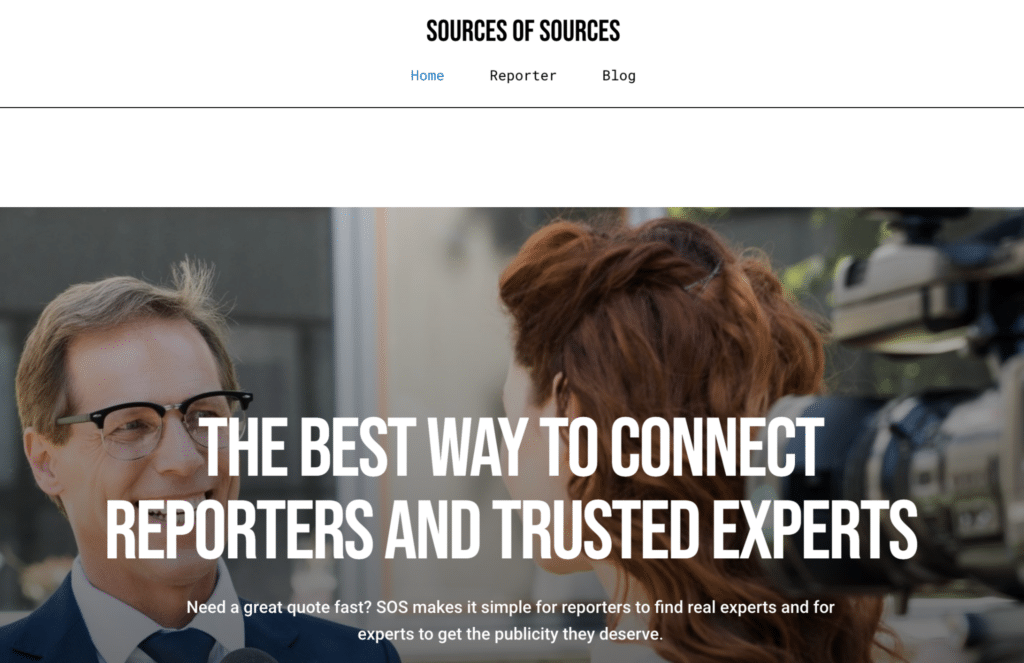
Some of the best current options include:
For SaaS founders, this used to be one of the more attractive link building channels, but in practice it’s become harder to justify. The competition is intense, journalists get flooded with responses, and many of them come from low-quality or generic “experts,” which makes it difficult to stand out. It also takes time to monitor requests, write responses, and follow up, with no guarantee of getting published.
That said, it can still work if you’re a real expert with something specific to say. If your response is based on actual experience, includes concrete examples, and doesn’t sound like something AI could generate, you still have a shot at getting picked up. In those cases, it’s worth trying; just don’t expect it to be a consistent or scalable channel.
I’ve seen SaaS companies spend thousands on backlinks while barely thinking about how pages connect inside their own website.
At the same time, some strong ranking improvements come from internal linking alone.
A common situation looks like this:
So backlinks come in, traffic comes in, but the authority is trapped on isolated pages instead of strengthening the lead gen pages.
The goal for your SaaS website is to build an interconnected ecosystem of pages in a strategi way where pages that get lots of backlinks (think original research page or Academy) support your lead gen pages and push them up in Google.
A visitor reading about “how to reduce onboarding dropoff” naturally lands on onboarding templates, customer onboarding checklists, onboarding analytics comparisons, and eventually the product itself. Everything supports everything else.
This also matters much more now with AI search. LLMs are trying to understand relationships between concepts, use cases, industries, integrations, and products. Strong internal linking helps create that context.
One thing I’d strongly recommend is revisiting older high-traffic articles regularly. Sometimes adding several highly relevant internal links to newer commercial or comparison pages can impact rankings faster than publishing another new article.
If your product has been on the market for some time, there’s a good chance people are already writing about it without linking to you. Could be a review on someone’s “tools we use” page. Or a mention in a roundup that never became a hyperlink. Or maybe a case study that references your product.
A few years ago, SEOs would often run entire unlinked mention campaigns trying to convert every brand mention into a backlink. And yes, these links can still be valuable. The publication has already acknowledged your brand, so the outreach is usually much easier than cold link building.
But in 2026, the mention itself already carries much more value than it used to.
LLMs rely on entity recognition, brand associations, citations, and contextual mentions across the web. So if a trusted industry article talks about your product positively, that signal may already contribute to how your brand appears in AI-generated answers even without a clickable link.
That doesn’t mean backlinks stopped mattering. They still absolutely help with rankings, authority, and discoverability. But if you already earned a strong contextual mention on a reputable site, it’s often not worth spending weeks chasing every missing hyperlink.
You can still monitor mentions using Semrush Brand Monitoring, BrandMentions, or Google Alerts and occasionally send a short, friendly email asking for a link. Some will happily add it.
But overall, your time is usually better spent earning more high-quality mentions, reviews, listicle placements, expert quotes, and industry coverage rather than obsessing over converting every existing mention into a backlink.
Review platforms (G2, Capterra, TrustRadius) rank for some of the highest-intent keywords in any SaaS category. “Best [category] software” pages from Capterra often outrank vendor websites in search results, including in international markets.
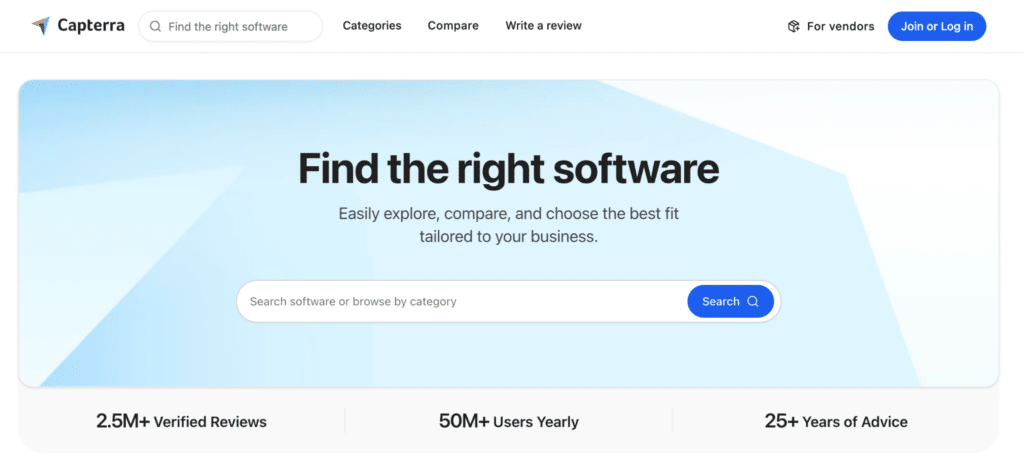
LLMs often pull from directories because they offer standardized, comparable data across vendors. A strong, up-to-date G2 profile is a signal that your product is legit, established, and trusted.
Some of the top platforms for B2B SaaS are G2, Capterra, TrustRadius, and GetApp. All of them offer free basic listings. Beyond these, there are dozens of niche software directories, review platforms, and industry-specific marketplaces where having a complete and active profile can strengthen your visibility across both Google and AI systems.
Where most SaaS companies go wrong is treating their directory profiles as a one-time submission. A stale profile with outdated screenshots signals to AI that it’s not active. Keep your profiles current and add verified reviews regularly. Make sure the product description matches how you’re positioning yourself everywhere else.
Integrations are one of those underrated SaaS growth channels people rarely discuss from an SEO or AI visibility angle.
When you build a native integration with another tool, you often earn visibility inside their ecosystem through integration directories, documentation, partner pages, or product mentions. Sometimes that includes a backlink, sometimes it’s simply a brand mention.
And honestly, in 2026 the mention itself already carries a lot of value.
When buyers repeatedly see your product connected with tools like HubSpot, Slack, Zapier, or Salesforce, your brand starts feeling more established and trustworthy.
AI systems pick up on these associations too. LLMs constantly see brands appearing alongside certain workflows, tools, and categories, which helps reinforce what your product does and where it belongs.
An affiliate programme doesn’t typically come to mind as a link building strategy, but it can work as a secondary benefit. When affiliates promote your product, they often publish content like reviews, comparison posts, and tutorials. These include links back to your site. If those affiliates are established bloggers, newsletter writers, or SaaS reviewers with real audiences, those links carry genuine editorial weight.
The downside is that affiliate links are usually marked as nofollow, so the direct SEO value is often limited.
But affiliate partnerships still work well for AI visibility because they generate something increasingly important in 2026: relevant brand mentions across the web.
Affiliates naturally create reviews, comparisons, tutorials, and “best tools” articles where your product appears alongside competitors and related workflows. Some publishers still include dofollow contextual links, especially inside longer editorial reviews, but even without them, those mentions help reinforce your brand associations across categories and use cases which LLMs tend to pick up.
A lot of link building tactics still technically “exist,” but many don’t move the needle anymore, especially for SaaS brands trying to improve both SEO and AI visibility.
The same thing happened with link building as with content: once everyone started mass-producing it, visibility, relevance, and human attention became much more important.
A few years ago, most SaaS companies were mainly chasing dofollow backlinks from high-DR websites.
Now people pay much more attention to where their brand shows up online and how often it gets mentioned across their niche.
LLMs pick up mentions from listicles, comparison pages, reviews, Reddit discussions, integrations, and industry articles. A mention in a strong “best CRM software” article can help your Google rankings and also improve your visibility in ChatGPT or Perplexity, even if the link itself is nofollow.
Another thing that changed is the importance of certain page types. Listicles, comparisons, reviews, integrations, and original research influence a huge number of AI-generated recommendations today.
For almost every SaaS client we work with now, listicle outreach became part of the strategy. If your product isn’t showing up on the pages buyers already read while researching software, there’s a good chance LLMs won’t mention it much either.
The goal today is getting your brand consistently mentioned on trusted pages in your niche instead of collecting random backlinks from websites nobody visits.
I’ve seen a lot of SaaS companies building links for months without knowing if anything is improving. Here’s what we usually look at:
Are your lead gen pages moving up in Google?
Your comparison pages, landing pages, and high-intent articles should slowly start ranking higher for the business keywords.
Is traffic growing on those pages?
Check impressions and clicks in Google Search Console. Slow steady growth is usually a good sign.
Are the links sending visitors?
Some placements look good in Ahrefs but sit on pages nobody actually reads. The best mentions usually bring at least some referral traffic over time.
Is your brand showing up more often in AI answers?
LLM visibility platforms like Allmond can help track whether your company starts appearing more often in responses from ChatGPT, Claude,Perplexity AI, or Google Gemini.
Most SaaS link building campaigns start showing results in about 2–3 months, while bigger traffic growth usually comes over 3-6 months. If someone promises huge results in 30 days, I’d be careful.
We’ve been doing SaaS-only link building for five years. Our client list is exclusively B2B software companies, which means our entire network – the blogs we work with, the editors we have relationships with, the exchange partners we coordinate – is built specifically for the SaaS ecosystem.
Every link we place is checked against a consistent set of criteria before we proceed like topical relevance to the client’s niche, organic traffic, domain rating, spam score, dofollow status, outbound-to-inbound link ratio, and whether the client already has a link from that domain. We don’t work with content mills or PBNs. Every placement is an editorial, in-content link from a solid website with an actual audience.
PassKit, a mobile wallet solutions provider, is one of the clearest examples of what this looks like over time. They’ve worked with us for four years and rely entirely on our content and link building strategy for their organic growth. Over 14 months of focused work, we generated 876 leads from 26 articles by pairing high-intent content with a consistent backlink building programme that built authority around the topics their buyers were actually searching for.
I always recommend treating link building as a long-term investment, which is how we structure every engagement.
Our three core link building services work in tandem. Guest posting puts you in front of editorial audiences in your niche. ABC link exchanges build your backlink profile with relevant SaaS domains from our established network. And our Listicle Outreach Service gets you featured in the comparison content your buyers are reading, and the content AI models are pulling from.
SaaS link building in 2026 is much simpler than most SEO advice makes it sound.
The goal is to get your product mentioned on trusted websites your buyers already read and trust, then keep doing it consistently over time.
That can happen through guest posts, listicles, PR, integrations, affiliate content, expert quotes, or product reviews. All of it adds up. A strong mention on a good SaaS website can help your rankings for years and also increase the chances of your brand showing up in AI answers.
What changed is that people stopped obsessing so much over raw backlink numbers and whether a link is technically a dofollow. Visibility, relevance, and strong mentions on pages people actually visit now matter much more.
If you want to understand where your backlink profile stands today, what’s holding your rankings back, and how your brand appears in AI search, you can book a free strategy call with Quoleady.
SaaS link building in 2026 is basically getting your product mentioned and linked on trusted websites through reviews, comparisons, listicles, PR, integrations, and other industry content.
Those mentions help your software rank higher in Google and make it more likely to appear in AI answers from ChatGPT, Perplexity AI, and similar platforms.
Organic search is still one of the best growth channels for SaaS, but content alone is usually not enough. Backlinks and brand mentions help Google understand which companies are trusted and worth ranking higher. Without them, even good content can struggle to compete for valuable keywords.
There’s also a compounding effect: once your site starts earning strong mentions and links, new pages usually rank faster. And in 2026, those same mentions also help with visibility in LLMs
Yes. Backlinks still matter a lot in 2026, both for Google rankings and overall online visibility. What changed is that low-quality links are much easier to ignore, and sometimes they can even hurt. A few strong, relevant mentions on trusted websites usually do far more than hundreds of weak links nobody actually reads or visits.
Avoid cheap mass link packages, spammy outreach blasts, and links stuffed into footers or author bios nobody reads. Chasing DR without thinking about relevance is another common mistake. The same goes for building links aggressively when there’s barely any good content on the site. Most shortcuts are pretty easy to spot now, both for Google and for people.
Most SaaS link building campaigns start showing results in about 2-3 months, while bigger traffic growth usually comes over 3-6 months. It depends on your starting point, competition, and how consistently you’re building mentions and links. If someone promises huge results in 30 days, I’d honestly be careful.
Olga Mykhoparkina
Founder, CEO
Read also



GoRout, a leading provider of wearable sports technology, specializes in advanced coach-to-player co
Maja Volarević
Sep 15, 2026
At Quoleady, we’ve believed in content marketing for years. After working with more than 200 B2B S
Olga Mykhoparkina
Jul 27, 2026
At Quoleady, we’ve worked with more than 200 B2B SaaS companies, from early-stage startups to
Olga Mykhoparkina
Sep 18, 2026 Let us know what you are looking to accomplish.
We’ll give you a clear direction of how to get there.
All consultations are free 🔥