Olga Mykhoparkina
Founder, CEO

Olga Mykhoparkina
May 26, 2026Over the last few years, we’ve focused on helping SaaS businesses grow through organic search.
I’ve been saying this for years – the goal is not only to get traffic, the goal is to get actual high-quality leads that translate into revenue and that’s what we do for our clients at Quoleady (if this sounds ChatGPT to you – it’s not, I wrote this line back in 2022).
We helped RingBlaze go from 0 to 50K visits and 0 to 650 leads with only 20 articles, 500 leads with 16 articles for FullSession, 876 leads with 24 articles for PassKit, +47% booked meeting for Legal Nodes and many more. That’s the kind of results we’re after.
For years, we experimented with different SaaS SEO strategies until we found the one that really moves the needle – High-intent content marketing strategy.
In this article, I want to share the best SaaS SEO practices that will help you rank high on search engines. SEO success today correlates with AI visibility, so the more you work on your SEO, the more clients from ChatGPT and other LLMs you’ll have knocking on your door.
This guide can help you whether you want to work on a SaaS SEO audit of your web page or you’re just getting into creating your SaaS SEO strategy.
You’ll find a detailed SaaS SEO checklist below, but let’s get first things first.
A good SaaS SEO strategy is one that finds the balance between:
As a SaaS SEO agency, we found that some of the strongest results usually come from focusing on high-intent keywords.
These are the searches people make when they’re already comparing tools, looking for alternatives, checking pricing, or evaluating different solutions before making a purchase.
You’ve probably searches this at some point as well:
These keywords work well because the person searching is often much closer to buying than someone reading educational top-of-the-funnel blog content.
That’s exactly the angle we used for our client FullSession, a web analytics software company. We focused on competitor-related keywords around Hotjar and positioned FullSession as a top result for searches like “Hotjar alternatives” and comparison terms related to competing tools.
This campaign helped FullSession generate more than 21,000 visits and 500 leads in just four months. If you want to see the exact approach we used, you can read the full case study.
While your content marketing strategy could include various channels, at Quoleady we believe that your SaaS website and blog should be the core of your strategy. Here’s why:
I’m sharing the checklist that’s based on 15 years of my exprience in SaaS SEO industry. I prioritized it and sorted from the most important to less influential.
This is probably the most important part of SaaS SEO today.
A lot of companies keep publishing new content while their old articles grow old and outdated. In many cases, updating and improving existing pages brings much faster results than writing another 30 generic blog posts.
It’s the first thing we do at Quoleady when working with an established SaaS company. We ask:
If you already have 10 strong lead-generation articles, it often makes more sense to continuously improve them instead of publishing 50 average-quality posts with not-so-clear intent.
I’d especially recommend updating:
At minimum, review your important BOFU pages every 6 months. In fast-moving industries, even more often. We’ve seen lots of competitive niches where marketers put a specific month at the end of the title to indicate it was reviewed recently, for example: “Top 10 LinkedIn automation tools as of June 2026”

This graph is an example of how traffic and impressions behave once you’ve updated the content on your blog (data for one of our clients – Bettermode after we’ve updated their blog pages).
A lot of SaaS companies rely too heavily on blogs.
A couple of years ago, that worked much better. Today, both Google and AI tools expect much deeper website coverage around your product and category.
Make sure you have:
The more use cases and customer problems you cover, the higher the probability that your pages match the kinds of prompts and questions people ask in ChatGPT, Perplexity, Gemini, and Google.
I like to show example of Pandadoc’s landing pages ecosystem – a client we’ve worked with. Every menu tab is a carefully designed and very well-organized hub of pages: Features, Solutions, Comparisons (vs pages), Integrations, etc. if you don’t know where to start, visit their homepage for site-structure inspiration.

We’ve asked 10+ GEO experts about AI visibility and the thought they all share was: “There’s no magic trick to suddenly appear in ChatGPT or Claude answer”. AI visibiltiy involves a lot of work around building your brand – trust, authority and visibility. And that includes a lot of SEO work.
I also ran an experiment the other day with Lovable. I created a dummy homepage for our Quoleady website and asked it to optimize it for AI search. Everything it added afterwards was the basic SEO on-page optimization including robots.txt, structured data, meta titles, etc. Nothing new except the LLMs.txt file which many experts I’ve interviewed have found useless.
What actually helps is:
AI tools are much more context-driven than traditional search. People describe their exact situation and expect specific answers.
That’s why SaaS companies should think less about “keywords only” and more about:
This is one of the biggest SEO and AI visibility opportunities for SaaS companies today.
When someone searches:
…the search results are often dominated by listicles and review articles.
AI tools also often pull information from these pages when generating recommendations.
That’s why you shouldn’t only focus on ranking your own website. You should also work on getting your product featured in the pages already ranking.
Check:
We use Listicle Manager to track ranking listicles, organize opportunities, and manage outreach.

We’ve found that there’s a straightforward correlation between the listicle mention score and your AI visibility score. Just look at this data for PandaDoc – the pattern is basically repeated on both graphs:
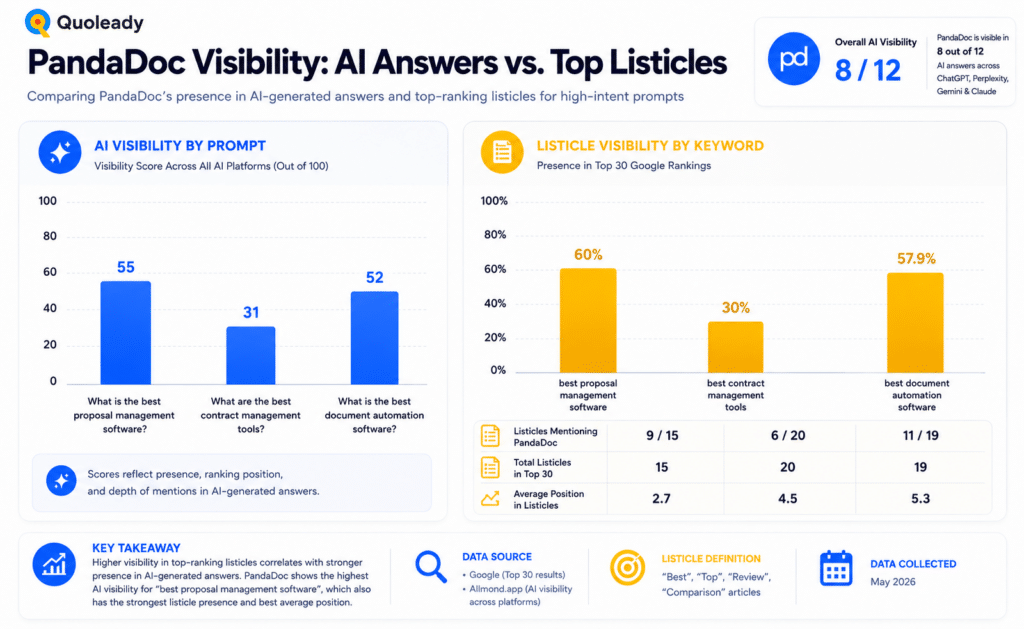
For AI search, mentions are becoming extremely important.
Backlinks still matter a lot for SEO, but AI tools also rely on:
Sometimes your brand doesn’t even need a backlink to show up in AI answer.
When I’m checking the AI visibiltiy opportunities for clients I look into:
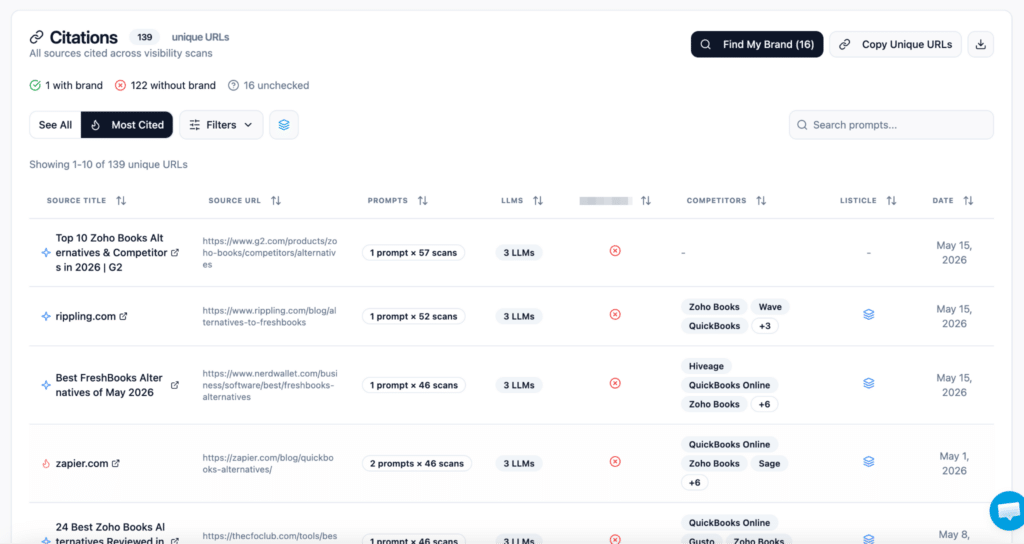
If your competitors keep appearing in the sources AI tools trust while your brand is missing, that directly affects visibility. In order to find the list of sources that different LLMs cite, we use Allmond.app. It shows the sources that are being cited the most, sources where you are mentioned, sources where competitors are mentioned as well as showing you which sources are listicle articles so you can easily find those and outreach asking for your brand inclusion.
Traffic alone means very little if it doesn’t generate pipeline.
Some of the best SaaS SEO pages are:
These pages often bring much fewer visits than informational TOFU content, but the conversion intent is significantly higher.
I’d rather have:
Another thing worth mentioning is TOFU vs BOFU situation in 2026. As you’ve noticed, Google AI Overviews are now answering pretty much any top-of-the-funnel query and the user doesn’t need to click through the blue links. We’ve focused on BOFU content for years and now, in many industries, BOFU content is becoming one of the few content types where organic search traffic still translates into revenue.
If the previous section made you think you should stop creating TOFU content completely, I’m here to stop you from making that mistake. Your articles shouldn’t exist as isolated pages. Imagine going to a blog where every post is “Competitor X alternatives” and “Competitor X vs Y” blogs. The blog should reflect your expertise. Work on the educational content but work on it adding your expertise, unique opinion, angle, perspective.
If it’s article #20,030 covering the same keyword, generated with ChatGPT and recycling what’s already been published a hundred times before, what’s the actual value of it?
You’ll quickly notice that content like that disappears from search results faster than it was published.
Connect related content together through:
This helps both search engines and AI systems better understand your expertise around a topic.
Katelyn from “LaunchTheDamnThing” is a freelancer running a small website that outperoms industry giants for lead gen keywords like “client’s portal software”. Her website is full of technical issues, her website loading speed is very poor but she still ranks number one.

Technical SEO still matters, but many SaaS companies overestimate how important it is compared to content quality and positioning.
I’ve seen many other examples of relatively slow, imperfect websites outranking large competitors simply because the content was:
That said, you should still check:
Technical SEO creates a strong foundation, but content quality and market relevance are usually what move rankings for SaaS businesses.
I hope that this article helped you answer your questions and that you will use these SaaS SEO tips on your blog.
To sum it up, I’d focus less on publishing huge amounts of content and more on creating pages that actually help potential buyers make decisions. I’d start with high-intent keywords, make sure the content stays fresh and updated, cover different use cases and customer problems, and work on getting your brand mentioned in relevant third-party websites and sources that Google and LLMs already trust.
Technical SEO still matters, but in my experience, strong positioning, experience-based content, and visibility across the web usually move the needle much more for SaaS companies.
I know that it may seem like a lot, especially for smaller SaaS businesses that may not have a whole SEO team at their disposal. That’s why we’re here to help!
If you need a hand with SaaS SEO strategy and content creation, you’re in the right place. We can help you start generating revenue through your website like we helped many SaaS companies. Book a free call and let’s talk!
As always, feel free to reach out to me on LinkedIn if you have any questions.
Olga Mykhoparkina
Founder, CEO
Read also



At Quoleady, we’ve believed in content marketing for years. After working with more than 200 B2B S
Olga Mykhoparkina
Jul 27, 2026
At Quoleady, we’ve worked with more than 200 B2B SaaS companies, from early-stage startups to
Olga Mykhoparkina
Jul 10, 2026
I often see teams paying for 15–20 different marketing tools while still struggling to publish con
Olga Mykhoparkina
Jun 30, 2026 Let us know what you are looking to accomplish.
We’ll give you a clear direction of how to get there.
All consultations are free 🔥