Olga Mykhoparkina
Founder, CEO

Olga Mykhoparkina
Jun 09, 2026For a while, SaaS content writing felt more or less predictable.
You’d find keywords your buyers search for. You’d write articles around them. Build some links. Wait for the traffic to grow. And to a large extent, it still works. But the way people research software changed really fast.
A few years ago, someone might search Google for “best employee onboarding software” and open ten different blog posts comparing tools. Now they open ChatGPT and ask:
“What’s the best onboarding platform for a remote company with a lot of contractors and compliance requirements?”
That changes what good SaaS content needs to look like.
Google changed too. A lot of searches now get answered directly inside search results before someone even clicks a website. So even if your rankings stay stable, the traffic doesn’t always follow. Which means SaaS content writing has a bigger job now than just ranking articles.
Your content needs to explain complex products in simple language. It needs to earn trust quickly. It needs to work for someone skimming at 11 PM before a demo call. And it also needs to be visible for LLMs.
A lot of the old advice still works. You still need to find the right keywords, create genuinely helpful content, and have strong distribution.
But if you’re writing SaaS content in 2026, you also have to think about how buyers actually discover software now, because more and more of those journeys start inside AI tools instead of traditional search.
So before we get into tactics, let’s talk about what actually makes SaaS content writing different from every other type of content on the internet.
With B2B SaaS content, you’re selling something intangible (software), to multiple people at once, on a timeline that can stretch months, with a product that changes constantly.
That’s a very different challenge than writing a product description for a physical item or a how-to post for a single reader with a simple problem.
A few things that make SaaS content specifically hard are:
When we started working with RingBlaze, a business phone system for sales and support teams, their biggest challenge was producing content that served all the people involved in a buying decision. This ranged from the founder approving the purchase to the sales manager using the product daily, and the IT person worried about whether it would integrate with their existing stack. That’s why none of their articles on the blog bring any traffic or leads. Each of those readers needed a different angle, a different level of technical depth, a different answer to “why does this matter to me?”
That challenge is pretty common in B2B SaaS. Your content has to speak to multiple roles without feeling generic to any of them.
Software is harder to explain than physical products because buyers usually need to experience it before fully understanding the value. Your content carries the entire job of making an abstract product feel real. That’s why screenshots, product walkthroughs, and concrete use cases are important in SaaS content. These things separate content that converts from content that informs.
Most SaaS content strategies focus almost entirely on bringing in new users. But for a subscription business, the readers who’ve already signed up matter too. Content that helps customers get more value from your product reduces churn, increases expansion revenue, and creates the kind of loyal users who actually leave reviews and refer others.
According to data from Search Engine Land, ChatGPT drove 87.4% of all AI referrals. Although organic search still dominates site visits, AI is becoming a performance channel through which brands buyers see and trust. Your content is now being read by humans and processed by AI systems deciding what to recommend. The way you write affects both audiences.
Before you start planning what to publish, it helps to know which format fits which goal.
They sit at the bottom of your funnel. When someone searches “HubSpot vs Salesforce,” they’re close to a decision and evaluating specifics. These pages convert well because the reader has already decided they want a solution but haven’t picked one yet.
Someone searching for alternatives to a tool they’re already using is unhappy with their current choice and actively looking to switch. If your product is a credible option, you should be ranking for these.
These cover the educational middle of your funnel. They attract buyers who know they have a problem and are trying to solve it. The best how-to content in SaaS shows the reader how to do something while naturally demonstrating how your product fits into that process. Although TOFU content becomes less visible in Google, it’s still the source of knowledge for AI tools plus it helps build topical authority in the niche.
These are articles where your product is the example. A guide on “how to run a sales pipeline review” that uses your CRM’s interface throughout is product-led. It teaches something genuinely useful, and your product earns its place in the article by being the best way to show how it’s done.
A well-written case study with specific numbers, challenges, and an account of what happened does more for conversions than almost any other format. This is the original, unique content showcasing results you’ve achieved for your customers that is hard to replicate for AI.
A downloadable template (sales proposal, onboarding checklist, customer interview guide) attracts links naturally, ranks for high-intent keywords, and puts your product or brand in front of someone at exactly the moment they’re doing the work your product is supposed to help with. Example: works great for proposal software, recruitment software and many other niches.
This is the hardest to do well and the most rewarding when you get it right. This is original analysis, a strong opinion grounded in real data, or a perspective your founder has developed from years in the industry. It builds the kind of credibility that makes everything else you publish more trustworthy. The key is having original thinking, real experience, and a strong point of view at the center of this kind of content.
This sits on the retention side of the funnel. Onboarding guides, feature walkthroughs, troubleshooting articles – this content reduces churn by helping customers get value from your product faster. A lot of SaaS companies focus on acquisition and barely invest in this type of content, even though it often has a direct impact on retention and customer satisfaction.
Most SaaS teams start with “what should we write next?” They pick topics based on what competitors are publishing, or what the founder finds interesting, or what their most recent customer asked about. That’s not a SaaS content marketing strategy.
A better place to start is to understand who is buying from us, what are they already searching for, and where are they in the buying process when they find us?
Your ICP (ideal customer profile) is a person who lands on your article, reads it, and thinks “this is exactly my situation.” You need to know:
The last one is more important than people think. Your buyers might search for “how to reduce meeting overload” rather than “team communication software.” Your content needs to start where they are, not where your product is.
This ICP definition also affects how your brand shows up in AI answers. LLMs learn about your brand from your content and from what other people say about you online.
If your content keeps speaking to the same type of person with the same specific problems, AI starts connecting your brand to that audience. That’s how your company ends up getting recommended when someone asks ChatGPT for advice. You need to create the most useful and relevant content for one specific type of reader.
If you’re early-stage or have limited content bandwidth, don’t try to rank for everything. Start with keywords that signal buying intent. We’ve written a full breakdown of how high-intent content works if you want to go deeper on this.
The funnel gives you a useful frame:
A lot of founders assume you need brand recognition before BoFu content pays off, because “who’s searching for us if no one knows us?” But at this stage of the funnel, you’re not targeting searches for your own product. You’re targeting searches for your competitors, or for the category you’re in.
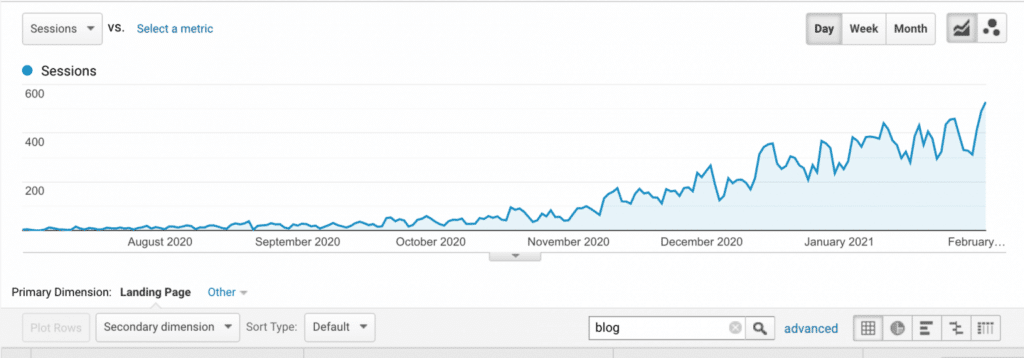
For RingBlaze, we focused their entire early content strategy around competitor alternatives and comparisons with keywords like “RingCentral vs Vonage” and “Grasshopper alternatives.” We put RingBlaze as #1 alternative in the ‘alternative’ posts and mentioned product benefits in the ‘vs’ posts. Those articles brought in 650 leads and grew their blog traffic from zero to 50,000 monthly visitors, entirely with 20 articles.
In 2026, keyword research also means paying attention to how your buyers use AI tools to research. The prompts they type in ChatGPT today look completely different from a Google search. They’re longer, more specific, and more conversational.
Example: “What’s the best CRM for a 50-person B2B company that already uses HubSpot and needs better pipeline visibility?”
If your content gives an answer to that specific question, AI tools start pointing people toward you. That’s the opportunity.
Content compounds over time. A single article won’t do much in month one. But 20 articles over six months, consistently updated, can become a lead generation engine. The update piece is even more important now than it ever did. Content freshness is a meaningful factor in both traditional rankings and AI citation. Don’t just publish articles and leave them untouched. Make it part of your process to regularly update stats, reports, examples, and dates so the content stays relevant..
Most guides on the internet will tell you to “write quality content” and “understand your audience” without explaining what the writing process looks like. Here’s what ours looks like.
Every article at Quoleady starts with a brief. The brief is the decision document as it defines everything before anyone writes a sentence.
Check out our content brief from one of our clients below:
A strong content brief includes:
If you’re working with an external writer, the quality of the brief determines the quality of the article. A clear brief leads to a strong draft. A vague brief leads to generic content that takes hours to fix.
The most common mistake in SaaS content is starting with the product. Don’t.
Your reader came to find a solution to a problem. If your intro is about your product’s features, you’ve already lost them.
Instead of “Our software has automated reporting,” write like you’re trying to solve their problem, “Your ops team is probably spending 6+ hours a week pulling numbers from different tools and pasting them into a spreadsheet. Here’s how to fix that.” The product comes in once you’ve earned the reader’s attention with relevance.
When your content looks too promotional, it doesn’t add credibility. What you need is content that builds trust first, so people are more open to hearing about it. Show the reader you understand their situation. Then show them how your product helps.
A freelance designer named Katelyn runs LaunchTheDamnThing.com. Her site has a domain rating of 45, around 3K traffic at the start of 2026, weak backlinks, no aggressive internal linking, and failing Core Web Vitals.
Yet she ranks #1 for keywords like “client portal software,” “best task management software,” and “app for freelancers” – terms SaaS companies with full marketing teams and six-figure budgets compete for. Between January and April 2026, her traffic grew 4x.
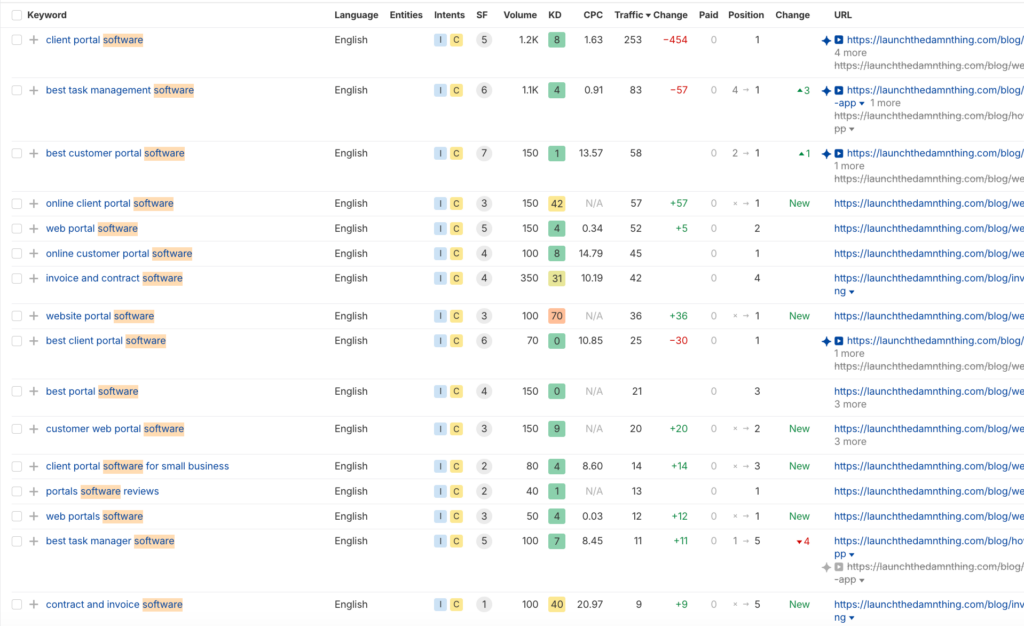
We figured that this is due to:
This is the part of SaaS content strategy many teams avoid because it’s harder to scale. But firsthand experience beats content written purely to cover a topic, even when the latter has stronger backlinks and cleaner technical SEO.
For SaaS specifically, that means a few things:
One experience-based “software” article that ranks #1 can generate more leads than 100 generic articles that rank on page two. The math works out. The effort is in being willing to do the harder kind of writing.
At Quoleady, we’ve started backing this up with something we call the Secret Buyer approach. We have testers who actually use the tools, talk to the sales teams, and evaluate the full experience across 200+ data points before we write a word. The resulting articles have a level of specificity that generic content can’t match because it comes from people who did the thing rather than people who researched the thing.
Product-led content is the practice of writing educational articles where your product is the natural example. This is not promotional. The article would be genuinely less useful without your product appearing in it, because your product is the best way to show how to actually do the thing the article is about.
We’ve seen the same pattern across dozens of clients. Generic “how to manage a remote team” content gets read. “How [Company] teams use async standups to cut meeting time in half” gets sign-ups. The conversion rate difference between those two types of articles is often 2-3x.
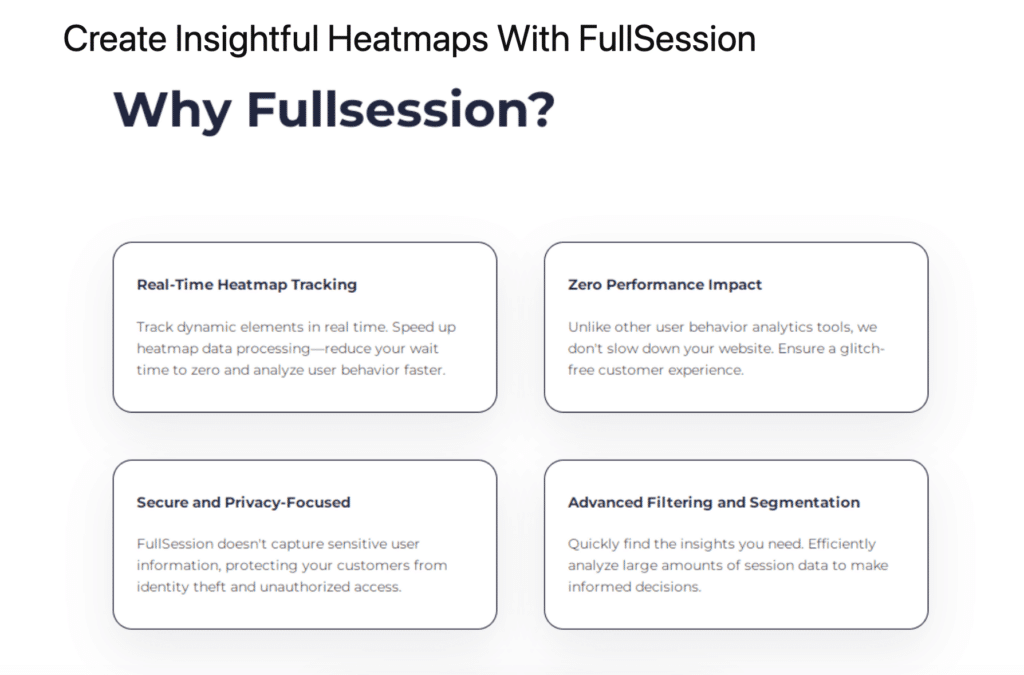
We had a web analytics software client named Fullsession. Their product helped with session recordings and replays, interactive heatmaps, customer feedback forms, and detailed analytics. So we wrote a series of educational, product-led articles showing readers how to use and interpret website behavior data.
For example, we wrote one article titled ‘How to Read a Heatmap and What You Can Learn From It’ in a very conversational tone to engage the readers. We explained everything about website heatmaps from the different types to benefits and best practices. Towards the end of the article, we introduced the Fullsession product contextually.
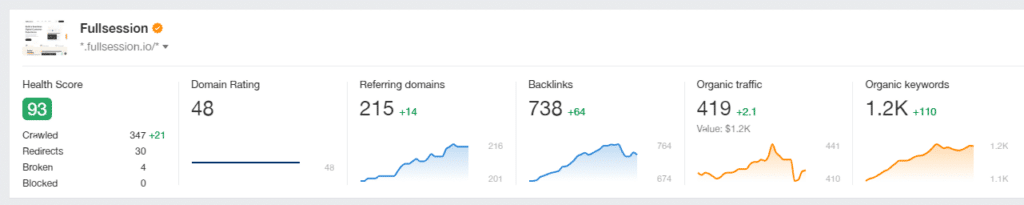
Before working with us, Fullsession had a few blog posts on their website that didn’t generate any traffic or leads. The website had a DA of 2 and zero backlinks and referring domains. After following our strategy, their DA increased to 49. With product-led content, we were able to get 500 Leads with 16 articles in 4 months for them.
In 2026, your SaaS content has two audiences: the human reader who’s skimming and the AI system that’s extracting.
GEO (Generative Engine Optimization) is the practice of writing and structuring your content so that ChatGPT, Perplexity, and Google’s AI Overviews cite you when buyers ask questions about your category.
According to G2’s 2025 Buyer Behavior Report, nearly 8 in 10 respondents say AI search has changed how they conduct research, with 29% now starting research via ChatGPT more often than Google.
A few practical things that matter and you should keep in mind:
LLMs extract information based on heading structure. If your subheadings are descriptive and your paragraphs start by answering the question in the heading, your content becomes much easier to extract and cite. That’s why it’s important to structure your web pages for AI-first indexing, so that your content shows up in LLM answers.
The earlier your answer appears in the article, the more likely it is to be cited. Concise answers near the beginning of an article tend to get surfaced more often. Try putting your most quotable, citable claim near the top, not buried in section four.
Until May 7, 2026, FAQ sections with structured schema helped pages stand out in Google Search through expandable rich results. Google has now removed FAQ rich results, and Search Console will stop reporting FAQ structured data by June 2026.
Does that mean you should stop using FAQs? No.
Google confirmed it still uses FAQ structured data to better understand page content, even though the rich result feature is gone. The visual benefit disappeared, but the SEO value remains.
FAQs are still important because AI Overviews and LLMs rely heavily on structured Q&A content. A strong FAQ section gives AI tools clear answers they can extract and cite when users ask related questions.
So you’re no longer adding FAQs to gain more space in search results. You’re adding them to make your content easier for AI systems to understand, quote, and reference.
To work well, FAQ answers should be genuinely useful with short, clear responses to real customer questions, not keyword-stuffed filler. Quoleady’s guide on formatting content for LLM extraction walks through the specific structures that work best.
Vague statements like “content marketing increases brand awareness” get skipped. Specific claims with sources like “How ResponseScribe Went From 0 to 4.62k Clicks in 6 Months” get cited. AI tools prefer information they can trust and clearly reference. So whenever possible, use real data, examples, and sources to back up your points.
Researchers from Princeton University and IIT Delhi tested which content strategies increase visibility in AI-generated responses. Adding expert quotes and citations from credible sources was one of the top three strategies, boosting visibility by over 40%. Expert quotes alone can increase LLM visibility by 30–40%, especially when they come from credible, relevant sources.
Google’s E-E-A-T framework – Experience, Expertise, Authoritativeness, Trustworthiness – has always mattered for rankings. In 2026, it’s important for AI citation too. LLMs and AI Overviews need confidence signals before they’ll cite your content. If your article is written by “the team” with no named author, no data, and no references to actual experience, it’s harder for any system to know whether it’s trustworthy.
In practice, E-E-A-T for SaaS content means:
Good SaaS content doesn’t happen by accident. It follows a repeatable process that keeps quality consistent even as you scale. (If you need to run a SaaS content audit, feel free to use our checklist.)
Here’s the process we use with our clients:
That loop – brief, draft, optimize, publish, update – is what makes content keep growing instead of fading away.
For FullSession, we applied this process across their entire content strategy. In the first four months, 16 of the articles we published were generating leads on their own. The result was 500 leads, a domain rating that climbed from 2 to 49, and 1,300 organic keywords ranking. When we went back and rewrote their highest-traffic article – restructuring it, shortening the intro, adding more H2s and H3s, cleaning out generic content – conversions on that single article jumped nine times.
That’s what the process produces when you apply it consistently.
You don’t need a complicated toolstack to create good SaaS content. But a few tools are useful at specific stages of the process:
The honest answer is that both work, and both have real trade-offs.
An in-house writer knows your product cold. They’ve sat in on customer calls, they know your company’s voice, and they don’t need three weeks to get up to speed on what you do. That deep product knowledge shows up in the content. The downside is that internal writers often have blind spots. They’re too close to the product to explain it the way a new customer would experience it, and they may not have the SEO or LLM optimization skills needed to make content rank and get cited.
Outsourcing to an agency gives you fresh eyes, professional content skills, and the ability to scale output without hiring. The trade-off is time upfront because external writers need to understand your product, your ICP, and your brand voice before the content gets good. If you give them a brief and nothing else, you’ll get generic content back.
You should start with the basics. Track traffic to your articles, keyword rankings, and where readers go next. Organic search traffic growth is still the primary signal that your content strategy is on the right track.
Beyond that, two things are worth tracking:
Are you being mentioned when buyers ask ChatGPT or Perplexity about your category? You can test this manually. Search for the prompts your ideal customers would use and see whether your brand appears in the responses. For a more systematic approach, you can use tools like Allmond, which is specifically built for tracking AI visibility. It monitors where your brand appears in LLM answers across different platforms and prompts, so you can see whether your content and off-site presence are translating into AI mentions.
Which articles are your prospects reading before they book a demo or start a trial? This is measurable if you set up your CRM properly with UTM parameters on every piece of content. When a contact books a call and you can see they read three articles before doing it, that’s content influence on the pipeline, and it’s a much more meaningful metric than pageviews.
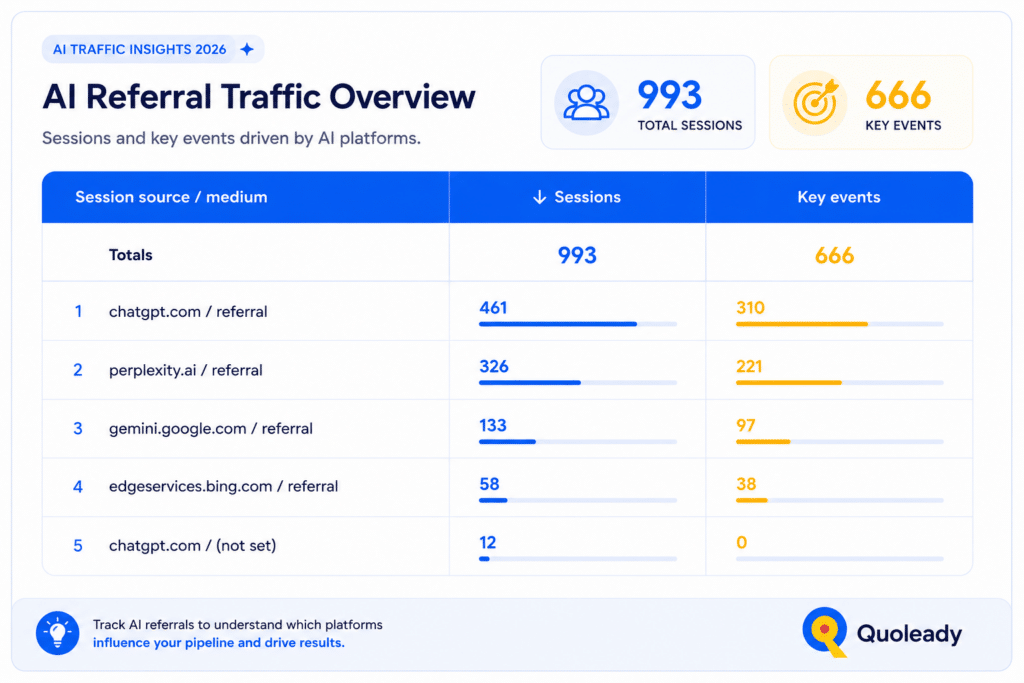
If you want to go deeper on tracking LLM traffic, read this step-by-step guide to set up LLM referral reports in GA4. Our SaaS clients currently see 0.5–3% of total traffic coming from LLMs – a small share today, but one that’s growing consistently month over month.
ROI formula for content: (Revenue from content – Cost of content) ÷ Cost of content × 100. If you spent $5,000 on content that influenced $25,000 in pipeline, your content ROI is 400%. Track it per article if you can, or at least at the cluster level.
SaaS content in 2026 runs on the same principles it always has – understand your buyer, write about their problems, and show how your product helps. There is one important addition, that is, structure it so that the next person asking the same question through an AI tool gets pointed toward you.
The clients succeed when they stay consistent for 6-12 months, keep updating what they’ve published, build genuine author authority, and write about their product specifically enough that no AI tools could confuse them with a competitor.
This kind of content builds into a lead generation engine that works while you’re doing other things. And when a buyer asks ChatGPT which tools to consider in your category, your name is in the answer.
If you want help building that kind of content strategy, one that ranks on Google and gets cited in AI answers, book a free call with Quoleady.
SaaS content writing is the practice of creating educational, problem-focused written content like blog articles, guides, case studies, comparison pages. Such content helps a SaaS company attract its ideal buyers through organic search and, increasingly, AI platforms like ChatGPT and Perplexity.
A SaaS content writer researches the topics potential buyers search for and creates useful content around them. They write articles that can rank in search results and appear in AI answers. Strong SaaS writers also understand product positioning, so they can mention the product naturally without making the content feel promotional.
B2B SaaS content has to address multiple decision-makers in a single company, explain an intangible product through outcomes and use cases rather than physical attributes, and support both acquisition (bringing in new buyers) and retention (keeping existing customers engaged).
Comparison pages (“HubSpot vs Salesforce”), alternatives pages (“best Zoom alternatives”), how-to guides that use your product as the example, original research reports, case studies with real client numbers, onboarding documentation, thought leadership from your founder, and templates your buyers can download and use immediately.
Yes, but only when the product genuinely improves the article. Product-led content means the product is naturally part of the solution, not added at the end for promotion. If removing the product would make the article less useful, the content is product-led.
Expect the first signals, that are ranking for long-tail keywords and early organic traffic, around 1–3 months after publishing. Compound results, where multiple articles rank and consistently generate leads, typically appear 6–9 months into a consistent publishing cadence.
Focus on clear H2/H3 structure, specific and verifiable claims, named authors with credentials, and a strong presence on third-party platforms like G2 and Capterra. Content freshness also matters so update articles regularly rather than leaving them static.
Both work. In-house gives you deep product knowledge. Outsourcing gives you content expertise, fresh perspective, and scale. The best results come from giving external writers direct access to your product, customers, and internal data, not just a brief.
It depends heavily on the format, the writer’s experience, and whether you’re working with a freelancer or an agency. A standalone blog post from an experienced B2B SaaS writer typically runs $300–$800. A full-service content program with strategy, writing, optimization, and reporting, like what Quoleady runs for clients, varies based on output volume and scope.
Olga Mykhoparkina
Founder, CEO
Read also



At Quoleady, we’ve believed in content marketing for years. After working with more than 200 B2B S
Olga Mykhoparkina
Jul 27, 2026
At Quoleady, we’ve worked with more than 200 B2B SaaS companies, from early-stage startups to
Olga Mykhoparkina
Jul 10, 2026
I often see teams paying for 15–20 different marketing tools while still struggling to publish con
Olga Mykhoparkina
Aug 24, 2026 Let us know what you are looking to accomplish.
We’ll give you a clear direction of how to get there.
All consultations are free 🔥